
Article and images by Jules Howard, Wildlife Trusts
This spring, rather than celebrating screeching swifts and prancing-dancing orange-tip butterflies, I’ve opted for a seasonal treat that’s a little more… niche. To the confusion of my family and friends, I’ve spent the last six weeks crouched over a small planted-up sink in my back yard that I’ve left to fill with rainwater. Each day I’ve marvelled at the animal comings-and-going and the experience has been nothing short of mind-blowing. It’s a story I want to share and so in this blog post I’ll describe some of what I learned, along with some tips along the way should readers be encouraged to do the same. In fact, it’d make a superb #30DAYSWILD project!
ACT 1: Protozoan overload
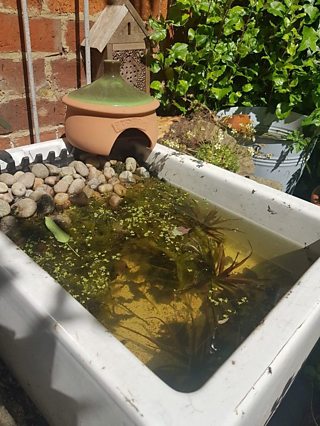
My mini-pond is actually an upcycled porcelain sink and within it I’ve added native pond plants, transferred from a nearby pond. Safely installed in a sunny spot, I then filled it up with rainwater (not tap-water) so that there were fewer free nutrients for pond algae to exploit. Even though I used rainwater, the water did go quite green and grimy in those first few weeks. To find out what was going on, I decided to squirt a few droplets of pondwater onto my microscope slide. What I saw exceeded my wildest expectations.
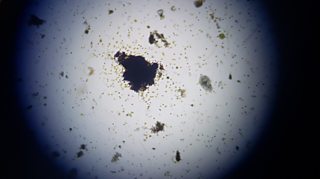
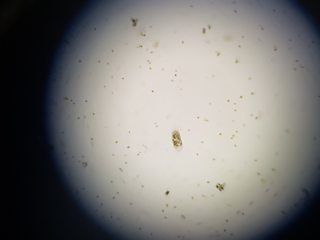
LIFE! Within only a matter of weeks the pond had become a habitat for thousands of creatures. These tiny organisms are protozoa – tiny life-forms, many of whom travel around as eggs on pond plants or simply as detritus blown about in the air. When these eggs hit a new pond, they spark into life and blossom. Among the smallest I saw were Coleps – a protozoan that hoovers up detritus. In the image above there are hundreds of them gathered around an old leaf which they were busily breaking down. The second image shows stylonychia – these large protozoa are like angry sharks. They regularly chase down other protozoa using apparently razor-sharp senses.
ACT 2: Crustaceans colonise!
The plot thickens – a mystery! About five weeks into my pond project the murkiness of the water and the furry layer of algae on everything began to mysteriously disappear. Closer inspection revealed the culprit. Finally, there were tiny animals that I could see with my naked eye!
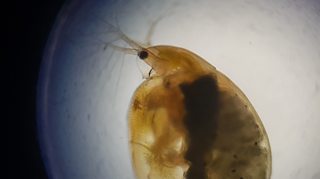
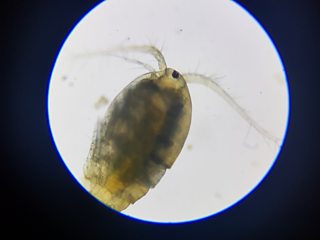
These are copepods and water fleas which are both common and widespread representatives of the crustacean family. (In other words, think crabs rather than fleas!). To feed, these crustaceans wave special appendages through the water, sieving out food particles, including algae and protozoans, which explains the dramatic clearing of the water that I saw. In the weeks that follow, their populations wax and wane in response to the algal blooms. A classic predator-prey relationship begins – a primitive food-web has formed in my tiny pond.
ACT 3: Brimming with bloodworms
The present day. After eight weeks of colonisation, another layer of food chain complexity is currently manifesting itself in its pond because… the bloodworms are here!
The name ‘bloodworm’ may bring fear to your bones but fear not: the name ‘bloodworm’ (a descriptive that loosely encompasses 10,000 or so fly species) comes from the red colour of the water-dwelling larvae, which is very rich in iron a little like our own. I think I have at least three bloodworm species in the water, but truthfully I’m still working this one out.
One species seems to jiggle freely in the water. Another seems to make a little hidey-hole out of pond detritus and the third species is living among the leaves of duckweed, feasting on the tiny roots (pictured below). And mosquitos? Yep, on a slightly less positive note, I have had larvae of mosquitos in my mini-pond too, but not as many as I feared. Currently the tally for mosquitos is at six single individuals. Scary? A bit. But remember that half of these are non-biting males (that depend on nectar rather than blood) and the females (I hope) will quickly move away or be eaten by the bats that swoop past in the warm evenings.
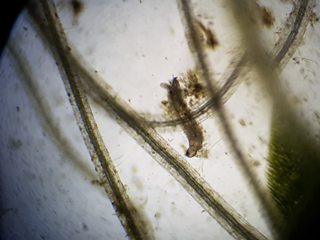
Of all the pond’s inhabitants, bloodworms are the real success story of my tiny pond so far. As I write these words, my little pool is home to about 30 or more of their larvae and each represents an accessible packet of food to celebrated garden predators including birds, water-beetles and newts. It’s only a matter of time, therefore, before these larger predators join in the party, making my private ecosystem that little bit more bustling. When they arrive, of course, I’ll be waiting in the wings, eyes wide open and with a big smile on my face like a proud parent - a friendly neighbourhood deity overlooking a world of my making.
If you’re thinking of creating a wildlife pond for your backyard space, check out the Wild About Gardens campaign website which has lots of guidance and free resources.
