Eight British marine conservation heroes you should know about

Chris Hitchings
BBC Springwatch Digital Team
As Blue Planet II comes to a close it’s clear that the oceans increasingly need positive action to help them remain healthy. Although the problems seem huge, there are already a host of people around the UK working to make the seas around the British Isles a cleaner, safer and generally better place for the marine life that call them home.
To celebrate them, we've gathered seven of these people from all walks of life to be our marine heroes – representing the thousands more who are out there doing special things for the seas. Hopefully their stories might inspire even more of you to get involved as well. If you know about others that deserve recognition, then add them to this conversation and let’s all get together to celebrate our ocean superstars.
1. Martin Dorey
In 2009 Martin set up The Beach Clean Network; a not-for-profit organisation aiming to establish a UK-wide network of beach cleaning supremos. But it wasn't until ferocious Atlantic storms during the winter of 2013/14 left litter across the country's beaches that the campaign really took off, and #2minutebeachclean was born. By harnessing the power of social media to enthuse people to clean up our beaches, the campaign has steadily grown to a nationwide network, and with a new app allowing people to see which beaches near them need cleaning, there is no excuse for not getting involved next time you are at the seaside.
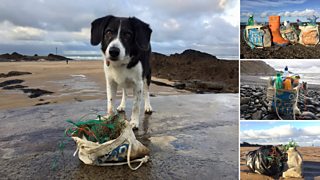
Everyone can take part in a #2minutebeachclean
2. Jan Wells
Martin’s whole ethos is built around the fact that just 2 minutes of your time can make a difference to our oceans. So image the effect Jan Wells has had, committing 2 minutes EVERY SINGLE DAY this year to beach cleaning.
An avid #2minutebeachclean-er, Jan tweets photos of what she has found on the beaches near her Cornish home. Bottles, bags, rope, nets – the list goes on.
She once found "a Quaker Puffed Wheat Deputy badge from a 1958 promotion" balanced on a rock after a "belter of a storm”, proving categorically how long plastics can stay around in our oceans.
3. Frankie Hobro
Olive Ridley turtles are normally found in warmer waters near the equator, so it must have been a real surprise for Frankie Hobro to find one in the Menai straights. Thought to be the first of it's kind to have been reported in British waters since records began almost 200 years ago, the turtle she discovered was weak, with its body going into a shut down mode after so long in unfamiliar cold waters.
But this was one lucky turtle - Frankie might be the best person in the whole country for a sick marine reptile to wash up next to. The Anglesey-based Frankie also happens to be a highly trained Marine Biologist, and she nursed "Menai", so named after the waters the turtle was found in, back to health. It meant it could be released off the coast of Gran Canaria several weeks later - and continue its life in a more natural habitat.
4. ATM
The city streets might seem like an unusual place to find an ocean hero – but street artist ATM has been using urban walls as a canvas to highlight the plight of marine and terrestrial species to people across the country.
This year he was commissioned by The Wildlife Trusts to produce a painting of a cuttlefish in Southsea in Hampshire, in order to highlight the fragile ecosystem that supports these colourful creatures. He has also produced a mistle thrush on the side of a brick-built house and a buzzard on the side of a supermarket in the Somerset village of Long Ashton.
5. Dan Jarvis and Tim Coleman
Cast your mind back to Springwatch 2017, when we showed you dramatic footage of a humpback whale which had sadly become entangled in fishing equipment at Start Bay in Devon. Dragging the lines behind it, the footage shows the whale clearly struggling to escape, and the decision was taken to try and help free the cetacean, all 15 tonnes of it. Working alongside the RNLI (a different kind of ocean heroes!), Dan and Tim from Marine Life Rescue, had the unenviable task of freeing the whale from the fishing lines, successfully releasing it from the fishing gear after a long and dangerous operation.
Two weeks later they were at it again, releasing another whale had become stuck in nets off the south coast. For their dedication we think that Dan, Tim and the people they work alongside deserve a massive round of applause
Watch dramatic humpback rescue off Devon coast
6. Ross King
Sadly not all cetaceans are as lucky as the two whales rescued by Dan and Tim – worldwide it's thought that around 300,000 are killed every year by entanglement in fishing gear. Ross, a third-generation fisherman working from Cornwall has been trialling brand new sound technology to keep marine mammals away from his nets. Using a device called a "banana pinger” to send out sound signals from his gear, Ross hasn’t had a single case of entanglement in the year he has been using the devices. The technology is starting to be used around the world, with millions being invested in an attempt to bring cetacean entanglement to an end.
7. David Ainsley
It's thanks to the hard work of David Ainsley that the scallop habitats off the west coast of Scotland have been protected. An avid diver, David was shocked when he found that the sea bed resembled a ploughed field, and after some research he discovered that it was the result of a fishing method called dredging - where a net is dragged along the sea floor to catch creatures such as the scallops that live there. David went to the EU to make a case that the area needed to be protected, and much to his surprise the EU agreed.
The Firth of Lorn is now a Special Area of Conservation (SAC) where scallop dredging is banned, and the marine life has come back with remarkable speed. David’s efforts started ripples that spread around the UK, and there are now many more areas of marine protection like this in British waters, ensuring that the wildlife and habitats in those zones are protected from over-exploitation. The effect has to be seen to be believed.
8. And... you?
When the “Watchers" work together; counting bees, butterflies and birds, we have seen that we can make a massive difference to all kinds of issues around the natural world.
So let's use this opportunity to harness that power for the oceans too - and make an army of marine champions.
For ideas of what to do check out our pages on how you can help our oceans – and let’s make a tribe of ocean heroes.
