The Midnight Song Bird
Like Gary Moore, Mike Drew from Anglian Water has been enchanted by the Nightingale’s song. He explains why it’s so important we ensure that its song remains a part of the British countryside, and how work by BTO and Anglian Water is trying to learn how we can achieve this.
I first heard the song of the Nightingale in spring 2002 at Grafham Water, when I got my first full-time job as an Assistant Warden working for the Wildlife Trust Bedfordshire, Cambridgeshire and Northamptonshire (BCN). The song of the Nightingale is something you never forget; it’s quite amazing as there are parts you can’t hear as it’s singing past the hearing range of a human being. It’s my favourite of all of the song birds. I now work for Anglian Water as their Biodiversity Action Plan Scientist. In 2011 the British Trust for Ornithology (BTO) approached Anglian Water to invite us to get involved in a new research project which was being launched to understand why the UK population of Nightingales was declining, and to find out where these birds spend the winter months. Alarmingly, this beautiful bird had seen a 90% decline in the last 50 years. Could it be due to climate change, destruction habitat or lack of management? Even in my lifetime there was a risk that our coppiced woodlands and scrubby areas could fall silent from these birds.
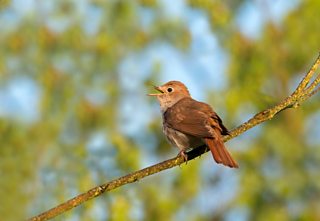
You may wonder why Anglian Water is involved. Well, the main distribution of Nightingales falls within our region and the South East, plus we have a number of sites where they breed. So in 2012 BTO, Anglian Water and the Wildlife Trust BCN started a research project to find out some answers. We surveyed several sites: Grafham Water in Cambridgeshire (an Anglian Water site), Methwold Hythe in Norfolk and Orlestone Forest in Kent. We conducted four surveys every week; two early mornings and two midnight surveys from mid-April to the end of May. We were also interested in the migratory routes these birds take every year, so we fitted geolocators to male Nightingales as they are very site faithful. These devices measure light intensity and the position of the sun (about which you can read more here).
Staff at Anglian Water and the Wildlife Trust have been so interested in the research and keen to get involved that I’ve had to limit it to 3 volunteers per visit! In 2012 we fitted geolocators to 20 Nightingales and in 2013 13 Nightingales had returned to the focus sites. I was then intrigued to see where they had gone for the winter.
One male Nightingale that sticks in my mind is 083 (his tag number). He overwintered on the border of Senegal and Gambia, but in the middle of February he flew further south to Sierra Leone! I caught him at Grafham Water every year up until spring 2015, which was the last time I saw him. In 2015 the BTO approached us again about a further study of the Nightingale. We carried out more surveys, tagged more birds and also produced a booklet on how to managing scrub for Nightingales.
We’re coming to the end of our surveys at Grafham Water which started in 2012. Since then we’ve walked 549 miles, listened for Nightingales for 429 hours, carried out 143 surveys and had the support from an impressive 73 volunteers.
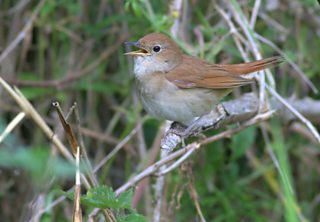
The more I know about this bird, it only confirms what an amazing bird the Nightingale is, and how lucky we are that it calls the UK its home for 4 months of the year. Let’s hope that with a greater understanding of the Nightingale from research projects like this one we can better manage our landscapes to ensure our woodlands and scrub never fall silent from this beautiful song.
