Blackbirds use our gardens more than any other bird

BTO
Partner organisation of the Watches
Written by Paul Stancliffe, BTO
During last year’s Springwatch, over 130,000 people took part in Gardenwatch, the UK’s biggest garden audit. As a result of your Gardenwatch data we now know that Blackbirds make more use of our gardens than any other bird: for nesting, feeding and sheltering.
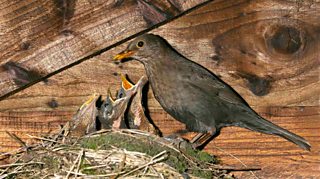
Image courtesy of Jill Pakenham/ British Trust for Ornithology
Where in the UK do Blackbirds live?
Formerly a bird of woodland, the Blackbird has spread into farmland, gardens, cities and towns and is now one of our most widespread birds. We know that gardens are important for Blackbirds, but the Gardenwatch results give us some interesting insights into how this familiar bird uses our gardens. No other bird was found using gardens in springtime in so many ways as the Blackbird!
You might expect there to be little variation in the abundance of such a common bird across the UK, but there are some interesting differences. Blackbirds breed less in urban areas and so it is no surprise that the London area recorded less breeding activity than anywhere else. Blackbirds readily nest in gardens, but the Gardenwatch results show that they make less use of our gardens for nesting in central and southern England and some parts of Scotland – could it be that some gardens in these areas lack the structure needed for Blackbirds to breed successfully?
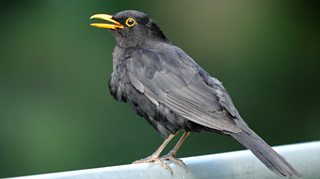
Image courtesy of Amy Lewis/ British Trust for Ornithology
Where do Blackbirds nest in gardens?
Gardenwatch results have shown that gardens are an important habitat for breeding Blackbirds for both feeding and nesting, but exactly where do Blackbirds nest in gardens? Nest use was observed in 52% of participating gardens and breeding activity in 62%. Mature climbers such as Ivy and Honeysuckle, shrubs and small trees are all used by Blackbirds to build their nests in, but Blackbirds will also build nests in outbuildings, using a beam or a bracket on a wall to support the structure. Blackbirds are also occasionally known to use sites that to our eyes seem totally unsuitable – on a ladder hung on an exposed wall, on the top of a waste bin and a gas bottle are all sites that have been used by Blackbirds.
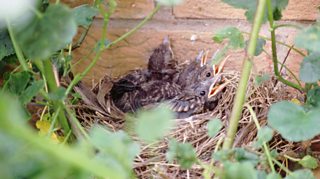
Image courtesy of Edward Charles/ British Trust for Ornithology
What do Blackbirds eat?
As a woodland bird Blackbird historically fed among the rich leaf litter of the woodland floor, turning over the mulch to search for invertebrate food. Earthworms are a particularly important source of food for Blackbirds but they will also eat a variety of other invertebrates. Earthworms are eaten throughout the year, and in urban gardens they are the main food given to young Blackbirds in the nest. During periods of drought or times when ground is frozen hard and earthworms aren’t available food provided at garden feeding stations gains importance, along with fruit and berries.
During the Gardenwatch survey it was found that Blackbirds used feeders in 58% of the gardens that took part and fed on natural foods, such as invertebrates and berries, in 90% of gardens – clearly most gardens can adequately provide for the needs of Blackbirds.
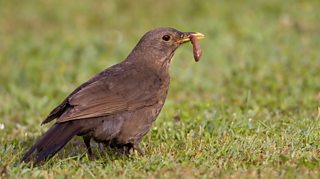
Image courtesy of Liz Cutting/ British Trust for Ornithology
Why monitor birds such as the Blackbird?
It has become increasingly clear that gardens provide important habitat for our birds, but just how important is open to debate. Taking part in a garden wildlife survey turns these observations into scientific data, allowing scientists to produce trends and compare with data collected in the wider countryside. So far we have produced basic maps and summaries of the Gardenwatch dataset, but these records will provide a valuable resource for examining garden wildlife interactions for many years to come.
Explore the Gardenwatch results and learn about how to improve your garden for Blackbirds and other wildlife by visiting the Gardenwatch results site.
