Helping Eagles Soar
Author: Dave Sexton RSPB Scotland Mull Officer
It always brings a lump to my throat. The thought of the last known white-tailed eagle in Britain in 1918 sitting atop a wild, wind-swept cliff in Shetland searching in vain for its mate. Indeed, looking for any other of its kind. What must it be like for the last one of a species? They must feed and preen as normal of course but for many hours a day, sometimes for years on end, they sit and watch…and hope.
This last sea eagle had been widowed eight years previously in 1910 but returned faithfully every year after to the eyrie they’d raised chicks in together “to gaze out over the wide horizon and wait”. Sadly, no new mate would ever appear over that wide Shetland horizon as all over Scotland sea eagles were being ruthlessly persecuted – shot, poisoned, collected and their eggs stolen. From what had once been the commonest, most widespread eagle in Britain nesting the length and breadth of our country from the Isle of Wight to the far Northern Isles, its population was reduced to a tiny remnant. A few years previously in 1916, the last recorded breeding attempt had already occurred on Skye. Doubtless a few immature birds and even some unpaired adults still drifted, lost and aimless, along the remotest sea cliffs but for all intents and purposes, sea eagles were already extinct as a breeding species. What a desperately sad and shameful period in our history.
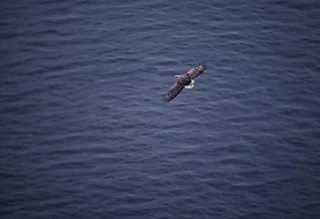
Image by Chris Gomersall
Folklore has it that this last British sea eagle was a female and an albino. There’s a poignant black and white photograph taken sometime between 1912 and 1918 by Harry Brewster Macpherson who travelled to Shetland from Strathspey to record this remarkable bird for posterity and it remains the only known photograph of an original British sea eagle ever taken. Harry might not have realised then that the bird sheltering on the cliff below him was probably the last of its kind.
But like all folklore, it’s sometimes rather more fiction than fact! In truth, the bird probably wasn’t an albino. As some observers at the time noted the primary feathers on the wings were ‘light brown’. Whilst undoubtedly striking in appearance this sea eagle was more likely to have been leucistic. Furthermore, this sad, lonely female was almost certainly a sad, lonely male. Research by John A. Love who, with Scottish Natural Heritage, helped pioneer the successful reintroduction of sea eagles to Scotland beginning in the 1970s, has shown that early local reports of this bird refer to it as being ‘much smaller’ than its original mate. Sea eagle males are noticeably smaller than females. And just one final bit of myth busting! This widowed, single, leucistic male probably wasn’t the absolute last of his kind! Reliable reports persisted into the 1920s and even occasional later ones of sometimes a pair but normally of lone birds roaming the Highlands and Islands. However, for now, our almost white single bird in Shetland is the last proven, documented individual. Despite three decades of protection by islanders and RSPB Watcher James Hay even this bird was eventually shot in 1918 by ‘an old man’ no longer able to ignore financial inducements offered by collectors. Effectively this was the end for sea eagles in Britain.
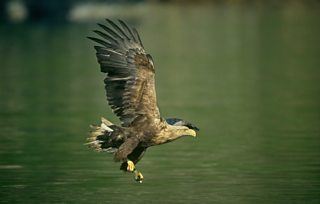
Image by Chris Gomersall
Even if a few lone immatures continued to frequent the wider landscape, they too will probably have eventually been killed. Fast forward forty years and conservationists, amateur and professional, were already trying to realise the dream of bringing this native bird back. RSPB Scotland Director George Waterston, so famous for his work with ospreys, also had a long held ambition to bring sea eagles home. Indeed, with his cousin Pat Sandeman, they made the first attempt to do just that by releasing three Norwegian sea eagles at Glen Etive in Argyll in 1959. Whilst one of the three survived for at least a year before being caught in a fox trap, one of the others ended up in captivity and the fate of the third was unknown. About ten years later a further four immature sea eagles from Norway were released on Fair Isle involving another ornithological legend Roy Dennis. Whilst both releases involved too few birds to be ultimately successful, important lessons were learned for the next ‘official’ reintroduction attempt on the Isle of Rum starting in 1975. This was to become Phase One of three of releasing birds gifted by Norway to the west and east coasts of Scotland, concluding in 2012.
The detail and successful results of this translocation project are well documented elsewhere but it was the first tantalising reports of sea eagles wandering away from Rum and on to the nearby Isle of Mull which first gripped my fascination (my family might say obsession!) I was on a birding trip to Mull with my friend Eric Kidd in May 1980. We’d already seen our first ever otter in the wild and had watched golden eagles displaying. Then on a late afternoon drive along the shore road by Loch Spelve, we screeched to a halt as we’d both simultaneously glimpsed the massive, plank-like wings of an adult sea eagle flapping hard across the loch being pursued by a mob of angry hooded crows.
As they all vanished behind a ridge, we looked at each other in disbelief; we’d just witnessed conservation history. Sea eagles really were back home at last. Soon after, I began to pester long-suffering Richard Porter and Mike Everett in the Species Protection Department at RSPB HQ begging for a job to protect the first known nesting attempts. My persistence eventually paid off and I was given a contract in 1984 to watch over an active nest on Mull with my colleague Mike Madders and boss Roger Broad. History was not to be made that year, however, as the single infertile egg failed to hatch. Undeterred, we were both back
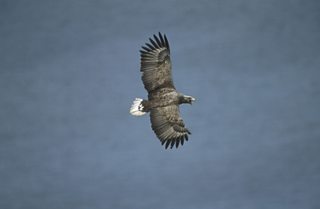
Image by Chris Gomersall
Finally, 1985 was to be their year. And ours! This pioneering pair of Norwegian – now Scottish – white-tailed eagles hatched and fledged the first wild-bred chick in the UK for some 70 years. That year we all witnessed wildlife conservation history (along with some heartache and near heart failure along the way). One of the two chicks which hatched died after a few weeks so we were down to one surviving chick. The pressure was on. It too very nearly didn’t survive long after fledging. Late one gloomy July day, we watched in horror as it ditched in the middle of a choppy grey loch and as dusk fell, appeared to slip beneath the waves. Sick with anguish and anxiety, we returned at dawn to retrieve what we knew would be a body. But there, sitting on the shoreline with his proud parents, was our chick; rather soggy but otherwise none the worse for his unexpected baptism in a cold Mull loch. Unable to contain my joy at finding him alive and well, I fell back into the dew soaked heather with the early morning sun on my face and wept tears of utter relief.
Unlike the lonely old sea eagle in Shetland in 1918, this very special, lone young eagle would also go on to ‘gaze out over the wide horizon and wait’ but he would see many others of his kind soaring over distant mountains, their echoing calls drifting towards him on the sea breeze. Tùsanaich a’ Tilleadh – Iolaire sùil na grèine: the return of the native - the eagle with the sunlit eye - was underway.
