Sand lizard reintroduction - an exciting update from the field!

Guest blogger
Peter Hill from the Amhpibian and Reptile Conservation Trust (ARC) talks about his work on a Sand Lizard reintroduction project in Surrey.
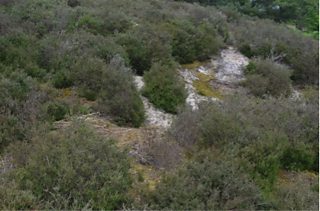
Recently I and a pair of friends surveyed a few sand lizard and smooth snake reintroduction sites in Surrey. On June 14th, following a cool, sun-less morning, the afternoon brought strong sun onto the Surrey bank pictured below. We happened to arrive just at the right time and witnessed some of the seasonal drama of the lives of the sand lizards unfolding at our feet. The following set of images portrays some of what was observed.
This bank is ideal for sand lizards, south facing aspect, sheltered from wind with plenty of cover for foraging, immediately adjacent to patches of bare sand for egg laying and basking, and plenty of open “sun rooms” carpeted with moss and situated next to mature heather.
Central to all of the activity was this female, freshly sloughed and receptive, wafting out pheromones that attracted a number of males. We were lucky to be there just at the right time as the males, drunk with pheromones, focused their attention on the female. A number of males were within close proximity of the female, and each other.
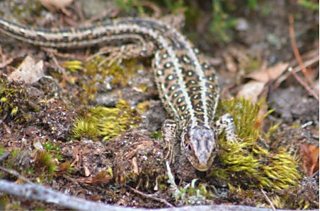
Male number one is pictured below. He was undoubtedly the dominant male and was observed chasing off the other males whenever they got too close.
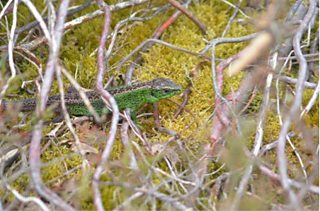
Male number two. Never far away, just out of reach of male number one, and waiting for an opportunity to sneak in.
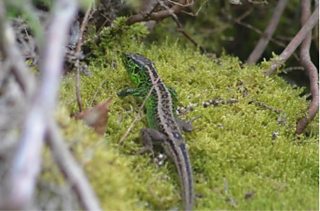
Male number three, or “Mr Crutches” as we called him. My colleague has a damaged ligament and is on crutches. Whilst watching the lizards he laid his crutches down in the heather, male number three was very interested and tongue flicked the crutches to see what they were.
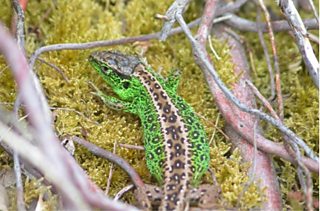
Male number one guards the female as she basks in her favourite moss-carpeted sun room.
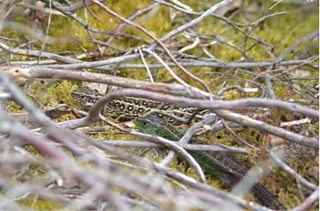
In between chasing off other males, male number one continues his vigil of guarding the female.
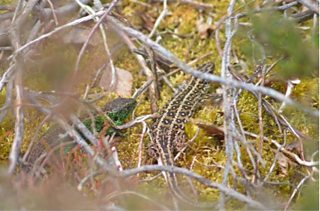
The female, fully charged up in the sun moves off to forage. Here she is pulling out invertebrates from the moss at another nearby open area.
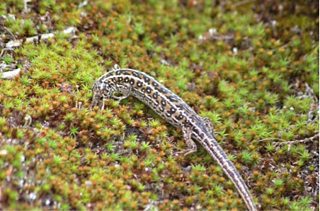
Male number one follows the female initially but is distracted by the invertebrates present in the suns heat and loses contact with the female. Notice that he has a few ticks in the armpit area.
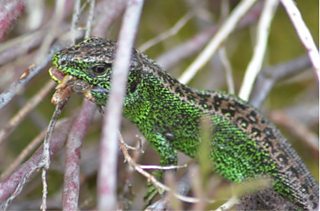
Whilst foraging and separated from male number one, the female is spotted by male number three, “Mr Crutches.”
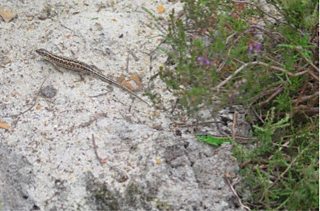
Male number one basks near-by, unaware of what is happening elsewhere.
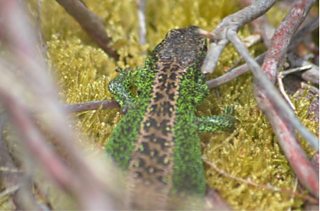
A strikingly marked immature animal is also basking nearby.
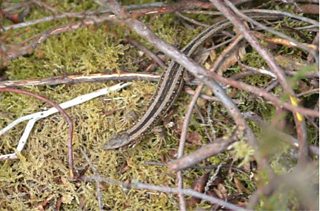
Male number three, “Mr Crutches” seizes the opportunity whilst the dominant male’s back is turned and mates with the female. (Photo Vaughn Matthews)
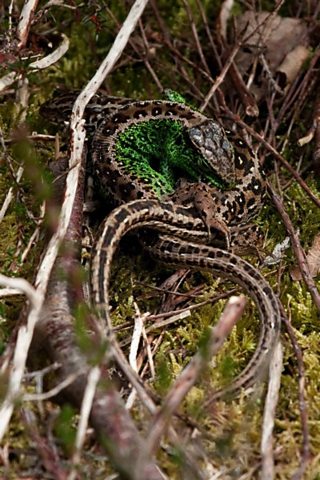
Male number one continues to bask and forage elsewhere. After mating, the female heads back towards her favourite sun room.
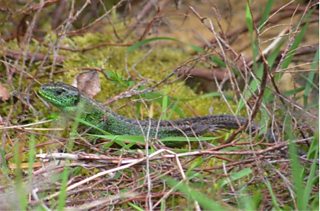
Upon arriving at her favourite sunroom male number two is there waiting for her. Straight away, he starts tail biting, the preliminaries of courtship behaviour.
The female drags male number two across the sun room.
Male number two also mates with the female. This is the second male that has mated with the female within a 15 minute time period, and neither of the successful males were the dominant male who is still basking elsewhere.
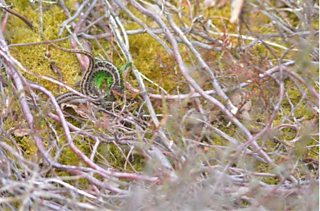
A new fourth male appears nearby, drawn in by the irresistible pheromones emitted from the female. This is how the species ensures genetic diversity. A single clutch of eggs can have as many as six separate fathers. A mating this late in the season, (June 14th) can only mean that the female is going for a second clutch, great news and a sign that the reintroduction is succeeding. We left them in peace.
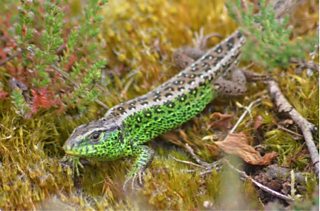
Read more about the sand lizard reintroduction here.
More on the Amphibian and Reptile Conservation Trust.
