Guest Blog: Sea eagle sagas

Guest blogger
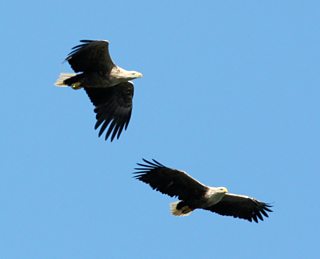
Image credit: Iain Erskine
Part 1: Sea eagle sagas – In the beginning
I can see her now. I was hiking through a glen on Mull when two huge dark birds caught my eye over the far ridge. Two immature sea eagles were soaring along the ridge. Often with their legs down they looked like hang gliders drifting back and forth. One was bigger then the other. I'd stumbled across a young pair (at that time, it was the only pair) and they looked to my inexperienced eye to be prospecting a potential nest site. The female of that young pair, although I didn't know it at the time, was set to become one of the most famous sea eagles of all time. With her faithful mate beside her, they would go on to raise the first wild bred sea eagle chick in Scotland for some 70 years.
Fast forward five years. It was 1985. By now this pioneering pair were full adults and the female was particularly striking. He pale sandy head just gleamed in the sunlight; her eyes and beak a rich yellow and her white tail just dazzled as she soared over that same wood I'd seen her as a youngster over all those years before. Given who was in the charts at the time, she quickly became known as ‘Blondie’ and as the years passed, that pale blonde plumage extended further down her back and her front. A year earlier this pair had unsuccessfully tried to breed nearby but their single infertile egg never hatched. The male just wasn't old enough. But this was to be their year. The story of that first historic chick and the terrifying adventure that overtook him on his maiden flight will live with me forever and will be a blog here on BBC Springwatch in the days to come. For now though I just want to pay tribute to Blondie.
She had been taken from her nest in Norway as an unfledged chick as part of phase one of the reintroduction project. She was released on the Isle of Rum a few weeks later but quickly found her way to Mull which would become her home for the rest of her long life. She paired up and for the next 20 years, she would become the mother of many young sea eagles, some of which - like Springwatch star Frisa hatched by Blondie in 1992 - are still with us and breeding successfully today. She was a true pioneer in every sense of the word and it is no exaggeration to say that without her and her mate's productivity, the whole sea eagle reintroduction project would not be the success it is today.
For me as a young RSPB warden watching her way back then in those momentous times, she would always hold a very special place in my heart. I used to love watching her sitting in her favourite dead oak tree at the front of the nest wood. She would have been incubating eggs or brooding chicks all night and then would be relieved by her mate at dawn. She'd fly from the nest to the tree and sit in the early morning light, preening and occasionally calling back to her mate on the nest. As the first rays of the morning sun peaked over the hills and shone straight at her like a spotlight, she looked amazing - her head at times looking almost as white as a bald eagle.
In 2000, I'd watched her at that year's nest. She'd just hatched her latest chick and was brooding it carefully - as she'd always done. It was always a great comfort to see her each time I went to Mull - in those days as a tourist. It really was like visiting an old friend. As I turned away to continue my walk, I couldn't know it would be the last time I'd ever see her. A week later I was called by the RSPB Mull Officer at that time to say that Blondie was missing, presumed dead. He thought I should know. One day she just hadn't returned from a hunting trip. Her mate had carried on brooding their chick as long as he could before he too was forced to leave to feed himself and get food for the chick. He valiantly kept this going for a few days and got some help from us too by leaving food out that he could find easily and quickly. But he couldn't do everything and during a spell of cold, wet spring weather, Blondie's last chick succumbed to the elements. After a few days, his lonely vigil was at an end and he eventually drifted away from the nest and spent his days searching for Blondie. He would often sit nearby and just call and call and call - but there was to be no answer. She was found many weeks later, high on the hill, lying in the heather. It was too late to carry out any tests to determine what had happened to her on that last fateful hunting trip but we suspect she'd been the target of another eagle attack - perhaps by a neighbouring sea eagle or golden eagle whose territory she accidentally strayed into. We would never know. But what a fabulous, wild, free and productive life she'd had. We all owe her a great debt and I will never forget her.
In the autumn I went back to the original nest wood where Blondie and her mate had reared that first chick 15 years previously. The place they'd courted and built their early nests. I hadn't seen them there for many years but I thought I'd scan across the loch anyway, just out of habit. The image that filled my binoculars momentarily took my breath away. There, sitting on Blondie's favourite oak, was her mate. Home - alone. He looked content enough and was preening in the soft, fall sunshine, just as she always used to. Often they'd sit there together. On this fine October day, with the bellowing of the stags echoing around the hills, he had come back to look one last time. Perhaps he thought he'd find her there. Perhaps I did too.
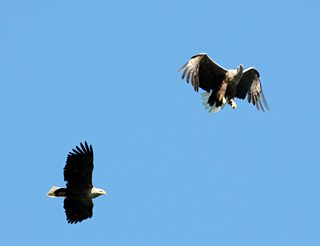
Image credit: Iain Erskine
Part 2: sea eagle sagas – the first chick
It really had been the most extraordinary summer. We had been watching history unfold. Finally, after ten very long years of waiting, the first pair of white-tailed eagles to nest in the wild in the UK had produced a chick. So much effort had been invested in this very important eaglet. It had been 70 years since white-tailed eagles had last nested here. This was the moment everyone had been working towards. Blondie and her mate had in fact hatched two chicks but one had died unexpectedly at four weeks old. That had been a huge blow for us. Now we were down to one. There was no room for error. We couldn't let anything go wrong. Please don't let anything go wrong.
We were still on 24 hour protection duties. The nest, the adults, the chick were never out of our sight. We camped nearby at night, listening out in the half darkness of the short June nights for any disturbance. Any crack of a branch or a call from Blondie to suggest something was wrong. Sometimes it was a deer or a sheep which had us straining our ears and eyes. Then the panic would pass. There were times when you wondered if you were losing your marbles. I made good friends with a very cheeky wood mouse who I often shared my sandwich with. He repaid me by chewing a huge hole in my back pack to get at the remains of my rations which were meant to last me all night and half the next day. And I thought we were friends? I thought I meant something to him. Never again!
At night, we often wouldn't realise that we were being eaten alive by clouds, swarms of midges - until morning came and the next person on duty would come to do their 36 hour shift and say 'what happened to your face?'. Back home in the mirror you could see one big, red puffy face where the midges had been working away, biting, feasting all night long. You would pick off countless ticks from every part of your anatomy - always a joy. And then you would sleep, eat, dry out (a bit) and then head back to the observation tent for the next shift. We must have been mad. And so it had gone on for twelve long weeks - three long months - in the wettest, most miserable summer anyone on Mull could ever remember. But we were working to one goal, one aim. We wanted that first chick in living memory to take to the skies.
And so that dawn finally arrived. A quick check through the telescope and there he was. Flapping hard on the nest, jumping up and down. Can't be long now? Five minutes - literally five minutes later and another check. He was gone! We'd missed it. After being glued to that eyepiece for 90 wet, midge-infested, tick-ridden days since the hatch, we'd missed it. How could he do that to us? But he wouldn't have gone far, probably down onto the woodland floor. Yes, there he was, sitting startled and wary on the ground wondering what to do next. But history had been made. The first chick of this historic reintroduction project which had started ten years ago on the Isle of Rum had just 'flown' from his nest on the Isle of Mull. Surely it was time to celebrate? Hadn't we all deserved it? Well, not quite yet...
I hoped he would just sit and regain his confidence before trying anything else. Blondie and her mate were sitting nearby. What a moment it was for them too. Oh to know what was going on in their heads! But he wasn't done yet. He was a pioneer after all. As we watched, feeling very pleased with ourselves, he launched off again, straight out of the wood and away out over the loch. A bit wobbly but strong enough. Damn it! Out of sight. Too many trees in the way. He'll reappear in a minute. Two minutes passed but he didn't reappear. He must have reached the other side by now. Better go and check. We eased our way down the wet, grassy slope to a better vantage point and scanned the far shore. Keep scanning, he'll be there somewhere. Even Blondie and her mate were excited by this momentous flight. Both were out and calling loudly over the loch. A bit strange, I remember thinking. Something wasn’t right.
Then came those awful, horrible, dread-inducing words which will live with me forever: "What's that in the loch? Do you get seals this far up?" Seals? What was he talking about. “Seals? Where?” "There - in the middle of the loch. Look, there!" The head of some creature kept appearing and disappearing in the waves. With a rising sense of complete and utter panic, the terrible truth dawned on me, not gradually but with one sickening gut-wrenching bolt of realisation. Our chick - the only chick in Britain for 70 years - had ditched in the very centre of the huge loch. The chick we'd watched over day and night, fretted over through wind and rain, was struggling and virtually submerged hundreds of metres out in the cold, grey waters. Running and stumbling down the steep rocky slope, we half fell down into the shallows at the loch edge. Through steamed up binoculars, lungs heaving and out of breath, we searched for any sign of life. All that was visible and audible was Blondie and the male circling low over the water, calling out in desperation as they too searched and searched. Up and down, round in circles they went. But the loch was now still. The waves had eased. We were drained, shaking and in shock. This just cannot be happening. It just cannot be happening.
By now it was virtually dark. We had stood staring into the gathering dusk for what seemed like hours, unable to think or act. We had to go home. I had been due to 'phone into the RSPB office that evening to report on progress. Everyone in the outside world was waiting, desperate to hear news of the fledging. I stood outside the village phone box unable to make that call. Although there were lights on in houses all around, with TV screens flickering, the occasional person's voice or a dog's bark, it was a very lonely and desolate place to be at that moment.
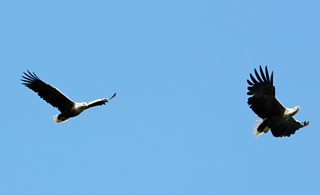
Image credit: Iain Erskine
Part 3: sea eagle sagas – a new dawn
At some point I must have wandered back from the phone box to Eastcroft. The team were exhausted but couldn't sleep. We began to prepare ourselves mentally for what had probably happened out on the loch today. And we began to prepare how we were going to explain it to the waiting conservation world. There was little sleep for anyone. We just longed for the dawn to come. Some morning light so we could survey the scene again, just to be sure.
At the track junction we split up. One team to the south side of the loch and I headed for the north shore, just above the nest wood. It was a horrible walk in, across tussocky Molinia terrain, forestry ditches and bog. I got there within the hour and sat on the rocky outcrop. After getting my breath back I raised my binoculars and started to scan, far and wide, across the loch, down below to the water's edge half dreading what I'd find, anywhere, everywhere. Nothing. I could see the others arriving on the far side, clambering out, setting up tripods and telescopes. We made contact on the walkie-talkies, channel 9: "Anything yet?" "No - nothing..." The radio clicked off.
It's bizarre what you remember about such occasions. Despite the deepening gloom we all felt inside, I remember it was the most stunningly beautiful mid-summer day. Curlews nesting on the moor were calling their liquid, cascading, bubbly flight song; the occasional high pitched whistle of golden plovers drifted over on the breeze. A pair of ravens criss-crossed the glen, their amazing aerobatics normally so impressive - but not today. Two long hours later, we had all but given up hope. Every few minutes, we'd check in on the radio. Desperately wishing for positive news, anything to give us a glimmer of hope. "Hi guys, anything from your side?" "We'll call you if we see anything - over and out". Messages were short. Nerves were frayed. Tempers on the edge. It was probably time to call it a day.
My eye caught a movement over the wood. It was Blondie, circling low over the tops of the trees. Then there was the male. The pair of them together - but alone. They slowly gained height. That's it, I thought. Game over. With that, Blondie closed her wings, legs down and stooped earthwards, closely followed by the male. I stayed with them as best I could but lost them both as they dipped below the ridge. Had they spotted something?
I daren't try the radio again. I knew what the response would be. It was another very long 30 minutes before the radio crackled again: "Dave? I've got him! I've got the chick!" I couldn't see him. I didn't need to. He was alive, sitting on the edge of the loch with both parents nearby. He must have struggled ashore, out of our gaze, as the light fell last night.
There would be many more adventures, many more highs and many more lows with these birds over the coming years. And here we are now 30 years later at 100 breeding pairs in Scotland! But at that moment, only one thing mattered. The chick - our precious chick -was alive! I just switched off the radio, listened to the curlews and lay back in the sun. Then I found myself quite overwhelmed with it all and unexpectedly in tears - probably from both exhaustion and relief. I quickly looked around, hoping no-one was watching! Of course nobody was. Far below me sat the historic sea eagle family, oblivious to all the heartache they'd caused. And not for the last time, they'd caused our emotions to go from rock bottom to sky high. This life with eagles was going to be a rollercoaster. With that I think I fell asleep in the heather, completely drained - but very, very happy.
Dave Sexton RSPB Mull Officer
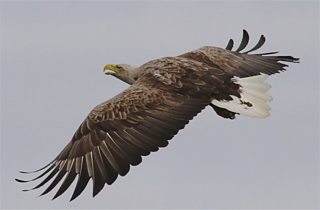
Image credit: Iain Erskine
