
Stephen McAvoy and Paul Stancliffe from the British Trust for Ornithology look to the east for the start of the annual bird migration.
October is probably the most exciting month for autumn migration, with most birds seemingly on the move, even if it is just from our gardens to the local woodland for some of our resident tits. It is the longer distance migrants that make it so exciting; birds arriving from the north and others leaving for warmer temperatures further south.
The weather conditions play an important role in these arrivals and departures and observers pray for high-pressure over Scandinavia, easterly winds across the North Sea and light rain on this side. Right now their prayers seem to have been answered as we have had a week of these conditions.
The rarer birds will always grab the headlines and there has been no shortage of unusual visitors to our shores as a result of these easterly winds. Windswept headlands and islands make the most ideal watchpoints for rarer birds due to their usually limited tree and plant cover making birds significantly easier to find.
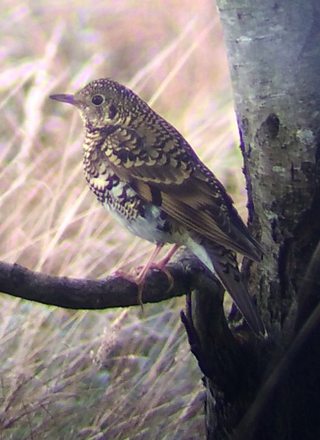
White's Thrush. Credit: Jack Bucknall
One of the highlights this week was a White’s Thrush found on Holy Island, Northumberland, on Wednesday. With its remarkable cryptic plumage, it is one of the more sought after rarities. Much rarer and arriving from much further east was Britain’s fourth Eastern Crowned Warbler that has been present at Bempton, North Yorkshire since Tuesday. The nearest breeding areas lie in eastern Mongolia so it will have flown well over 4000 miles to get here.
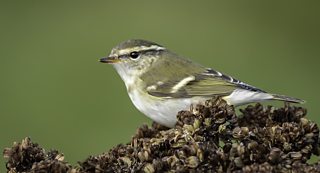
Yellow-browed warbler. Credit: Andy Mason
Formerly considered a rare visitor, Yellow-browed Warblers are now an expected feature of autumn and this week, they were recorded on over 3% of complete lists submitted to BirdTrack. Yellow-browed Warbler breeds across a large swathe of Siberia and the normal wintering range lies in south-eastern Asia. Ever increasing numbers have been recorded in autumn in the last decade, but few if any are recorded the following spring. Do the Yellow-browed Warblers not survive the migration or not find a suitable winter quarter? Or do they take a different route back in spring?
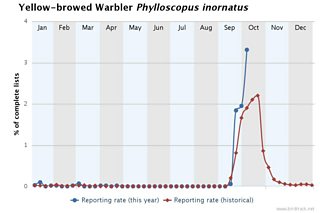
BirdTrack data for the yellow-browed warbler
Commoner winter visitors are on the move as well, with Redwing especially benefitting from the easterly winds to quickly get across the North Sea. The BirdTrack graph shows the quick arrival in the last week, with the reporting rate jumping from less than 1% to almost 10% of lists.
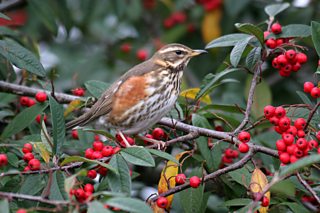
Redwing. Credit: John Harding
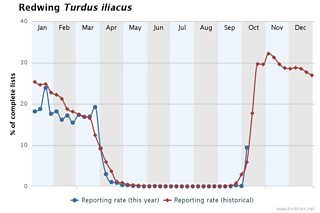
Redwing BirdTrack data
Similarly, Goldcrests are moving across the North Sea from their breeding grounds in Scandinavia, a remarkable journey for a bird weighing the same as a ten pence coin. Up to 90 have been noted around Spurn Point, East Yorkshire in the last week and 15 to 40 birds is a typical count at sites along the east coast.
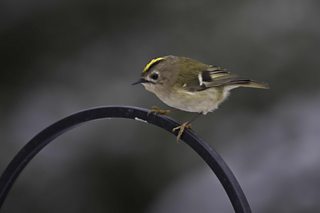
Goldrest. Credit: John Harding
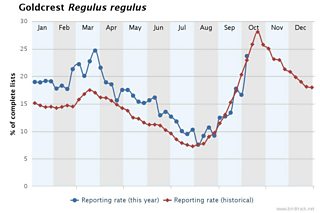
Goldcrest BirdTrack data
House Martins are one of the latest breeding of our summer visitors and the last broods will only have fledged in the last week. Some exceptional birds may even still be feeding young at the nest. The majority will be on the move though, and hundreds of House Martins and Swallows were counted heading out to sea from Hengistbury Head, Dorset on 5 October.
With the weather forecast to continue in this vein for at least another three or four days we can expect more of the same; more thrushes that should include more Blackbirds and Song Thrushes, more finches, Bramblings and Chaffinches in particular, and the first real arrival of Dark-bellied Brent Geese.
Follow the British Trust for Ornithology:
