What do owls eat?
As our little owls take centre stage this Springwatch, Emily Joachim delves into the behaviour of the little owl....
Little owl vs blackbird has been one of this year’s most dramatic storylines on Springwatch. Last week, two blackbird fledglings from a nearby nest were predated and fed to the little owlets. This blackbird family has since left the barn, but overnight, the little owls found a second blackbird nest and predated a nestling at 5:38am and a second at 6:10am; the forth surviving blackbird chick fledged at 7:04am. This was its best chance of survival.
At approximately 85-100 grams, a fledgling blackbird is the equivalent weight of four adult field voles or 10 large common earthworms. It’s a good meal for the three little owlets who need lots of food. People have been in touch asking if it’s normal for little owls to eat birds so I thought I’d write this blog on the little owl’s diet in Britain.
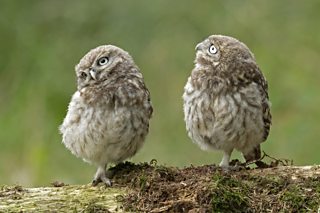
As you’re probably aware, the little owl was successfully introduced into England during the late 1880s. In the following decades, it rapidly colonised much of England and Wales. Initially, they were welcomed, but by the early 20th century, there were unsubstantiated beliefs that little owls were killing large numbers of game birds. Several little owl diet studies were subsequently carried out to learn more about what little owls were eating in Britain. The most significant was by Alice Hibbert-Ware, on behalf of the British Trust for Ornithology, who led an impartial inquiry into the little owl’s diet during 1936-37. This scientific study investigated pellet, stomach & nest contents. The final report, survey correspondence and insect samples can be viewed in the BTO’s archive.
Hibbert-Ware concluded that little owls are opportunistic predators who predominantly eat insects throughout the year, usually predating the most dominant species at any given time. Earwigs were the most taken insects, with an incredible 686 pincers found in a single little owl pellet. Black clock beetles, rove beetles, weevils, click beetles, dor beetles, crane flies, cockchafers were also commonly found in prey remains. Little owls often take other invertebrates including spiders, moths (larvae and adults), millipedes, centipedes, ants and earthworms. I’ve found nests crawling with live earthworms, delivered by the adult birds and stored for a later meal for young.
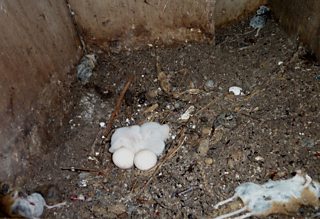
Small mammals are also an important part of the little owl’s diet. Hibbert-Ware found voles, mice and young rats in pellets throughout the year. During the breeding season, remains of medium-large-sized rats, and small and medium-sized rabbits were found in nests. It’s remarkable to think that a little owl can predate a medium-sized rabbit! We often find field voles, wood mice and common shrew prey remains in little owl nest sites in Wiltshire.
As you’ve seen on Springwatch, the little owl will also predate birds. Hibbert-ware concluded that birds were more likely to be consumed by little owls between May and mid-July, i.e. during the breeding season. Starlings, house sparrows, blackbirds and song thrush were most frequently predated and the author found very little evidence of nest raiding. Overall, birds represent a minority total of the little owl’s annual diet by number of prey items taken, however, on rare occasions, we find a glut of avian prey in nests, but this is uncommon. I once found 12 dead house sparrows in a little owl nest – a large house sparrow colony was within 20m of this little owl nest. All impartial little owl diet studies have since concluded that the little owl very rarely predates game birds.
Little owl diet can and does vary tremendously between breeding sites and in different months and years. And it’s worth noting that the little owl itself is prey to a number of mammalian and avian predators, including rats, weasels, stoats, squirrels, foxes, badgers, barn owls, tawny owls, buzzards, sparrowhawks and peregrine falcons!
To find out more about the UK Little Owl Project and how you can get involved, visit the UK Little Owl Project website.
