After seven weeks and seven amazing episodes, Blue Planet II finally comes to an end this Sunday.
The final instalment, which airs at 8pm on BBC One, has a strong emphasis on marine conservation and the fight to save our oceans for us, for future generations, and for the wildlife that lives in and relies on them.
So this week, we're getting in on the act by dedicating our '7 things' to life beneath the waves.
1. UN resolves to stop plastic pollution
The plague of plastic that litters our oceans came up earlier in the series, but the effects it can have on marine habits and wildlife is explored in more detail in this final episode.
With extraordinary timing the United Nations this week sealed a resolution in which it agrees to do more about plastic pollution worldwide. The non-legally binding agreement puts into writing that global governments will tackle problems caused by the manmade material through a global task force.
Some campaigners have said the deal does not go far enough and that businesses should be included on that panel for the body to have true impact. Meanwhile Li Lin from the WWF said: "At last we are seeing some action on this issue, but we still don’t have the urgency we need. The problem needs solving right now."
But some countries are already acting on the damage plastic can do. Kenya, who hosted the international summit where the resolution was passed, banned the ownership, retail and use of plastic bags this year in a bid to help the environment, with those caught flouting the laws face fines of £31,000 or four years in prison.
2. "Shame and anger at plastic pollution" expressed by scientists working with Blue Planet II team
Crews working on the production have expressed their dismay at finding plastic littering beaches in almost every single location where they were filming, no matter how remote.
In Sunday's final episode we'll see how an albatross died on Bird Island, South Georgia after a plastic toothpick pierced its stomach. Dr Lucy Quinn, the zoologist who found and dissected the bird told the BBC's David Shukman that she feels "real shame and anger that it’s humans who have caused this problem."
Dr Quinn has also been involved in a study of fulmars found dead on beaches or caught accidentally by fishermen around the UK. The study showed that from 2010-2014, fulmars in the North Sea were found to contain on average 39 particles of plastic weighing a total of 0.32 grams – the equivalent to a 80kg human having 30g of plastic in their stomach
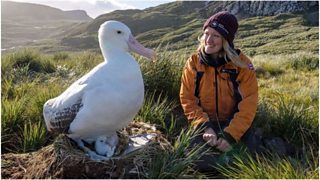
Lucy Quinn seen checking albatrosses on Bird Island, part of South Georgia. Image: BBC /John Dickens
3. Free coffee for a bucket of trash
A beach side coffee shop at Mudeford near Bournemouth in Dorset is offering beach-goers a cup of coffee for free - if they collect a bucket of rubbish from the beach and present it at the cafe's counter.
The sign on the pebble beach was noticed by Dorset based photographer Matt Pinner. He posted a photo of the sign on Twitter. Other Twitter users commented that they had seen similar signs at Abbotsbury, between Weymouth and Lyme Regis.
Coffee + helping the planet? Count us in!
4. Britain's coral reefs ‘rival the tropics’
"Far from being murky and dull, the waters surrounding the British Isles contain riches to rival the tropics - and they're just as in need of protection" writes Fiona Gell for The Guardian.
Below the waves that lap against our shores lie some vital habitats and ecosystems. Fiona highlights how programmes like Blue Planet II and Coast have opened our eyes to what lies offshore, and to the fact that we need to work to protect those special places.
Read more (The Guardian)
5. Beauty of Scottish reefs revealed
Over ten years ago, David Ainsley, an avid diver, was shocked when he found that the sea bed off the west coast of Scotland resembled a ploughed field. After some research he discovered that it was the result of a fishing method called dredging - where a net is dragged along the sea floor to catch creatures such as the scallops that live there, and David went to the EU to make a case that the area needed to be protected.
Much to his surprise the EU agreed, and the Firth of Lorn is now a Special Area of Conservation (SAC) where scallop dredging is banned - and where the marine life has come back with remarkable speed. BBC Earth went to meet the man behind the spectacular restoration of this stunning habitat, and the effect of his work has to be seen to be believed.
6. Study looks at state of British birds
A report from the BTO has shed light on how birds living around the British Isles are faring. The report says that birds in the UK are showing changes in abundance and distribution, predominantly moving northwards, in a way that is consistent with a changing climate.
In terms of the British seabird population it says: "The UK’s kittiwake population has declined by 70% since 1986 because of falling breeding success and adult survival. Climate change has reduced the availability of the sandeels they rely upon in the breeding season. Other species that feed largely on sandeels, such as Arctic skua, Arctic tern and puffin, are at high risk of climate-related decline.”
7. Plans to ban releasing balloons on public land
Releasing balloons on public land could be banned in plans being considered by a Welsh council.
In a move welcomed by the Marine Conservation Society (MCS), Neath Port Talbot has said it wants to extend an existing ban on sky lanterns to include balloons.
The lanterns are already banned by 20 of Wales’ 22 councils as they often land out at sea and can be mistaken as food by many species, leading to blockages of digestive systems and the starvation of animals.
Campaigners say that the same applies to balloons. Should the ban go ahead, releasing balloons would be treated in the same way as littering.
