Stop, Look and Listen

Guest blogger
Guest Blogger Jason Alexander challenges you to to try a different kind of 5 a day.
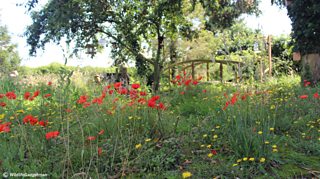
1. Photo by Jason Alexander
Stop. Look. Listen! Sound familiar? No, this isn’t a blog post about road safety, it’s about taking time to relax a little and get closer to nature in your garden.
‘When was the last time you were in your garden and just stopped, sat quietly and watched and listened to what’s going on around you?’
You’ve probably heard people ask this question a number of times and you’ve probably had a go at doing it, I know I have, and I bet you probably noticed one or two things you might not have done if you had just carried on at your usual pace. But how long did you actually sit there for? How many of your senses did you consciously use?
For me, getting in tune with the living and breathing organism that is my garden is a lot like meditation. I find it a brilliant way to start or end the day and even find time to incorporate it into my lunch break occasionally.
I’ve probably taken things a little further than most however by creating a simple routine I follow each time.
Have a go. You know it makes sense!
I’ve found following these easy steps not only helps me to relax but also heightens my awareness of every living thing, large or small, animal, vegetable or mineral around me, if only for a few minutes. They can be done in any order and for any length of time but the important thing is to try and include every step. They are also an excellent way to discover wildlife ‘hotspots’ in your garden and identify potential areas for your next wildlife project.
The alternative ‘5 a day’!
Not really an alternative ‘5 a day’, more like an additional ‘5 a day’. Tune up and stretch your sensory muscles by taking a ‘sensory safari’ around your garden.
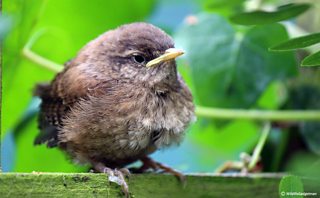
2. Photo by Jason Alexander
Start by choosing a spot in your garden and stop. Stand, sit or lay down, whatever you fancy. Grab a chair or stool, sit on a low wall or even on the grass. I often take a cuppa along too! Try choosing a different spot each time.
Look – Take a look around. What can you see? Birds? Mammals? Insects? Flowers? Grass? Trees?All wonderful in their own right and amazing to watch but rather than just look at the world around you as objects or things try looking beyond the obvious and the literal.
Look for colours. How many colours can you see? How many shades of the same colour can you see? Look for interesting shapes. Symmetry is everywhere, even where you least expect it. Look for patterns, shadows, reflections. Watch how the wind affects your surroundings, the clouds blowing overhead, the leaves rustling on the trees, ripples across the surface of a pond or a bird bath, the way the feathers are ruffled across the back of a perching bird.
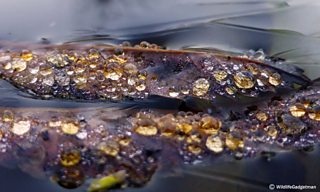
3. Photo by Jason Alexander
Think about scale too. It doesn’t matter how big your garden is, there will always be something to see. Look closer and closer at smaller and smaller areas and you’ll be amazed at how much detail you start to notice!
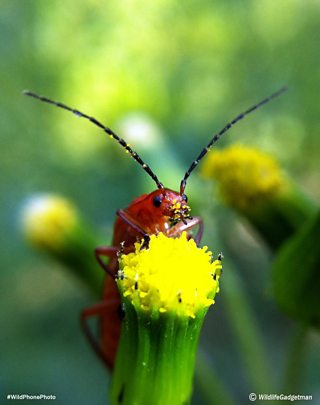
4. Photo by Jason Alexander
Listen – What can you hear?No matter where you are you’ll be surrounded by the cacophony of life. You may find it easier to close your eyes to begin with when concentrating on the sounds around you. I usually mentally split sounds into two categories when I’m listening – sounds I can hear from the world outside my garden and those I can hear inside.
I usually start with sounds close by and then gradually listen for sounds further afield. I visualise my hearing like ripples in a pond. Starting from where I’m sitting and then expanding out in an ever increasing circumference around me.
Birds singing are usually the first thing you notice and if you are anything like me you can spend hours just listening to their conversations and song. Keeping your eyes peeled when listening to birdsong is a great way to start identifying a species of bird by its song. You’ll be surprised how quickly you learn what birds are visiting your garden just by hearing them.
Insects buzzing around the flower borders are also wonderful to listen to. I find sitting by my wild flower border or in the middle of my wild flower patch totally captivating. Every species of bee, wasp or hoverfly has a different buzz. You can even hear the odd sound made by butterflies if you listen closely enough!
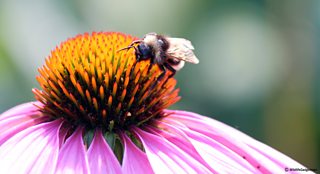
5. Photo by Jason Alexander
As you start to widen your aural attention you begin to hear the leaves rustling in the wind or a branch rhythmically tapping against a fence. As your focus crosses your garden boundary you start to pick up the clatter of the neighbour’s lawn mower, the distant rumble of traffic or the faint roar of a jet flying high overhead.
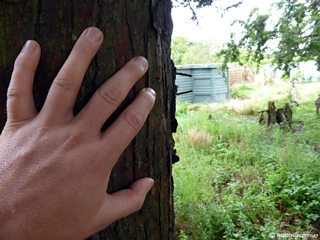
6. Photo by Jason Alexander
Touch – Don’t be afraid to get your hands, or your feet for that matter, dirty! How many times do you walk around your garden but don’t actually touch anything?!
Get ‘hands on’ with the trees and plants in your garden. Feel the different textures of bark. The differing textures of leaves. Are they smooth? Rough? Furry? Waxy? Get your hands in the soil too. Is it wet? Is it dry?
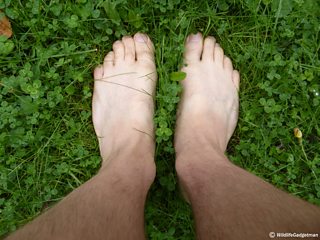
7. Photo by Jason Alexander
There’s nothing better than sitting in your garden on a warm sunny day, watching and listening to the world go by with your bare feet nestled in the cool damp grass! Add a gentle breeze blowing against your skin and you’ve got a recipe for your own slice of Eden!
Smell – Human’s sense of smell is pretty good but doesn’t come close to the olfactory prowess of many of our garden visitors. That said, we shouldn’t underestimate how much we can learn about our garden and its visitors by having a quick sniff! Using your nose as you wander around your patch can help you identify potential visiting species, their path in and out of your garden and it definitely adds an extra dimension to the whole experience. The smell of freshly cut grass, the perfume of bloom and blossom, the earthy tang of the compost heap! Nothing quite invokes memories like our sense of smell. It’s a very personal thing. Everybody’s taste is quite literally different. You can share a sight or sound by taking a photograph or recording and audio clip but a smell is something we all experience in our own way. I find it totally fascinating!
Taste – On the face of it taste can appear a little tricky to incorporate into our ‘sensory safari’ but it wouldn’t be complete without it! I’m not suggesting wandering up to the nearest tree and giving the trunk a quick lick, or having a nibble of the nearest flower, but there are a number of obvious things we can do to add a variety of tasty treats to our gardens that both we and our visiting wildlife will find irresistible!
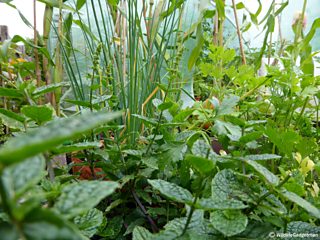
8. Photo by Jason Alexander
The addition of a small vegetable or herb patch makes a wonderful addition to any garden and can act as a magnet to many forms of wildlife. Getting the balance right between food for your plate and food for visiting wildlife can be a bit of a challenge but it’s definitely worth it! Don’t restrict your edible planting, particularly of herbs, to a single patch. Spread them around the garden a little and as you brush past them you’ll be rewarded with a wonderful aroma!
Trust me, if you make the effort to spend a while (regularly over a period of weeks) consciously using ALL your senses as you walk around your garden your awareness and enjoyment of the experience will grow exponentially!
I guarantee you’ll also identify areas in which you can improve your garden for visiting wildlife and your own pleasure, and if you don’t there’s always me and the rest of the entire Springwatch community to give you ideas!
Get out there. Practice, practice, practice and don’t forget to share your experiences with the rest of us!
