
Connecting with nature and talking to grandparents can help us become more aware of environmental declines.
By Lizzie Jones, PhD Student
People of all ages are now increasingly aware of the current ecological crisis. In 2019, the UN IPBES Global Assessment announced that global biomass of wild mammals had fallen by 82% while temperatures soared to the hottest on record and over 1 million species were considered at risk of extinction. Yet, it’s often extremely difficult to translate such enormous global issues into concepts relevant to our daily lives.
It’s often easier to look back and consider change in our own lives and ask, “How much change have I experienced?” As a child I remember enjoying huge variety of birds in our garden, annual snowfall and predictable summers, all things that seem less common today. Thinking back, remembering the past and considering change allows us to better judge current conditions. How many bird species used to arrive in the garden each spring? Is that different to now?
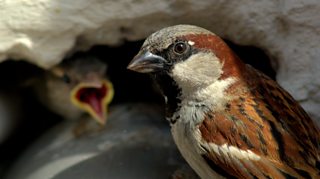
Found from city centres to open farmland, house sparrows have been in rapid decline, and would have been much more abundant 20 years ago. Image by Patrick Wright
The world we grow up in and observe from an early age forms our personal reference point, or baseline, against which we compare all future experiences of change. We are inherently influenced by our own sense of what is ‘normal’ and what are acceptable changes from that starting point. Looking further into the past, it’s even harder to fathom the experiences of our ancestors and how they might see the world today, as what we now consider pristine nature, might appear to them as wholly degraded.
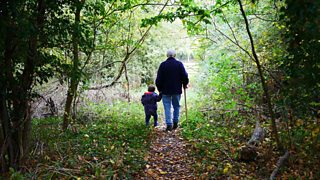
Talking about memories of the past and sharing experiences of nature are important to develop an understanding of long-term ecological change.
This phenomenon, known as Shifting Baseline Syndrome (SBS), can lead us to underestimate ongoing ecological decline, as our imperfect memories allow the accepted thresholds for environmental conditions to be continually lowered, generation by generation. Without knowledge of the past, each new generation will inherit a degraded environment and normalise even more depleted conditions.
Against a backdrop of increasing urbanisation, diminishing greenspace and greater reliance on technology as lockdowns keep us inside, growing evidence for SBS provides a bleak outlook for the future.
However, recent studies provide hope, suggesting possible ways to combat SBS at personal, local and global scales:
- As individuals, connecting with nature, experiencing change and resetting our personal baselines is critical to combat the effects of SBS and more accurately judge accelerating ecological declines. Personal experience of the natural world contextualises learned facts and allows us to more effectively recognise declines.
- At home, the importance of communication shines, especially sharing memories across generations. Grab a tea and talk with older family members about past memories and future expectations, to help break the cycle of normalisation.
- Within our local communities, offering young volunteers the chance to gather data about wildlife and work in conservation projects could help foster meaningful experiences with nature, while providing valuable data and restoring habitats.
- Globally, in the age of social media, not only is it easier to communicate with distant family and friends, but we can share photographs, anecdotes and stories about our ecological past. Virtual and Augmented Reality (AR and VR) can allow us to experience the natural world in new and immersive ways, visiting places that many might never have the chance to experience in person.

New technologies, from social media to Virtual Reality, are opening up new ways to connect with each other, and connect with nature. Image by Jeremy Bishop
In a world of accelerating ecological change, SBS poses a significant, yet relatively unspoken threat to the future of conservation. Yet greater understanding of the syndrome may hold one of the keys to halting our ongoing tolerance for degradation of the natural world and the protection of our ecosystems for future generations. We must all connect with nature while we can, but always try to imagine how it might have been in the past.
