
Spring on the summits of the Cairngorm mountains can look very much like winter! Large areas are sometimes blanketed with snow well into May and patches hang on throughout the year in some sheltered corries. Even in May and June it can feel wintry up here, which shouldn’t surprise us given that this is the closest thing we have to an Arctic climate in Britain.
As the snow melts, ptarmigan, the grouse of the high mountains, begin to lose their white plumage and grow grey feathers in order to blend in with the newly exposed rock. Their creaking calls echo among the boulders, loud enough to be heard above the strong winds that often scour the ridges.
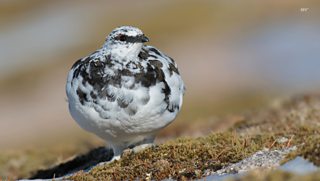
A ptarmigan. Photo by Paul Jessett via Flickr.
It’s not only the ptarmigan that change colour. Mountain hares respond to the disappearing snow by moulting, losing their winter coats and turning brown. Staying snow-white isn’t a safe option when there are golden eagles flying overhead, scanning the mountainsides for prey.
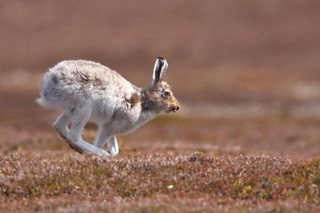
A mountain hare. Photo by Peter Lewis via Flickr.
Two very special birds breed on the mountain tops. Snow buntings are the most northerly breeding small bird in the world and nest almost nowhere else in Britain.
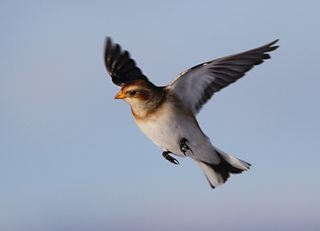
A snow bunting. Photo by Paul Walpole via Flickr.
Dotterel are smart, striking plovers whose British stronghold is also in these whaleback mountains. The female dotterel lays her eggs on the stony ground and then leaves the male to incubate them and rear the chicks. She ventures off – sometimes as far as Scandinavia – to find another husband, who will also end up doing all the parenting!
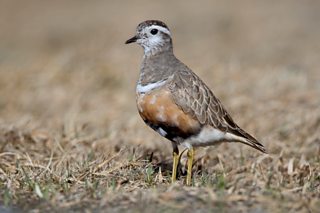
A dotterel. Photo by Paul Jessett via Flickr.
