Autumnwatch Unsprung round-up week four: Spiders, fungi, frogs and bugs!
Post categories: Autumnwatch Unsprung
 |11:15 UK time, Tuesday, 1 November 2011
We hope you enjoyed last week's Unsprung. If you missed it you can catch up on the BBC iPlayer here. We pack so much in every week that if you blink (or nip out to put the kettle on) you can easily miss something. So here's a round up of last week's show.
We had a spooky quiz this week in the form of a skulls spectacular. If you want to have a go at it, go to the Unsprung quiz.
Lots of you had reported seeing birds nesting now which seems unusually late. Big Chris saw swallows on the nest on 8 October, Jane Rees saw a pair of magpies building a nest two weeks ago and Jim Mercer fillmed some young ducklings last week.
Our Chris explained that some species such as collar doves, blackbirds and barn owls do breed in every month of the year and Pauline from Secret World brought in an extraordinary find: an orphaned young barn owl that was rescued in Somerset.
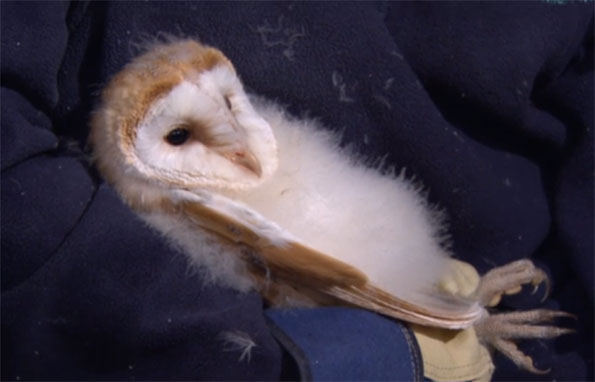
An orphaned barn owl visited the show from Secret World
Pauline was putting out a request for any other young barn owls in captivity that might join this orphan to help their release. Since the show Pauline has been in touch to let us know that she may indeed have found another owl to help with her orphan's release. Tune in to next week's show for the latest update.
Our group of the week, the Avon Bat Group asked us some great questions:
Joe asked what is the largest fungi in Britain? This question is a tricky one as what many people don't realise is that the fruiting body, the bit we see above ground, is just the tip of the iceberg when it comes to fungi.
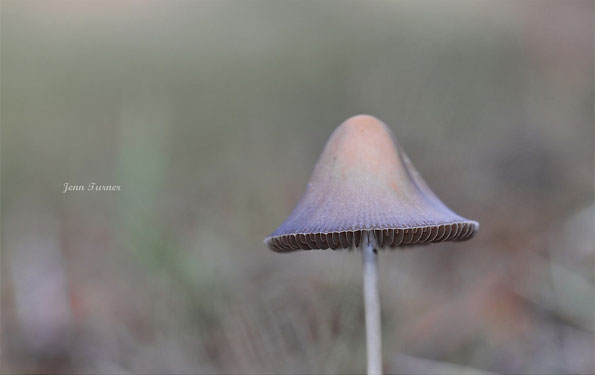
The fruiting body is just the tip of the iceberg when it comes to fungi. Image © Jenn Turner
Chris mentioned the world record holding fruiting body that used to exist at Kew Gardens. This measured over four metres in diameter but was actually knocked off the top spot this summer when a giant fungus was discovered in china which weighed half a tonne!
In terms of the entire fungus, however, the largest ever recorded fungus was discovered in Oregon, USA. It spanned across 8.9 square kilometres or about 2,200 acres! This honey fungus was discovered in 1998 and is thought by some to be the largest known living organism ever recorded. We get honey fungi here in the UK and the chances are that the largest individual fungus that we have here is a honey fungus.
Richard asked how far frogs travel since he gets them in his garden and there's no water nearby. Frogs don't actually need to be in ponds and river the entire time. They go to water to breed and lay eggs but otherwise they're quite happy just to be near damp habitats. You can find them up to about a kilometre away from ponds and rivers. Also at this time of year they will be out and about searching for places to spend the winter.
They'll find a damp spot and hunker down to lie dormant through the cold months, coming out in good weather to forage. Although some do go to the bottom of ponds to do this, many will seek out crevices under logs and rockeries (or your shed!) and in your compost heaps.
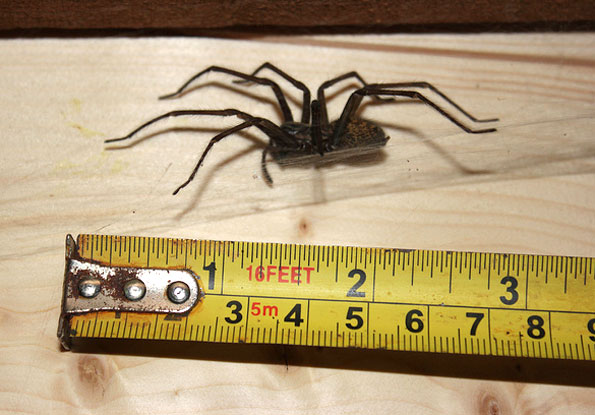
We were also pretty arachnid-tastic this week with Nick 'Bug Boy' Baker starring alongside some of his leggier friends!
We've launched a challenge to find Britain's biggest spider so if you spot an eight-legged arachnid in your house you can get involved. Just grab a coin or ruler, drop it next to the spider and snap a picture. Then post your picture on the Autumnwatch Photo Group and let us know in the Britain's Biggest Spider discussion.
If you've got any questions for next week's Unsprung let us know by commenting below. We love seeing your pictures of autumn wildlife so add them to the Autumnwatch photo group, or if you're more handy with a camcorder then upload your wildlife home movies.

Comment number 1.
At 08:56 2nd Nov 2011, Victoria Norman wrote:I saw a Woodcock on the pavement in Newcastle city centre at the weekend (there is a picture on the flikr site..) It didn't seem obviously injured but was just sitting very still on the floor. It was being guarded by a couple of very confused policemen so I assume was safe and waiting to be looked after by the right people but I was just wondering if you had any ideas why this might have happened? It's obviously not it's natural place for a rest from its journey. Thanks, Victoria
Complain about this comment (Comment number 1)
Comment number 2.
At 10:42 2nd Nov 2011, Gavin Unsprung Producer wrote:Hi Victoria,
I'm really keen to see the picture of your urban Woodcock, I've had a look on the photo group and could'nt spot it. Would you be able to post the link here?
Thanks,
Gavin
Complain about this comment (Comment number 2)
Comment number 3.
At 12:22 2nd Nov 2011, davmcn wrote:Gavin 2 I can't find it either, but I have no trouble finding the one photo I sent in the spring.
Complain about this comment (Comment number 3)
Comment number 4.
At 17:31 2nd Nov 2011, Joseph Hatch wrote:We found a dead woodcock near royal dock in london which looks like it had been eaten by a fox? We have pictures also
Complain about this comment (Comment number 4)
Comment number 5.
At 23:08 2nd Nov 2011, casey00 wrote:We've had wasps nesting in one of the bird boxes this year. Is it safe to open it up and clean it out for next year or are the wasps likely to still be inside? Sue Barlow
Complain about this comment (Comment number 5)
Comment number 6.
At 09:56 3rd Nov 2011, davmcn wrote:casey00 Hit it with a long stick to check. The wasps will eventually vacate the box.
Complain about this comment (Comment number 6)
Comment number 7.
At 13:07 3rd Nov 2011, Mike Burton Phillipson wrote:Pfft... that's now a big spider.. check this out!.. i risked my life getting this shot!!:
https://www.flickr.com/photos/30388254@N06/6303235025/
Complain about this comment (Comment number 7)
Comment number 8.
At 14:16 3rd Nov 2011, SarahT wrote:Please could you identify this poo/pellet for me?
https://www.flickr.com/photos/69198651@N03/6305858544/in/photostream
Thank you,
Sarah x
Complain about this comment (Comment number 8)
Comment number 9.
At 16:30 3rd Nov 2011, Barb385 wrote:I went to watch the fallow deer rutting this week, as you suggested in last week's programme. Perhaps next time you suggest this, you could do it well before the fallow doe shooting season begins on 1st November. On 2nd November, with 4 friends I arrived at a meadow where there were at least 70 wild fallow deer, just starting activity after a lazy sunny afternoon. In the dusk we were quietly watching some deer close to us, when a shot rang out and about 100 yards away we could see a doe falling to the ground. A man with a gun then came and dragged the body away. Meanwhile all the deer left the meadow, so that was the end of our deer watching!
Complain about this comment (Comment number 9)
Comment number 10.
At 10:01 4th Nov 2011, feedyourhedgehog wrote:I read once that Siskins are attracted to red feeders and I've only ever seen them in my garden when I 've provided them with either a red peanut bag or a red metal peanut feeders. Can you explain why this is please
NB I don't do the meshy feeders anymore beacause of the dangers of the birds getting trapped........Thanks
Complain about this comment (Comment number 10)
Comment number 11.
At 16:23 4th Nov 2011, davmcn wrote:Sarah T 8 Looks like a tape measure to me, but I could be wrong.
Complain about this comment (Comment number 11)
Comment number 12.
At 20:37 17th Nov 2011, LizzyMaisonpierre wrote:Hi Team, HOUSE SPIDERS: I have always put them outside, worrying that they will starve in my house. After watching last week and learning they are cave-dwellers and that is why they come in in Autumn time, I am worrying that I have condemned thousands of spiders to a cold, wintry death over the years. Is the answer to let them stay in over Winter, putting them out in Spring time? This begs the next question: Do they eat over the Winter? and will they find enough to eat in my house? Thanks, Lizzy Maisonpierre
Complain about this comment (Comment number 12)