Autumn bird migration news: Still plenty to come
Post categories: Autumnwatch, Migration news
 |22:06 UK time, Thursday, 3 November 2011
Each week Paul and Nick from the BTO are updating us on all the comings and goings of autumn's bird migration. We'd love to hear what you've been seeing too, whether in your garden or out and about.
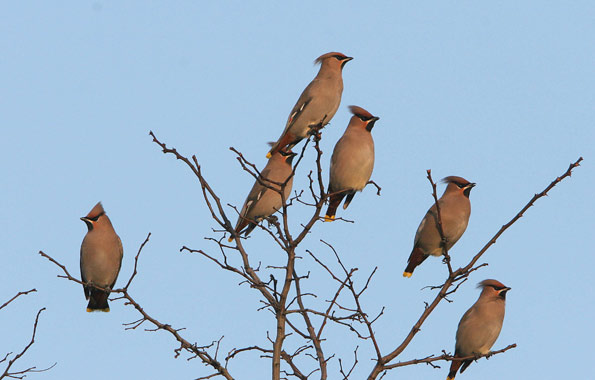
The first waxwings are here © John Harding/BTO
As the migration of our summer visitors comes to a close, it's easy to think that autumn migration also comes to a close. Nothing could be further from the truth. Migration watchers in early November can be rewarded with some of the most spectacular bird migrations of the year.
At this time of the year migration is very much influenced by the weather in northern and eastern Europe, with temperature all important.
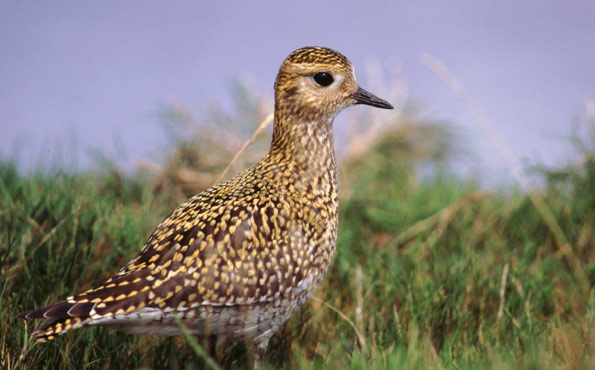
Falling temperatures on the continent will mean an influx of golden plover © Tommy Holden/BTO
A sudden freeze will see berry crops fall and waterbodies ice over, prompting cold-weather movements for thrushes (redwings, fieldfares, blackbirds, song thrushes and ring ouzel), finches (siskins, redpolls, linnets, chaffinches and bramblings), larks (skylarks and woodlarks), pigeons (woodpigeons and stock doves) and wildfowl (ducks, swans and geese).
So far this autumn with temperatures higher than normal we have seen very little of this. The daytime temperature in eastern Europe, however, is forecast to drop to near freezing this weekend, so we could see an arrival of pochard and goldeneye, along with a small arrival of Bewick's swans. [Editor's note: Slimbridge, Autumnwatch's hosts for the next four weeks, is one of the UK's best sites for Bewick's.]
Up until now there hasn't been a need for these birds to move. Check out the BirdTrack reporting rate for goldeneye.
Any cool crisp day with light winds, particularly from the east, over the next couple of weeks should prompt a big movement of woodpigeons, with flocks often tens of thousands strong heading south-west. You don't have to be on the coast to observe this migration spectacle, big flocks can be seen flying over land-locked counties too.
A sudden freeze will see blackbirds on their way © John Harding/BTO
The first waxwings of the autumn have been seen, with a flock of 20 birds being found in Stromness, Orkney, and three seen on Lewis, Outer Hebrides. It's too early to say whether it will be a waxwing winter, but with the drop in temperature on the continent this weekend we might see a few more arrive. At this time of the year waxwings generally arrive in the north and work their way south as berries become harder to find.
Flocks of lapwings and golden plovers on the move are a sure sign that the ground is frozen on the continent, so falling temperatures there could cause an influx of these winter field inhabiting waders.
Question of the week: Is it true that some birds reduce internal organs to compensate for the extra fat they carry for migration?
This is absolutely true and is illustrated perfectly in a passage from Ian Newton's excellent book, Bird Migration. Organ reduction has been found in a number of migratory species, including pied flycatchers, willow warblers and swallows. However, extreme changes were found in bar-tailed godwits killed accidentally in Alaska as they hit a radio tower, just after take-off on a presumed trans-Pacific flight of at least 10,400km to New Zealand.
These Alaskan godwits had some of the highest fat contents recorded among birds, comprising 55 percent of total body mass. They also had relatively large breast muscles and heart (exercise organs), but very small gizzard, liver, kidney and gut (digestive organs). They had largely dispensed with parts of their metabolic machinery that were not essential during flight, presumably converting them to other tissue.
On arrival at their migratory destinations, birds rebuild their digestive organs, so that they can once again feed efficiently.

Comment number 1.
At 10:04 4th Nov 2011, serryn wrote:about 12mths ago there was a news report about 1000's of birds(starlings?) falling dead at one time during their flight(Migration) in the U.K. Many reasons were given but not a definate report! Has the reason for this event been found yet and what was it?? Does anyone else remember the news story??
Complain about this comment (Comment number 1)
Comment number 2.
At 10:40 4th Nov 2011, Brenda Thompson wrote:Do Cormorants migrate? We saw over 100 of them along the water's edge by Hilbre Island, Wirral yesterday around midday. Thanks. Brenda Thompson
Complain about this comment (Comment number 2)
Comment number 3.
At 18:31 4th Nov 2011, colin wrote:Just been surprised by a flock of Fieldfares while out on my bike. They flew out of a hedgerow and into the trees on the other side of the road. Had some in the garden a couple of years a go. Really aggressive feeders. Bye the way I'm in Dundonald in Ayrshire
Complain about this comment (Comment number 3)
Comment number 4.
At 20:42 4th Nov 2011, phatbird wrote:What type of tiny bird about the size of a great tit flies in huges flocks? This morning about 6:30am I saw them but couldn't make them out. They were flying north to south across my garden in Runcorn Cheshire.
Complain about this comment (Comment number 4)
Comment number 5.
At 20:55 4th Nov 2011, rachaelfield wrote:where i walk there are wild bees living in a hole in a tree,do they partly cover the hole in winter? iknow they behave a bit like penguins do huddling together.
Complain about this comment (Comment number 5)
Comment number 6.
At 21:03 4th Nov 2011, nick rock wrote:are Red Kites re-populating the N/W of England?
Complain about this comment (Comment number 6)
Comment number 7.
At 21:06 4th Nov 2011, GerryRys wrote:Re your opening report on the geese on Islay: Love the show but anyone that has been daft (or devoted) enough to get up in the dead of night to witness a dawn sky full of geese will know that the most awesome part of the spectacle is the noise which you hear before you see anything. First you talked over it, then you played music over it, then you go back on set and Martin emphasizes the significance of said noise of which you have just deprived us! AAAaaarrrrrrgggggghhhhhh!!!!!!
Any chance of hearing the real soundtrack without all the diversions?
Keep up all the good work.
Gerry & Sandy
Complain about this comment (Comment number 7)
Comment number 8.
At 21:21 4th Nov 2011, Graham the iow batman wrote:Hi Chris have been watching swallows in Bembridge on the Isle of Wight what is the latest swallows have been known to leave england to migrate
Complain about this comment (Comment number 8)
Comment number 9.
At 21:32 4th Nov 2011, joshetland wrote:Perhaps a geography lesson required on Autumnwatch? The waxwing has been placed on the island of Shetland on your map but you said 1 has been spotted on Orkney.
Complain about this comment (Comment number 9)
Comment number 10.
At 21:41 4th Nov 2011, Robert wrote:This comment was removed because the moderators found it broke the house rules. Explain.
Complain about this comment (Comment number 10)
Comment number 11.
At 21:58 4th Nov 2011, Tricia wrote:Chris mentioned that starlings will start to migrate over from the continent shortly. We were on the Amsterdam to Newcastle ferry last night and saw small birds in their thousands passing the ship around 3 am last night, somewhere off East Anglia. Around 7 am off the north Yorkshire coast the starlings appeared, again in massive numbers, some of which hitched a ride for a while on the ferry, along with a solitary blackbird. Looks like they are on their way already!
Complain about this comment (Comment number 11)
Comment number 12.
At 10:19 5th Nov 2011, Lesley and Matthew wrote:I saw some migrating geese today! I think they where Canadian geese, flying in a double v formation (30-40 birds), honking to each other. An amazing spectacle.... My question is, where would they be heading? Are they arriving or leaving? I live in derbyshire and they seemed to be travelling SW.
Complain about this comment (Comment number 12)
Comment number 13.
At 17:37 5th Nov 2011, Cezza_B_ wrote:I had a tree full off birds in my garden last December which I had never seen before and until now did not know what they were... they were waxwings, my picture looks just like this one!
Complain about this comment (Comment number 13)
Comment number 14.
At 08:32 6th Nov 2011, squirrel712 wrote:I saw a black redstart in worthing were i live.Is this rare?
Complain about this comment (Comment number 14)
Comment number 15.
At 12:24 6th Nov 2011, chrism wrote:Question/Comment for the Chris Packham/Autumnwatch team from last Friday's program from Islay; thought you'd like to know that at 28.17 (on the I-player edition) a small wild Richardsons canada goose(a vagrant from canada/greenland)appears in close shot of barnacles whilst Michaela is talking to James of RSPB, anyone else reported this?
Complain about this comment (Comment number 15)
Comment number 16.
At 16:30 6th Nov 2011, Malcolm wrote:This afternoon I saw three bar headed geese in with a flock of Greylag in North Durham. Is it possible these are truly wild birds or may they be escapees?
Complain about this comment (Comment number 16)
Comment number 17.
At 21:06 6th Nov 2011, Sophie Lees wrote:On Friday 4th November saw our first waxwings in Petersfield, Hants
Complain about this comment (Comment number 17)
Comment number 18.
At 21:50 6th Nov 2011, katie_clowy wrote:Hello, Absolutly love the show by the way ! I live in Colchester, Essex (which is about 20miles or so from the coast). We get alot of brids in our garden, blue tits, great tits, robins, wrens to name a few. For the past few weeks there has been a new bird, I see it mostly on the ground, under the bird table and hanging feeder. It stays quite close to the edges, near the brush and flits in and out of the bushes. It is about the size of a robin and brown all over. It does not appear to have any other colouring, no markings or anything. I am quite sure that I have never seen this bird before in our garden. I am wondering if it could be a bird that has come over from elsewhere, but I never see it in a flock, or even just in a pair. It is always on its own. I have done the RSPB bird identifier a number of times to try and identify what bird it is but am still stumped. Please help as I really want to know what it is ! When I see it next I will try and take a photo, but it flys off as soon as I go outside, I always watch it through the french doors.
Thanks for any help, again, I really love the show !! Katie xx
Complain about this comment (Comment number 18)
Comment number 19.
At 19:21 7th Nov 2011, richard wrote:In the early 1950's I was a young lad living on a farm in Herefordshire, and became expert at catching rabbits for eating or selling to the local butcher. One year in particular I noticed that rabbits were being killed by something that would bite a chunk out of the back of their necks, no other marks being evident. Often while walking round the fields I would hear the squeal of a rabbit and go to where the sound came from to find a rabbit had just been killed, and had the bitten neck at the back. This seemed to happen at the bottom of tall hedges, and I sometimes would see a squirrel in the vicinity. I have often wondered what the culprit was, squirrel, stoat or weasel seemed likely. Could anybody clarify what was doing this?
Complain about this comment (Comment number 19)
Comment number 20.
At 16:48 9th Nov 2011, katie_clowy wrote:hi again !
I am quite sure the bird we have in our garden is a Dunnock. I have never seen it before though but it is a lovely little bird and i hope it will stick around ! xxx
Complain about this comment (Comment number 20)
Comment number 21.
At 21:35 9th Nov 2011, steve savage wrote:Spotted a male Gadwall on Southport marina on Sunday. After checking books it appears it's off any migration route shown.
Complain about this comment (Comment number 21)
Comment number 22.
At 10:11 10th Nov 2011, tracy wrote:up until yesterday it was possible to see a squacco heron at attenborough nature reserve in nottingham. Why is this bird so off course? what will become of it? will it get back on course or if it stays will it survive a cold winter?
Complain about this comment (Comment number 22)
Comment number 23.
At 11:04 10th Nov 2011, aly wrote:Over the past week during sunny spells I have listened to and watched a skylark singing his heart out as it flies continually up and down then plunges back to its nest on the ground from about 30 feet. On Tuesday of this week another beautiful day I stopped again to watch and listen as the sound was so loud and intrusive. This time there were four skylarks all together hovering/ flittering at about 30 feet they stayed and 'played' like that for about 10 minutes then all flew off in a south westerly direction. Were they a family or 'friends' meeting up to migrate together, they seemed so happy in each others company. We have the pleasure of lots of larks here but I have never seen them in a group before. I live in North Cornwall overlooking the Camel Estuary and Pentire Head,
in a wonderfully rich birding environment. Would be nice to see more Autumn or Springwatch reports from Cornwall other than Choughs and Owls.
Complain about this comment (Comment number 23)
Comment number 24.
At 02:44 11th Nov 2011, audiman wrote:Over the past 2days we have 3 owls ( short eared ) we think on or oil rig 120 miles SE of Aberdeen have never seen this in the Ten years i have worked off shore , have any other people heard of this before
Complain about this comment (Comment number 24)