Charlie Hamilton James: Swimming with salmon
Post categories: Autumnwatch, Autumnwatch guest presenters
 |14:19 UK time, Thursday, 13 October 2011
Guest blog post: Autumnwatch guest presenter and wildlife cameraman Charlie Hamilton James has been investigating the life of Atlantic salmon.
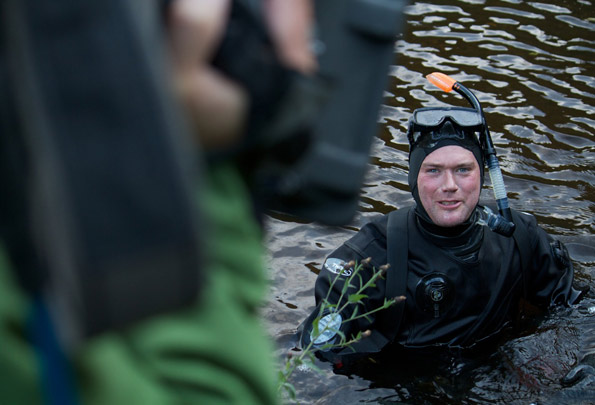
Me in a drysuit getting ready to swim with the salmon (photo: Hector Skevington-Postles)
Last year I was in Shetland swimming with otters for Autumnwatch. This year I'm slightly further south in Perthshire, filming salmon. Over the last few years I've really got into underwater camera work and photography and I have a particular passion for creatures that we rarely encounter underwater, hence the otters.
So I've been all over Britain swimming in all sorts of places: lochs with trout, chalk streams with chub, harbours with seals and now rivers with salmon. The waters up here in Perthshire are dark and freezing cold but the experience is something else.
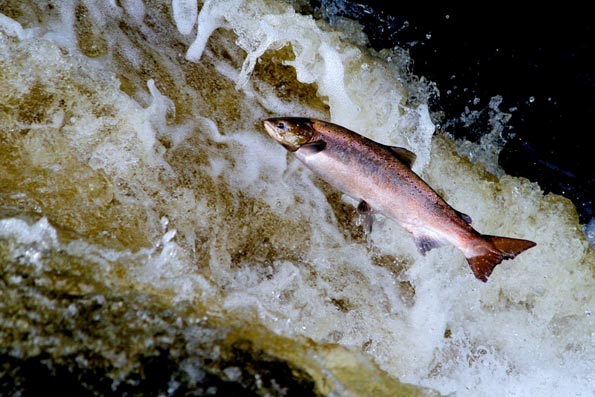
The rivers swell to allow the salmon to leap their way up them towards the head waters (photo: Ian Llewellyn)
The Autumnwatch Team and I have been investigating the life of Atlantic salmon. We started out in August, heading to Armadale in the far north of mainland Scotland. I'd never visited this area of Britain before. It's known as 'the flow country' and it's vast, remote and empty but utterly stunning.
This northern tip of Scotland is where a lot of salmon arrive on their journey back from their feeding grounds out in the North Atlantic, before they head round the coast to find the rivers where they were born. It's also one of the last areas where salmon can legally be netted in the sea.
Our mission was to go out with the netsmen to their salmon nets, have a look at their catch and find out what's happening with the salmon populations. The results were very interesting.
We met Chris Todd from St Andrews University who has been studying the salmon caught by the netsmen for years. What he's finding is also fascinating and slightly contradicts what the fishermen are finding. Chris's work is more than skin deep and although the numbers of salmon coming in are almost at record levels, it appears that they are gradually becoming thinner and shorter, a change that Chris thinks may have implications in the future with the ability of salmon to successfully breed.
Back to Perthshire. Filming salmon leaping is hard. Not just because it's a technical challenge but because weather conditions have to be perfect. It's a crucial part of our story of the salmon though and we have to get the shots. Luckily the weather is on our side - lots of rain for a couple of days and then a bit of sun.
The result of this is that the rivers swell and allow the salmon to swim and leap their way up them towards the head waters where they spawn. Cameraman Ian Llewellyn and assistant Hector Skevington-Postles had found a cracking spot to film the salmon - Buchanty Spout, a location well known to the locals as a place to watch the salmon leaping. By the time I arrived, they already had some stunning shots of salmon leaping in the bag.
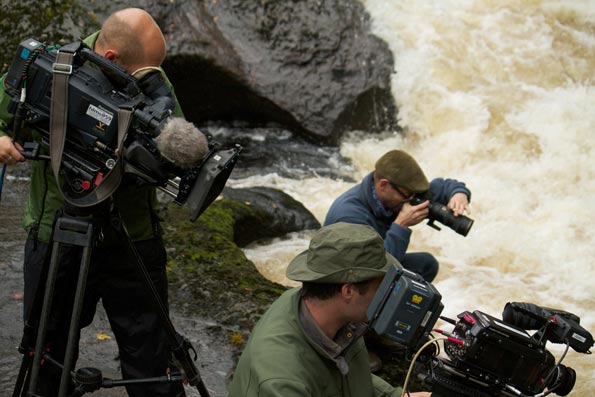
Making the most of the perfect conditions (photo: Hector Skevington-Postles)
Salmon leap high and fast and to have any chance of getting a good shot and view of one you need to use a special high-speed camera. These bits of kit are expensive and not the easiest things in the world to use. We had one for a couple of days and WOW did it pay off. Basically what the camera does is shoot a huge number of individual frames in a single second - we were shooting between one and two thousand!
This means that when we play the footage back, we can drag one second out for minutes and reveal a slow-motion world that we'd never be able to see otherwise. I was really excited about getting my hands on the slow-motion camera. I've used them a lot before for filming animals like kingfishers and cheetahs and they really are great fun.
No sooner had I got into position and framed up on the waterfall, than the salmon where leaping. It's hard working out where to point and focus but there were enough leaps that just occasionally one would be in exactly the right place and the shot would work. The best thing about these cameras though is that they have a thing called a loop.
This allows me to press the button after the fish has jumped! Work that out. Basically the camera caches a couple of seconds in its memory. It's always recording (but only the last couple of seconds), so when I hit the button, it grabs the action that's just happened and saves it.
So salmon shots looked great and we really lucked out with the weather. Within a couple of hours of turning up to film the water had dropped and the salmon had stopped leaping.
After leaping their way upriver the salmon reach their spawning grounds. It's a bit early now to spawn so a lot of them are just waiting in the river. This is where we want them and, even better, the rain has stopped for a day allowing the river to clear. The spot we choose to film is up river from the leaping spot, where the river is a little calmer.
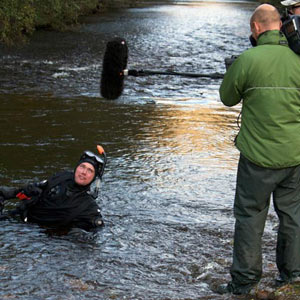
I'm no diver so I'm snorkelling (photo: Ian Llewellyn)
We park by the side of the road and kit up. I'm in a drysuit and Hector has my wetsuit (poor Hector). I'm no diver so I'm snorkelling. This is slightly less intrusive anyway and if I can hold my breath long enough should work effectively. The water is clear and peaty brown. It's cold but bearable.
The first thing I come across is a small shoal of minnows - not quite the huge shoals of salmon I was dreaming of. Then I spot small salmon smolts. These are stunning little fish, they're a kind of turquoise blue with bright red spots down their side. They seem completely unperturbed by me and swim right up to my mask.
I'm guessing the big salmon, if they're resting, will be hanging out in the slack water close to the river bank so I creep slowly up the edge. It's not long before I find my first salmon. It's not swimming though as I'd imagined, it's just resting, almost asleep on the river bed, tucked in next to a rock. It allows me to get really close and swim all around it filming.
It's a gorgeous fish, large, long and sleek, but marked on the nose with a white scar; probably the result of a smashing into rocks while leaping up the waterfalls. Further up river more salmon appear and disappear out of the gloom but none are coming close.
We meet a guy called Paul who's out fishing with his mate, Bob. Paul tells us of a spot not far from where we are where the salmon congregate. Paul clearly knows what he's talking about so we take his advice and head upriver a little way to a nice deep looking pool.
At first we see nothing but as we swim further up the pool we see, one, then two, then suddenly a whole shoal of big salmon. They're slightly nervous of me but don't just swim off straight away, instead they hang around to check me out. I'm so chuffed, it's an incredible experience to swim with these huge fish and something I've always wanted to do.
There are probably around 15 of them, some huge, some grilse (one year old fish). All of them are brown, not silver, which means they've probably been in the river since the spring, waiting for this moment to get up river to spawn. The fish disperse after a while but not before we get some really nice footage and grab a little time to enjoy these stunning creatures.
Watch Charlie follow the epic journey of the salmon, from the sea to their spawning grounds on Autumnwatch, at 8.30pm Friday 14 October.

Comment number 1.
At 19:38 14th Oct 2011, edukate wrote:Can't wait to see your footage Charlie!
Complain about this comment (Comment number 1)
Comment number 2.
At 20:51 14th Oct 2011, LazyRizzo wrote:looking great so far Charlie, so fascinating to see this footage!
Complain about this comment (Comment number 2)
Comment number 3.
At 20:58 14th Oct 2011, Rural Essex Girl wrote:Would the sound be a Brambling? Or maybe a Starling in night roost mode?
Complain about this comment (Comment number 3)
Comment number 4.
At 21:44 14th Oct 2011, Neil Turner wrote:I think that the immature salmon Charlie saw was a salmon parr, not a smolt - parr can be identified by the 'finger print' marks on their sides, while smolts take on a silvery colour in spring when they are ready for migrating down to the sea.
What great shots of the salmon leaping - I normally see them at this time of year at the large weir on the River Kent in the middle of Kendal.
Complain about this comment (Comment number 4)
Comment number 5.
At 17:46 15th Oct 2011, maggee johnson wrote:Having watched the salmon "jumping" at Falls of Feugh, Banchory, and in 45 mins not one managed to achieve their goal. What happens to them when they just can not jump up to the next level?
Complain about this comment (Comment number 5)
Comment number 6.
At 18:20 15th Oct 2011, signonymous wrote:Was that a DSLR Charlie was filming underwater with?
Complain about this comment (Comment number 6)
Comment number 7.
At 18:09 16th Oct 2011, LouiseHarrison wrote:Hello,
i was watching autumn watch and they said that on friday they will be looking at rockpools and stuff so i thought i'd send in to photos of the starfish i found in a rock pool, hopefully the moderator could pass these photos along to the show as i cant seem to find out how.
https://imageshack.us/photo/my-images/824/p1013295.jpg/
https://imageshack.us/photo/my-images/853/p1013298.jpg/
Louise Harrison
South Tyneside
Photo taken at Marsden Bay
Complain about this comment (Comment number 7)
Comment number 8.
At 20:30 17th Oct 2011, salmo111 wrote:Really good to see a networked programme featuring an article from my home area i.e. Buchanty Spout near the Sma' Glen, Perthshire.
Charlie mistook a salmon parrr and called it a smolt (parr only turn into smolts in April/May not mid-October).
Also on Blog above refers to a grilse as one year old, this is inaccurate because before even going to sea the smolt will be 2/3 years old, but if it returns to river within one year of leaving it will be a grilse (3/4 years old).
Complain about this comment (Comment number 8)
Comment number 9.
At 17:38 20th Oct 2011, granybarbara wrote:Saw three Whooper swans at Rother Valley Country Park near Sheffield on our walk there today.
Complain about this comment (Comment number 9)