Autumnwatch Unsprung round up
Post categories: Autumnwatch Unsprung, Behind the scenes, Flickr favourites
 |17:33 UK time, Monday, 24 October 2011
I hope you've been enjoying Unsprung. In case you missed it, you can watch last week's Autumnwatch Unsprung on BBC iPlayer.
I wanted to take this opportunity round up some of the best bits from last week's show. First up, here's what the team have been calling the 'Lush Montage' of our favourites from the Autumnwatch Photo group so far:
In order to see this content you need to have both Javascript enabled and Flash installed. Visit BBC Webwise for full instructions. If you’re reading via RSS, you’ll need to visit the blog to access this content.
You might also have noticed that we answered a question about corvids on this week's show. Mushy asked us on the blog to help him identify the differences between crows, rooks, ravens and jackdaws. So if you were too distracted watching Brann the raven destroying our studio here's a quick guide...
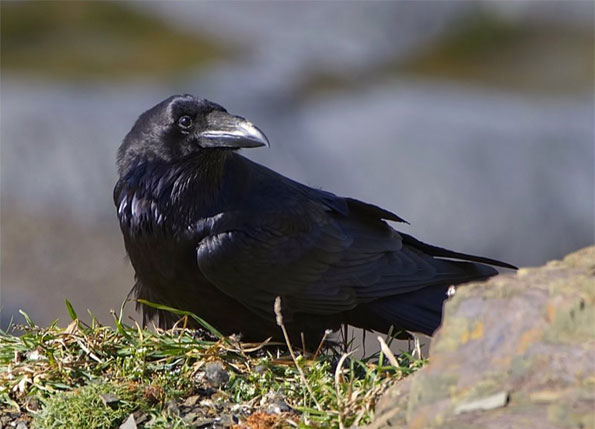
The raven, all black with a large and strong bill and long wings, is the largest member of the corvid family.
It can be found, usually alone or in pairs, around the western parts of the UK, inhabiting cliffy, rocky habitats mostly along coastlines.
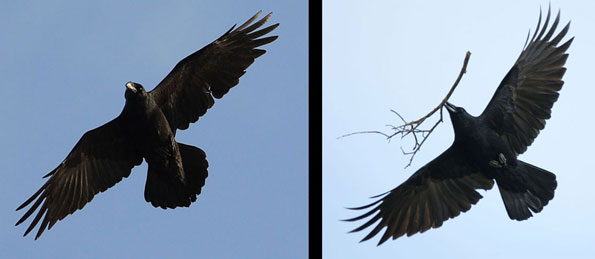
It's pretty hard to tell a raven from a crow at a distance as they are similar apart from their size. But they do have distinctive tail shapes if you spot them in flight: the raven's is diamond-shaped tail where the crow's tail is rounded.
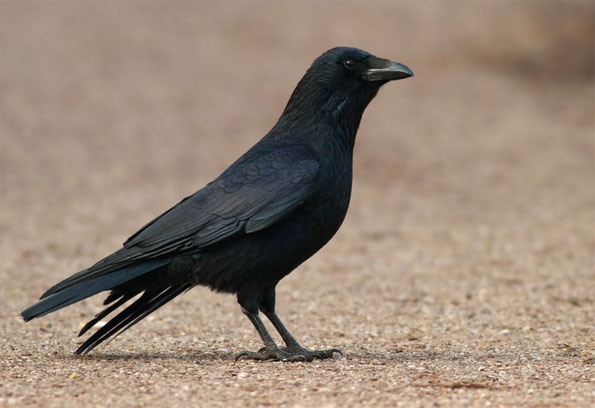
The crow is similarly all black but significantly smaller than a raven. Crows are also fairly solitary, being found alone or in pairs. Unlike ravens you can spot a crow almost everywhere, from city centres to parks and gardens and in upland moorlands, woodlands and sea shores.
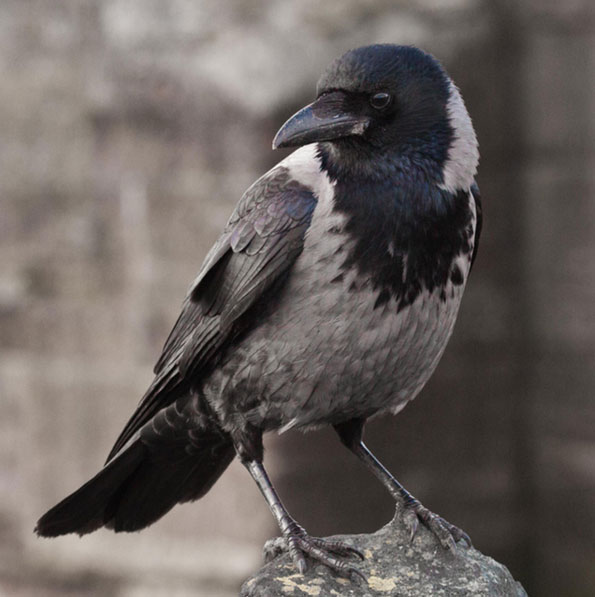
Those of you in northern Scotland, Northern Ireland and parts of Wales will be more familiar with hooded crows. These are a bit more sociable than the closely related carrion crows and have a distinctive mix of grey and black feathers. In particular they have a black head and throat that gives them their name. We get some visiting hooded crows from Scandinavia in the winter.
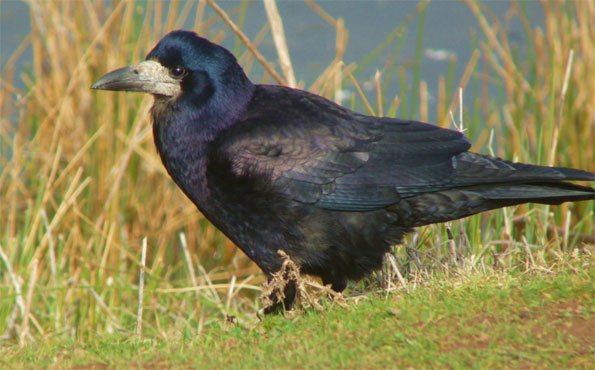
As Martin said on the show, if you see lots of crows together, they're probably rooks and if you see a rook alone it's probably a crow.
Rooks are rarely seen alone and particularly at this time of year will be gathering in large groups in tree top rookeries making a cacophony of noise as they roost. They can also be seen mixing with jackdaws. Look out for them in field hedgerows and along roadsides.
Up close it's easier to distinguish rooks from the other corvids by their bare greyish white faces. They also have a thinned beak, a peaked head and a more iridescent purpley sheen to their feathers.
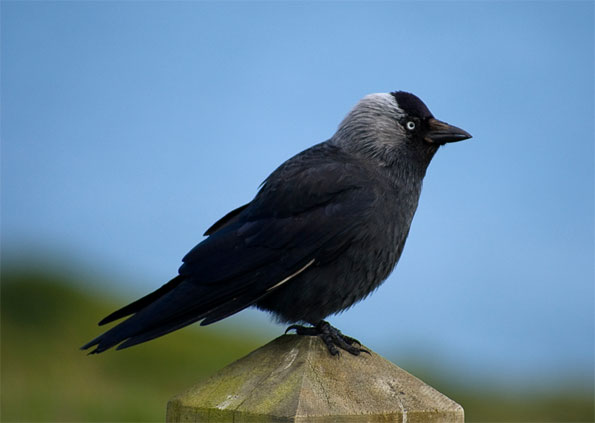
Jackdaws are also more easily identified close up. They have lighter silvery-grey heads with a dark black forehead and bright pale eyes.
They're generally seen in flocks and will join up in mixed rook and crow roosts in the autumn and winter. They're also seen almost everywhere; around fields and in woods, parks and gardens.
Hope this helps you identify corvids. Of course there are other members of the corvid family in the UK, including magpies and jays and the red-billed chough which featured in last week's Unsprung Quiz.
If you've got any questions for next week's Unsprung let us know by commenting below. And as Chris said, we'd love to see any pictures of black-billed blackbirds: just add them to the Autumnwatch photo group.

Comment number 1.
At 15:11 25th Oct 2011, Julia wrote:Great shots of the birds here. At least I can now tell the difference between a rook and a crow...was never sure before. Thank you for putting this up. Have now also 'liked' the Facebook page, so I can catch up with the latest :).
Julia x
Complain about this comment (Comment number 1)
Comment number 2.
At 15:33 25th Oct 2011, Riitta wrote:We live in the Highlands and we have both rooks and hooded crows. They live in separate communities, but some time ago I saw a rook with hooded crow's grey plumage with the other black rooks. They were all the same size (hooded crows are usually smaller). Could it be that a rook mated with a hooded crow or is this just an oddity?
Complain about this comment (Comment number 2)
Comment number 3.
At 16:32 25th Oct 2011, Tineke1963 wrote:Strange.........just saw a Robin on my garden table, I am pretty sure, but it was completely brown/grey. There where no spots on its chest, and it looked very much like an adult. Maybe a juvenile which orange chests is in the making?? Can somebody give me the right answer?
I am sure it was a Robin, without a doubt.
Complain about this comment (Comment number 3)
Comment number 4.
At 20:21 26th Oct 2011, Barbara wrote:This morning in my garden I saw what I thought was a chaffinch by my feeder. It had white at the end of it's tail, about an inch or so and white legs and feet. I've not seen anything like this before, can you tell me anything about this please. I did take some photo's but they are not of good quality but I will send them to you if needed.
Complain about this comment (Comment number 4)
Comment number 5.
At 00:22 28th Oct 2011, serryn wrote:Wow was I bored Monday (Oct 24th) from 5pm till 11pm I miss my badgerfriends on badgercam!! I hope you have plans for more webcam during the months Autumn, Winter, Spring and Summerwatch is not on our screens??? Fantastic show well done producers and staff connected with the programme, thank you for all your dedication/vocation. Will there be Big cat Diairy comming back soon too??
Complain about this comment (Comment number 5)
Comment number 6.
At 14:44 28th Oct 2011, Mushy wrote:Corvid Conundrum Clarified. BIG THANK YOU
Brann was brilliant and also beautiful.
ickle note to Gavin..Mushy is female..AKA Michelle ;-) X
Complain about this comment (Comment number 6)
Comment number 7.
At 17:06 28th Oct 2011, philh4955 wrote:Are sparrow hawks known to swoop at humans when gardening? Last week my wife was pruning shrubs at front of our bungalow in Gloucestershire when, what we are sure was a sparrow hawk flew close to her and landed on the fence nearby (about 8m away) It sat on the fence for for a minute or so eyeing her up before deciding she was too large for tea! Have been gardening for many years but not experienced anything like it before - quite amazing!
Complain about this comment (Comment number 7)
Comment number 8.
At 21:56 28th Oct 2011, Amanda Barry wrote:We rescued an injured young barn owl the other day and took it to a vet in Seaton, Devon, they called the RSPCA
Complain about this comment (Comment number 8)
Comment number 9.
At 22:27 28th Oct 2011, Wendy RedredRobin wrote:I've had a Sparrowhawk swoop & land near me & felt it had been targeting a garden bird & just happened to land close by as I was quietly pottering.
The poo quiz on unsprung tonight Chris had what looked like the dried remains of TOAD POO in that little glass bottle. I have a fair few toads in the garden & often find their poo on the patio. When it dries out it does contain lots of insect remains.
Complain about this comment (Comment number 9)
Comment number 10.
At 15:04 29th Oct 2011, aggie wrote:Unfortunately, we disturbed a mouse in our garden store area this morning. He (or she) had made a fabulous three tier home out of plastic seed trays, plastic plant pots and shredded bags. He had shoved chewed up plastic bags into a small pot which was under a seed tray. We feel really guilty now and wondered how we could make it up to him. We've kept some of his bedding he had and think we may use an old bird house and a long planter to try to create something outside thats safe from cats. Dont want to encourage him back into the garden store as he may get shut in one day and not be able to go out for food. There was no sign of a food store. What can we do?
Complain about this comment (Comment number 10)
Comment number 11.
At 16:56 29th Oct 2011, davmcn wrote:Autumnwatch was less silly this week and more questions were answered. Keep it up.
We feed squirrels (yes, grey) peanuts in the shell and a blue tit picked one up and flew off with it. Quite a load for such a small bird.
Complain about this comment (Comment number 11)
Comment number 12.
At 16:43 30th Oct 2011, Mike wrote:Maybe Chris Packham is being simplistic in rejecting "pleasure" as a motivation for behaviour. Since we are sure that animals don't really have propagating their species as a direct motivation they have to depend on instinctive behaviour. Maybe immediate feedback from pleasure centres in their brains helps to reinforce productive behaviour. That way the creatures do not need a critical faculty to help them to continue to do the Right Thing. Mike.
Complain about this comment (Comment number 12)
Comment number 13.
At 13:17 31st Oct 2011, Jane Hicks wrote:Just returned from the Algarve. Saw a pair of osprey on 29th October on a trip up the River Arade near Silves. One had a fish in claws. Would it have been migrating? If so where?
Complain about this comment (Comment number 13)
Comment number 14.
At 16:37 1st Nov 2011, davmcn wrote:aggie 10 I turned over the bottom half of an old plastic child's sand box and found a similar mouse house made from pine branches, paper, shredded plastic, and anything else it could find. Fortunately, the resident was out.
Complain about this comment (Comment number 14)
Comment number 15.
At 21:42 2nd Nov 2011, turnerp6 wrote:On 1st November whilst watching TIGERS at Doncaster Wildlife Park, saw an osprey flying over the wetlands adjacent to the park. Is it too late for this bird to migrate to Africa now and is it the mild weather keeping it here? Steve
Complain about this comment (Comment number 15)
Comment number 16.
At 21:30 11th Nov 2011, Nomester wrote:Hi unsprung, I was recently up at Symonds Yat and a beautiful raven flew overhead at the look out point, as it flew over us it folded its wings in and turned upside down, calling. Its did this a couple of times but I wasn't quick enough to film it unfortunately. Was it showing off or was it trying to intimidate us? look forward to hearing your opinion, Naomi.
Complain about this comment (Comment number 16)
Comment number 17.
At 21:52 11th Nov 2011, willieg66 wrote:Hello Autumn watch and other viewers, Is it correct if you see a hedgehog on the park E.T.C do you leave it were it its??
Complain about this comment (Comment number 17)
Comment number 18.
At 21:56 11th Nov 2011, willieg66 wrote:What is the fastest animal in the world? I have heard it is a type of falcon but I don't know what the actual bird is?
Complain about this comment (Comment number 18)
Comment number 19.
At 17:58 12th Nov 2011, Snoki wrote:Hi, not sure if this is the right place to ask this, but I am sure this could be of interest to many others:
I know I have many mamals using my garden at night, some even glimpsed during the day: badgers; hedgehogs; foxes included.
But these are, I understand, most active when too dark to really see them. So what is the best 'night vision' sytem?
Flash photography, is a possibility using proximity/beam break but will the 'flashes' disturb them?
Active Infra-red seems to be least costly 'vision' system, but, again, can IR be seen by these critters and so disturb them?
Passive heat sensing alone seems to give a poor image.
Passive image intensifying looks interesting, if costly.
And combined heat sensing/image intensifying looks to be most expensive, but cannot disturb beasts being viewed.
Any comment/suggestion on this would be much appreciated, particularly as I see that your photographers make use of all of these systems.
Thanks in advance,
Luapsnoki.
Complain about this comment (Comment number 19)
Comment number 20.
At 19:01 15th Nov 2011, tonyhal wrote:on a recent walk I saw what looked like a young Goshawk with a woodpigeon under its claws in a farmers field. For 10 minutes I watched as the Goshawk pecked away at the pigeon ripping feathers and flesh off. I tried to get closer for a better view and as I did the Goshawk tried to fly off with its prey but couldnt get off the ground. After trying a few times the Goshawk decided to leave the pigeon on the ground and flew off to a nearby copse. To my surprise the pigeon ( which I was sure was dead) jumped up and despite having a clearly broken wing it began to walk towards the tree line for cover. This got me wondering how long it would have taken the young raptor to actually kill its prey?
Complain about this comment (Comment number 20)
Comment number 21.
At 18:05 17th Nov 2011, sy6owl wrote:I live in South Shropshire and we've had a common wasp nest in the roof space of our front porch which we've not disturbed as they haven't caused us any problems. Judging by the continuing comings and goings of a few remaining individuals the nest appears to be still active. I found a large wasp in our upstairs bedroom today (very sunny and even warm) which I helped to usher out of the window. I'm pretty certain it was a wasp queen. It seems very late in the autumn for a wasp nest to be still active and for a queen to be flying - is this typical? Could it be due to the relatively mild autumn we've had I wonder?
Complain about this comment (Comment number 21)
Comment number 22.
At 16:01 18th Nov 2011, Samantha wrote:Hello, I was watching Atumnwatch and I was wondering why some species migrate at all, normally we have mild winters, so species like osprays should be able to access water throughout the winter. I then noticed that the area of Africa they migrate to is close to were the Tethys Sea once was (this was were the sahara desert is now). I believe this sea was very productive. Could the Osprays have started going there when the Tethys did exist, and when it closed and dried up just continued, but changed the place they stop.
Complain about this comment (Comment number 22)
Comment number 23.
At 16:11 18th Nov 2011, Samantha wrote:I also wanted to mention that Iolo was not correct, the Fin whale is not the second largest animal ever. Several types of dinosaur were longer, and some marine reptiles were heavier. It may be the second largest animal alive now, but not ever.
Complain about this comment (Comment number 23)
Comment number 24.
At 23:07 18th Nov 2011, eiley-boo wrote:Hi Unsprung, we have a small Lilac tree in our garden on the Sussex coast that has produced some flower blossoms during the past couple of weeks. Is this exceptionally unusual in the autumn, and have any other viewers had similar trees come back into blossom?
Complain about this comment (Comment number 24)
Comment number 25.
At 14:37 19th Nov 2011, colleen wrote:Can anyone advise on a pair of binoculars for a beginner bird watcher, Iv been glued to Autumn watch and cant wait to get out and start, but iv read lots of conflicting info on what i need. can anyone help, thanks Colleen
Complain about this comment (Comment number 25)
Comment number 26.
At 16:40 19th Nov 2011, davmcn wrote:Samantha 23 I wondered about dinosaurs when he said it.
Complain about this comment (Comment number 26)
Comment number 27.
At 23:42 20th Nov 2011, DonF65 wrote:In all the animal programs I have watched I have never heared any mention of NOT feeding birds especialy swans, ducks, etc, with bread, as this can cause 'Anglewing'.This deformaty is incurable, & prevents the bird from flying. For more information on this Google Angelwing.
Complain about this comment (Comment number 27)
Comment number 28.
At 10:42 25th Nov 2011, Jennifer Ide wrote:I still have an active wasps' nest in my loft. In the past three weeks I have found six living wasp's larvae in my bathroom, in five cases the larvae were in close proximity, an inch or so, from a dead wasp. What is happening? Are the larvae being cleared out by the wasps in preparation for abandoning the nest and why should the wasp be dead, or is their proximity just a coincidence? Is the mild weather responsible for the nest still being active?
Complain about this comment (Comment number 28)
Comment number 29.
At 21:39 25th Nov 2011, carol wrote:we heard a fox calling yesterday we thought it was a dog until we saw your program tonight, when we moved here in july we had a vixen and her cub in our back garden we had to block up the fence as we have two dogs, but we have still seen the vixen jump the fence to get into the garden we live in on the edge of a park in BISHOPS STORTFORD HERTFORDSHIRE
Complain about this comment (Comment number 29)
Comment number 30.
At 18:54 30th Nov 2011, gerimccue wrote:Recently on Autumnwatch you were discussing Snowy owls. Twenty six years ago when my daughter was 4 years. She woke me very early one morning around 4 am telling me there was an angel at the window. I took her straight back to bed thinking she'd had a dream. However, when I looked out the window there was a Snowy owl on the gate post beating its wings, making quite a powerful noise. Not sure how unusual that is. We live near Glasgow. Needless to say we've never forgotten this and never seen anything like it since.
Complain about this comment (Comment number 30)