Autumn bird migration news: Out of Iceland
Post categories: Migration news
 |17:48 UK time, Thursday, 6 October 2011
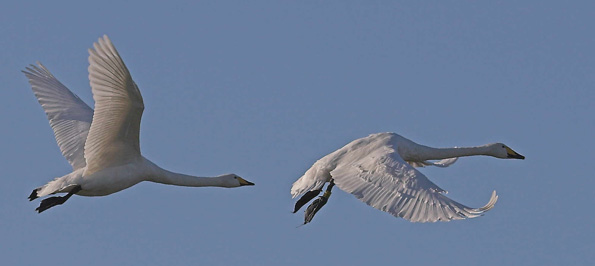
Whooper swans were part of the exodus from the north this week © Jill Pakenham
As we were basking in summer-like sunshine, winter arrived in Greenland and Iceland, where heavy snow and freezing temperatures were very much the order of the day. This was the trigger for Greenland wheatears to leave there. Monday saw a large wave of these birds pass through the UK, with at least 250 birds were counted at Spurn Point alone.
This peak is also reflected in the BirdTrack national reporting rate. It's amazing to think that some of these birds breed in western Alaska and still migrate to Africa for the winter, crossing Greenland, Iceland and the western edge of Europe on the way. Around the size of a robin, they will fly 10,000km (6,000 miles) before they reach sub-Saharan Africa.
Goldfinch numbers are beginning to build, with flocks in the low hundreds on the move, however, siskins and linnets are still dominating the finch movements. 1,350 linnets were counted heading east over Hengistbury Head, Dorset on Wednesday morning. Redpolls are beginning to get in on the act too. At present most of these seem to be lesser redpolls, at least with birds that have been trapped for ringing.
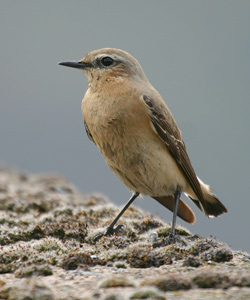
Wheatears: on the move from Iceland and Greenland © www.grayimages.co.uk
Birds also exiting the north included whooper swans, geese (mainly greylag, pink-footed and brent, with smaller numbers of white-fronted and barnacle) and dabbling ducks such as wigeon and teal.
Most swallows have already made their final big move south and reports of this species have already dropped dramatically. House martins normally leave a little later than swallows and they've certainly been seen in larger numbers this week.
So what can we expect over the weekend?
Leading into the weekend the winds will turn north-westerly and for a while come straight out of Greenland and Iceland, providing ideal conditions for swans, ducks and geese to leave, so we should see a significant arrival of whooper swans, greylag, pink-footed, barnacle and pale-bellied brent geese and wigeon and teal. We could also see the first big arrival of Icelandic redwings.
Question of the week: Why are some migrants very tame?
Every year there are stories of migrants like goldcrests that seem unusually confiding when encountered at coastal sites. From time to time much rarer migrants hit the headlines because of their tameness.
Famous examples from the 1980s included both baillon's and little crakes (in Sunderland and Sussex respectively) and an upland sandpiper on the Scillies, and more recently, a steppe grey shrike in Lincolnshire in 2008. All these birds were watched at extremely close range; the upland sandpiper was even seen to take a worm from a birdwatcher's mouth!
Sheer exhaustion is likely to be one of the reasons that can make migrants particularly tame. Birds use a huge proportion of their energy reserves when migrating. Hence their number one priority on making landfall is to find food, even if that means being less wary of predators. When humans provide food, tired migrants will often take advantage of the free meal much quicker than they would under normal circumstances.
Many vagrant birds that reach our shores come from places with low human population density and the fact that such species therefore don't associate humans with danger is another reason often given for tame behaviour. Finally, birds that have been disorientated by bad weather and attracted to lighthouses or lights on ships may be slightly dazed; this could also account for tameness.
Have you noticed any birds leaving yet? Anything unusual or surprising? As always, we'd love to hear, so post a comment below.

Comment number 1.
At 21:22 6th Oct 2011, lyncat wrote:I found two Wheatears in a field here in Angus Scotland would that be the ones from Greenland? I have never seen one before what a lovely wee bird
Complain about this comment (Comment number 1)
Comment number 2.
At 11:13 7th Oct 2011, BirdTrack Organiser wrote:That's certainly a possibility, lyncat. However, Greenland Wheatears are notoriously difficult to separate from 'standard' Wheatears in the field and are usually only safely identified on biometrics (taken in the hand whilst the bird is being ringed). More than 40 of the 250 Wheatears at Spurn were trapped and ringed; all of them had measurements that fitted with the Greenland race.
Complain about this comment (Comment number 2)
Comment number 3.
At 16:48 7th Oct 2011, galanthophile wrote:I think I might have seen one on the beach on the north east coast, it was very pale like the one pictured. Even a normal wheatear is nice to see!
Complain about this comment (Comment number 3)
Comment number 4.
At 21:41 7th Oct 2011, Gill Osborne wrote:Swallows and House Martins were still here in Alnwick, Northumberland on Thursday 6th October but seem to have virtually disappeared overnight! On the plus side, nine whooper swans were on the River Coquet at Amble, Northumberland, today, 7th October.
Complain about this comment (Comment number 4)
Comment number 5.
At 22:11 7th Oct 2011, hatchard2 wrote:We left Carnoustie this morning ( 7 October) having watched geese flying in formation over the last 3 days. they have been following the coast down from Montrose and during our journey this morning downpast the forth of tay we could still see flocks following the estuary. We lost sight of them once we were futher inland at Stirling.
Where are they likely to be flying to and will they break their journey or continue to fly overnight?
Complain about this comment (Comment number 5)
Comment number 6.
At 23:08 7th Oct 2011, Raptor_man wrote:At Caerlaverock Wetland Centre near me on the Solway Firth in SW Scotland, there are already some Whooper Swans. There are also approx 500 Barnacle Geese from Spitsbergen. For October this is a low number of Geese, normally there should be a few thousand by now. I have been told that the high winds we have experienced of the north coast of Scotland over the past couple of weeks are delaying the Barnacle Geese migration. As soon as the winds allow, the Geese will arrive in their thousands.
Complain about this comment (Comment number 6)
Comment number 7.
At 11:39 8th Oct 2011, annie wrote:We saw a wheatear at the St. Mary's airport Isles of Scilly on 1st October while waiting for the fog to lift.
Complain about this comment (Comment number 7)
Comment number 8.
At 12:13 8th Oct 2011, Peter Cumings wrote:Whilst out walking with the dogs at Leasowe Bay, North Wirral Coastal Park, yesterday and again this morning, 8th October 10.30am, I spotted a bird that aroused my curiosity. After searching the web to identify it...I am confident that the bird is a Northern Wheatear.
Complain about this comment (Comment number 8)
Comment number 9.
At 18:07 8th Oct 2011, claire j wrote:for the last 3 years i have had a wagtail come to my garden to feed on live mealworms. he is so tame i feed him out of my hand and he follows me round the garden like a dog or he comes into the house to get my attention.he arrives in march or april and migrates in september or october, this year he left on 26 september so im keeping my fingers crossed he survives the winter and i see him again next year
Complain about this comment (Comment number 9)
Comment number 10.
At 19:48 8th Oct 2011, T68teen3 wrote:Whilst up in the Highlands of Scotland on holiday, we saw Whooper Swans at Nairn on the 4th October and we saw 7 Whooper Swans at Loch Morlich on the 7th October. Later on in the day we saw about 7 Whooper Swans at RSPB Insh Marches (maybe the same ones?) Female Hen Harrier seen patrolling the reserve and apparently made a failed attempt at catching dinner!
Complain about this comment (Comment number 10)
Comment number 11.
At 17:18 9th Oct 2011, samjam wrote:I visited Margam Park on Sunday 9th October 2011 and saw some swallows. But I thought they had all migrated down to Africa.
Complain about this comment (Comment number 11)
Comment number 12.
At 18:50 10th Oct 2011, RyanMottram wrote:Saw lots of starling getting into large Groups outside my window in Cheshire Middlewich , Also saw 3 Tawny owls in the day light in the countryside, Not seen the hedgehog running around my garden for a few nights.
Complain about this comment (Comment number 12)
Comment number 13.
At 09:34 14th Oct 2011, dianejameson wrote:saw a number of flying Whooper swans on western shores of Lough Neagh on Monday 10th Oct. Maybe just passing through as that was the only sighting?
Complain about this comment (Comment number 13)
Comment number 14.
At 01:07 26th Oct 2011, Nicky wrote:Was in my garden today (Sale, Cheshire) When I saw a number of geese flying over ahead. I actually heard them before I saw them, I think there must of been around 5000 at least. It was quite eerie to be honest. I watched for around 10 minutes. Not sure if they were arriving or leaving. It was spectacular to watch. Wish I had filmed it.
Complain about this comment (Comment number 14)