Unsprung need more wildlife questions, stories, photos and objects
Post categories: Springwatch, Springwatch Unsprung
 |14:29 UK time, Friday, 3 June 2011
With one Springwatch Unsprung down and two left to go the team are still keen to get more of your fantastic stories, questions and images ready for the next show.
Here's a personal message from The Unsprung team.
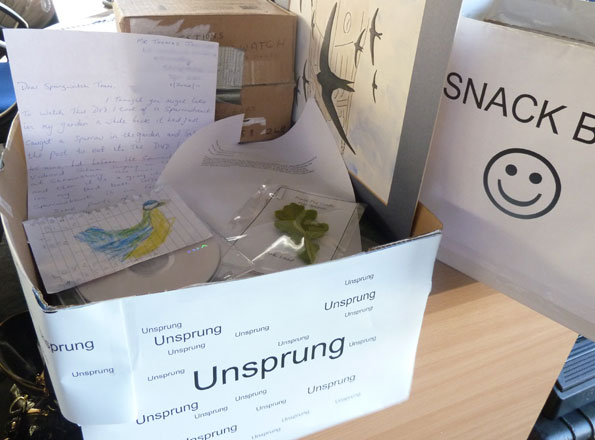
The Unsprung inbox is precariously close to another very important box in the office.
We definitely don't want the contents mixing!
Hi everyone,
We are LOVING the energy and excitement with which you’ve been sending in your letters, comments, ideas, objects, poo, bones, feathers and things!
We’ve got so many ideas flying around that we can barely move for Martin’s notes covering our desks; Level-headed Joe’s working flat out to keep them in order.
But the thing is, we want more! More questions, more stories, more mail that we have to lather ourselves in antibacterial handwash after opening!
You can send us your questions and stories for Unsprung by commenting below on this blog post, add your photos to the Photo group and here is an address for "things": BBC Springwatch, Broadcasting House, Whiteladies Road, Bristol BS8 2LR.
If you missed last week's Unsprung, you can watch it again on iPlayer.
Update 7 June: how to tell the difference between a bee and a wasp, when is it too late for a wren to lay eggs, and how to make your cat wildlife-friendly... Find the answers to these and more here.

Page 1 of 12
Comment number 1.
At 17:18 3rd Jun 2011, grisdale wrote:Hi team, a while ago my mother in law gave myself and my wife a smoothie maker which was an unwanted gift to her. We used it a few times and got fed up with smoothies, we have always fed garden birds and i decided to see if the smoothie maker would chop bread, and it did does it chop peanuts YES. My mixture contains now "for each use of the smoothie maker" any more is too much for the motor, two slices of wholemeal bread, small handful of peanuts, small handful of dried mixed fruit. This mix i do about four times and usually lasts about one hour. But since i saw the springwatch baby owls dehydrated i have started to dice pears up into one centimetre squares and mix them with my mixture, these squares of pear covered in bread and nut crumbs are taken by the food gathering parents back to the nests still holding the moisture that is so needed when it is warm and dry. it also works if cubed pear is put on the bird table as more juice gets back to the nest. thanks for reading Allan
Complain about this comment (Comment number 1)
Comment number 2.
At 18:07 3rd Jun 2011, knitter18 wrote:Hello Martin and everyone on the Springwatch Team. Martin - where have all the Greenfinches gone. I havent seen any in my garden since last year. There was some illness killing off our Finches was'nt there - but have they recovered from this.
Complain about this comment (Comment number 2)
Comment number 3.
At 18:19 3rd Jun 2011, Ian wrote:we have enjoyed pipistrelle bats flying round our house every spring and summer evening since we moved here over 20 years ago. It got me wondering how long pipistrelles live for and do they tend to be territorial, in other words are the ones this year likely to be the same as were around our house last year etc?
Complain about this comment (Comment number 3)
Comment number 4.
At 18:31 3rd Jun 2011, Ben Aldous wrote:When we were gardening we found some very strange worm like creatures.
They were about 3cm long had an orange face and legs, it was white and the rearend of it was black, what on earth was it.
Complain about this comment (Comment number 4)
Comment number 5.
At 18:35 3rd Jun 2011, Ben Aldous wrote:I have got a couple of pictures of the worm things but I dont know how to show u can u help??
Complain about this comment (Comment number 5)
Comment number 6.
At 18:48 3rd Jun 2011, rachel wrote:I had a hummingbird hawkmoth in my garden yesterday and I live in Grimsby. Can it normally be found this far north? The book I have says they favour the south unless there is an invasion...
Complain about this comment (Comment number 6)
Comment number 7.
At 19:19 3rd Jun 2011, Jackie wrote:To the unsprung team love the shows, can you solve a mystery for me when I am out walking the dog or just in the garden or basically anywhere I hear this bird noise that sounds like a high pitch whistle which I have not heard around before, it is one tone and seems to be a very common noise at the moment, can you name that bird for me please. Jax xx West Sussex
Complain about this comment (Comment number 7)
Comment number 8.
At 19:20 3rd Jun 2011, AliTurner wrote:Hi there, we have rescued a baby song thrush (I think) although possible black bird from my cat who was licking its lips, whilst the little guy was chirping for its parents having been shaken from a tree by visiting children the day before (no idea about country wildlife!). We had been watching for parents for hours but not seen any movement and with the cat in hot persuit we decided to take action and give it a new safe home on my balcolny. My daughter (age 14) is a big animal carer and took control with the feeding. He is now a beautiful fledgling who is convinced she is mum! He will happily be fed by her a me when she is absent. How do we teach him to fend for himself? He seems to be coping very well. he is now flying to the trees close by and more worryingly down to the ground to find us to feed him. He will happily land on my daughters shoulder squarking to be fed. I have now found him drinking from a saucer of water and pecking at the ground happily. Does this mean that his natural bird tendancies will take over? The last couple of nights he has slept in the trees but squarks for breakfast. I will try to get a picture of him so that you may be able identify him. Must dash need to check if the latest family member has been fed! Again!!
Complain about this comment (Comment number 8)
Comment number 9.
At 20:13 3rd Jun 2011, Chrissie C wrote:Hi Team,where have the linnets gone? I have had these beautiful birds come back to this garden to nest for as long as i have lived here -14 years and as the cottage was built approx 1850,so probably a lot longer than this! they usually appear in mid May and hear the cock singing for his mate.I have farmland around and the crops change each year,so dont think it is this,do they migrate?if not perhaps it was the harsh winter we had?
Complain about this comment (Comment number 9)
Comment number 10.
At 20:26 3rd Jun 2011, Feefan wrote:A couple of days ago we discovered 4 dead baby swallows on the ground of our shed.The strange thing was they were scattered around the ground and were quite far from the nest so it didnt seem like they could have simply fallen out.They certainly weren't big enough to have fledged.Also the nest was completely intact so didnt look like it had been attacked.It really upset us to find this scene as we adore our swallows and they bring such joy to us every year.Can you shed any light as to what might have happened here as we cannot figure it out?
Complain about this comment (Comment number 10)
Comment number 11.
At 20:34 3rd Jun 2011, Feefan wrote:couple of days ago we discovered 4 dead baby swallows on the ground of our shed.The strange thing was they were scattered around the ground and were quite far from the nest so it didnt seem like they could have simply fallen out.They certainly weren't big enough to have fledged.Also the nest was completely intact so didnt look like it had been attacked.It really upset us to find this scene as we adore our swallows and they bring such joy to us every year.Can you shed any light as to what might have happened here as we cannot figure it out
Complain about this comment (Comment number 11)
Comment number 12.
At 20:41 3rd Jun 2011, AlexC365 wrote:Hi, I saw 2 stag beetles for the first time flying in my Grandparents' garden on Wednesday evening. The next morning, sadly the female had been eaten, but the male was walking along the ground. Later that day the male was also eaten. I have a photo which I am adding to the Photo Group.
Complain about this comment (Comment number 12)
Comment number 13.
At 20:43 3rd Jun 2011, cal26 wrote:Dear Springwatch Team,
can you tell me the difference between swallows and swifts and house martins in flight???
Complain about this comment (Comment number 13)
Comment number 14.
At 20:45 3rd Jun 2011, clongmoor wrote:Hi Springwatch, we have had pairs of goldfinches visiting our garden daily for months now and last week one pair arrived with three fledglings. I managed to get a photo of 4 of them on our niger seed feeder to send to you. I noticed that within three or four days, the parents are visiting with fewer babies and now none - are the fledglings on their own so quickly and do you think the fledglings will come back to our garden in the future? thanks, the Longmoor family from Nottingham
Complain about this comment (Comment number 14)
Comment number 15.
At 20:52 3rd Jun 2011, Martin wrote:Team, Our garden is full of newly fledged baby birds today. There is a familily of Blue Tits, a Great Spotted Woodpecker and a young Crow. But here is the question. All the baby birds are being fed on peanuts from the bird feeder. Should'nt they be having live food? Is this the bird equivelant of bringing up the kids on junk food? Martin
Complain about this comment (Comment number 15)
Comment number 16.
At 20:59 3rd Jun 2011, clongmoor wrote:https://www.flickr.com/photos/63644384@N02/5794064693/in/pool-bbcspringwatch
this is the link to my goldfinch photo, thanks, Claire Longmoor
Complain about this comment (Comment number 16)
Comment number 17.
At 21:06 3rd Jun 2011, dwarfus wrote:Hi Team first thanks for a great programme. I noticed some one was complaining about a lack of Greenfinches in their garden, mine is just the opposite, more this year than ever, maybe it's feeding through the winter or location. Just a note to encourage anyone with only a small garden. we have an area probably smaller than Mr Packham's window box, two strips 4feetx12, yet we have a pond with frogs, toads,newts, most garden birds including a sparrowhawk, who feeds from the bird table (birds not seeds) bees, butterflies (recently holly blues) and a visiting hedgehog, had to cut a hedgehog whole in the bottom of the gate, it was too fat to squeeze underneath. So it is always worth it. This small piece of land is such brillant value and gives so much pleasure, each little bit adds to the mosiac of wildlife habitat.
Thanks again.
Complain about this comment (Comment number 17)
Comment number 18.
At 21:11 3rd Jun 2011, FletcherA wrote:Hello Kate and Chris
Why do you talk of birds fledging to mean leaving the nest for the first time?
My dictionary defines "fledge" as "to grow feathers".
Complain about this comment (Comment number 18)
Comment number 19.
At 21:31 3rd Jun 2011, Karen Hacker wrote:Hi spring watch, I have just been watching two foxes in the field at the bottom of my garden. They appeared to be tolerant of each other, but kept their distance. Could they be a mating pair, or just two hungrey foxes on the same patch. Also I would love to feed them, but have ( I know Chris will hate me) Four cats. Would the foxes attack the cats if I were to feed them? And what is it best to feed them with? There are plenty of watering holes in the garden if they want to drink. I live very close to Graham Hatherley one of your camera men, but can rarely catch him at home to seek his advice!!
Complain about this comment (Comment number 19)
Comment number 20.
At 21:54 3rd Jun 2011, JayRW - aka Red Squirrel wrote:Hi SW team! Hoping you can advise please. I had a dilemma which could re-occur. There are swallows nesting in my stable (a regular occurence). One night last week we had really heavy, persistent rain. So I decided it best to give my elderly horse his late night feed inside. This involved switching on the inside light to hang up his haynet. The poor old swallows of course wondered what on earth was happening and were flapping around inside the stable in panic. They eventually settled on a ledge near the roof. I assume they would have needed at some point to return to the nest. Once finished I then wondered which would be the best approach - to simply turn off the light and hope they'd find their way back in the almost dark or leave the light on for 10 minutes for them and then sneak back in quickly and turn it off. I decided that the light being on at all at that time of night would seem unnatural for them anyway, so opted to turn the light off straight away. In case this happens again, I'd love to know which would actually be the best thing to do, as I obviously wish to minimise any disprution to them.
Any advise would be really appreciated.
Great programs so far (although Unsprung every night would be nice!)
Thanks
Jacqui
Complain about this comment (Comment number 20)
Comment number 21.
At 21:59 3rd Jun 2011, JayRW - aka Red Squirrel wrote:Hi SW team! Hoping you can advise please. I had a dilemma which could re-occur. There are swallows nesting in my stable (a regular occurence). One night last week we had really heavy, persistent rain. So I decided it best to give my elderly horse his late night feed inside (He's usually only stabled in really cold weather). This involved switching on the inside light to hang up his haynet. The poor old swallows of course wondered what on earth was happening and were flapping around inside the stable in panic. They eventually settled on a ledge near the roof. I assume they would have needed at some point to return to the nest. Once finished I then wondered which would be the best approach - to simply turn off the light and hope they'd find their way back in the almost dark or leave the light on for 10 minutes for them and then sneak back in quickly and turn it off. I decided that the light being on at all at that time of night would seem unnatural for them anyway, so opted to turn the light off straight away. In case this happens again, I'd love to know which would actually be the best thing to do, as I obviously wish to minimise any disprution to them.
Any advice would be really appreciated.
Great programs so far (although Unsprung every night would be nice!)
Thanks
Jacqui
Complain about this comment (Comment number 21)
Comment number 22.
At 22:02 3rd Jun 2011, David Jarratt wrote:I've heard cuckoos a few times during May in Worcestershire. BUT, can anyone tell me, do people in W Africa, where they winter, ever hear cuckoos calling (or, for that matter,nightingales singing) or is it only we who live where they breed who have that delightful privilege?
Complain about this comment (Comment number 22)
Comment number 23.
At 22:02 3rd Jun 2011, JayRW - aka Red Squirrel wrote:Hi SW team! Hoping you can advise please. I had a dilemma which could re-occur. There are swallows nesting in my stable (a regular occurence). One night last week we had really heavy, persistent rain. So I decided it best to give my elderly horse his late night feed inside. This involved switching on the inside light to hang up his haynet. The poor old swallows of course wondered what on earth was happening and were flapping around inside the stable in panic. They eventually settled on a ledge near the roof. I assume they would have needed at some point to return to the nest. Once finished I then wondered which would be the best approach - to simply turn off the light and hope they'd find their way back in the almost dark or leave the light on for 10 minutes for them and then sneak back in quickly and turn it off. I decided that the light being on at all at that time of night would seem unnatural for them anyway, so opted to turn the light off straight away. In case this happens again, I'd love to know which would actually be the best thing to do, as I obviously wish to minimise any disruption to them.
Any advice would be really appreciated.
Great programs so far (although Unsprung every night would be nice!)
Thanks
Jacqui
Complain about this comment (Comment number 23)
Comment number 24.
At 22:09 3rd Jun 2011, dawninkenya wrote:Hi Team and Knitter88 - I have greenfinches in my garden here in Wiltshire. I have a permanent supply of black sunflower seeds available to them. In addition, I have some blue tit chicks in a bird box in my garden - really exciting stuff for me...
Complain about this comment (Comment number 24)
Comment number 25.
At 22:09 3rd Jun 2011, Ruth Morley wrote:Hi all, have spent lots of time in the last week watchin fledgling starlings in our and two neighbouring gardens. My question is, is it normal for small flocks of starlings to congregate together to feed their fledlings? At any one time we have seen at least 8 adults and countless fledlings. It's been a very noisey week!!!
Ruth Huddersfield
Complain about this comment (Comment number 25)
Comment number 26.
At 22:13 3rd Jun 2011, JayRW - aka Red Squirrel wrote:Hi SW team! Hope you can advise please. I had a dilemma which could re-occur. I have swallows nesting in my stable (a regular thing). One night last week we had really heavy, persistent rain. So I decided it best for my elderly horse to have his late night feed inside. This involved switching on the inside light to hang up his haynet. The poor swallows of course wondered whatever was happening and flapped around inside the stable in panic, eventually settling on a ledge near the roof. I assumed they would need at some point to return to the nest. Once finished I then wondered which would be the best approach - to simply turn off the light and hope they'd find their way back in the almost dark or leave the light on for 10 minutes and then sneak back in quickly and turn it off. I decided that the light being on at all at that time of night would seem unnatural for them anyway, so opted to turn the light off straight away. In case this happens again, I'd love to know which would be the best thing to do, as I obviously wish to minimise any disruption to them.
Any advice would be really appreciated.
Great programs so far (tho' Unsprung every night would be nice!)
Many thanks
Complain about this comment (Comment number 26)
Comment number 27.
At 22:54 3rd Jun 2011, James tantrum wrote:Hi springwatch team I am addicted to your show and the webcams you Are amazing people, I like making graphs and charts for the research on the webcams, I take wonderful photos of wildlifeand film making.
Complain about this comment (Comment number 27)
Comment number 28.
At 23:18 3rd Jun 2011, Martyn Williams wrote:I have a beautifull tawny owl, that comes to hunt in the middle of the sheeps field every night regularly. He or she lands on a fence post and then scans the grassland looking for prey, and occasionally, swoops to get a mouse or vole. In trying to get it to land on a particular fence post , I have tried tempting it with Corned Beef, which , even being of the lean variety, it is apparently not interested ?
Does this mean, that tawny owls only go for live moving food ? ... I did try to tempt it with some dead early fledged birds, and again it took no notice and I presume the crows ate them. I would like to come up with a suitable lure, as I want to get some good video of it on a feeding station , before it gets too dark. Can you suggest an Owl Friendly tit bit ?
Complain about this comment (Comment number 28)
Comment number 29.
At 23:27 3rd Jun 2011, Teifisewin wrote:Hi Martin and Team a question for you?
Currently in Mid Wales one of the big topics is wind farms, there is one located near to Ynys-Hir. I have heard that the turbines have little to no impact on the bird population, but I also understand that the same can not be said for the Bat population as the rotor blades when in motion affect the bats sonar causing them to fly into the rotor blades. If this is the case then surley it should be a major concern considerd during the planning process considering the protect status award to Bats. If it is not already then surley an idependant Bat Survey should be carried out as a standard part of the planning process to identifiy local specie status.
Complain about this comment (Comment number 29)
Comment number 30.
At 23:42 3rd Jun 2011, Fiona wrote:Dear Springwatch-This seems a good year for ladybirds-I have seen so many while out walking. Few are like the ones I remember as a child-most are multi- spotted but I have also seen a lot of black ones with red spots or red with no spots. Are these mutations or breeding with species that have been 'blown' in? Many thanks, enjoying the show Fiona in Chesham
Complain about this comment (Comment number 30)
Comment number 31.
At 00:48 4th Jun 2011, RachelPWilliams wrote:hello there this is my first comment on blog so just wondering if it works ? Myself and 8yr old live in a flat with v unkept shared gardens altho I do try and keep a bit neat and tidy we have even planted spuds and stuff to break up the very clay soil but my son is a budding Chris Packham and is looking for the birds all the time which is a bit difficult as we have a 3 legged ginger ninger cat that like killing squirrells! But rhys would like to known what else we can do to encourage the loads of wildlife that we already have in the garden (including woodpeakers, nuthatches,the usual bluetits,finches,frogs,toads,slowworms etc )because altho we have a juvenile fox in garden occasionally we do not have hedgehogs and they are his favourite ???
Complain about this comment (Comment number 31)
Comment number 32.
At 01:40 4th Jun 2011, karen wrote:Years ago,in Birmingham, we returned from a weekend away to find a hedgehog hiding behind the dishwasher. It seemed to have eaten the catfood, as the cat was hungry! We assumed it had climbed in through the small window (about 6 ft high) left open as a cat flap. Since then I had assumed hedgehogs were good at climbing and would be able to scale fences easily.
Hedgehogs have visited our overgrown sw London garden often in recent years, obviously attracted by unwanted cat food, but they can come under the fences easily.
Are hedgehogs good at climbing? If so, perhaps those people who cannot have holes in the fence could construct small lightweight 'ladders'.
Complain about this comment (Comment number 32)
Comment number 33.
At 04:34 4th Jun 2011, Maury wrote:Hi Martin and the Springwatch Team,
This is a question that has puzzled us for years...
As well as the usual coloured blue tits that visit our garden we have what I can only describe as grey tits (grey where they should be blue/green and pale lemon where they should be yellow). They are not pale because they are fledgelings or worn out parent birds - they are grey all year round! Is this colour variation common or could it be peculiar to our little corner of Northumberland?
Complain about this comment (Comment number 33)
Comment number 34.
At 06:16 4th Jun 2011, Dianthus wrote:I was woken up at 5 am yesterday by a loud commotion outside. Peering blearily out of my window I saw about 20 jackdaws perched in a small tree in a garden over the road - about 10 yards away. They seemed to be dive-bombing what looked like a crow which was perched on the end of a branch of the same tree. That was what seemed to be making the noise. Every time the jackdaws swooped in on it, it made a strange "kiiiiiiiiiiirrrrssssskkk" noise - not so much like a crow, more like an angry squirrel (which till I saw it I thought it was). It sat there for about 20 minutes making no attempt to move, despite the jackdaws, then decided it had had enough and flew slowly into a neighbouring tree with thicker foliage so I could no longer see it. After a few more swoops, the jackdaws finally gave up and they flew off too. What on earth was going on there?
Complain about this comment (Comment number 34)
Comment number 35.
At 07:06 4th Jun 2011, leboof wrote:Birds committing suicide!!!
Is there any way to help prevent young birds flying into my windows? I have a row of trees/hedges that reflect well in the glass and birds too often bang into them. Sadly, a young blackbird died the other day and it's very disheartening.
Thank you.
Complain about this comment (Comment number 35)
Comment number 36.
At 07:40 4th Jun 2011, lisa wrote:Hi guys, Loving the show, could you answer my question? Basically where have all the snails gone. I live in Lincolnshire walk my two greyhounds twice a day at different times in all weathers and I see no snails Why? hope you can solve this for me
Lisa
Complain about this comment (Comment number 36)
Comment number 37.
At 08:06 4th Jun 2011, will wrote:in the 1990's i worked for an oil company at coryton essex on the river thames.
in the loading racks above where the petrol tankers loaded up, pigeons had an ideal place to nest. these nests were sometimes made of lengths of steel wire. this wire was the discarded sealing wire dropped by the men that tested the delivery meters.
strong stuff.
Complain about this comment (Comment number 37)
Comment number 38.
At 09:22 4th Jun 2011, LynxTracker wrote:I had been hearing a strange noise coming from the loft space above my room. it sounded a lot like a collared dove, but this was quite unlikely as we had not noticed any activity on the roof of the house. i had also been hearing, added to the noise, a humming or buzzing noise, which people i asked attributed to flies stuck between the beams. it was only by looking at the roof that we noticed traffic flying in and out of the gutter - bees. And, after investigations, i discovered that the dove noise i had been hearing was actually the bees too. they have obviously nested inside something, and the noise was where they were buzzing their wings as they crawled through the entrance, probably in an old sparrow nest. The bees were bombus hypnorum.
Complain about this comment (Comment number 38)
Comment number 39.
At 10:21 4th Jun 2011, LukeParkinson1994 wrote:Hello Springwatch, My name is Luke Parkinson. I am a 16 year old that is very interested in Kingfishers. My dad brought me into the world of Photography about 5 years ago, and since then the passion for Kingfishers has been unreal. We have been going down to this river for about 2 years, this will be the 3rd and really can't wait too go down again. I went down the river yesterday, to be amazed by four Kingfishers all flying in a circle trying to get eachother - the noise was tremendous ! But the problem is that it gets unbelievably flooded, so going down there at the end on Autumn to the end of Winter is a big no - no. Here is one of my Kingfishers I got Last year, as you can tell it is one of the Juveniles and I was astonished by quiet it actually was. We would be standing with our cameras setting up and 3 foot away it would land. Incredible. Hope you like her?
https://www.ephotozine.com/user/lukeparkinson-113538/gallery/photo/kingfisher-16482866
Complain about this comment (Comment number 39)
Comment number 40.
At 10:31 4th Jun 2011, Angela Harvey wrote:Can you give us information on what I believe are processionary moths which are infecting hedgerows in this area. There are patches of cobweb-covered hedge with defoliated areas inside. There were some last year but probably more this year. I believe these come from the continent and may be a new problem for us.
Complain about this comment (Comment number 40)
Comment number 41.
At 10:52 4th Jun 2011, beck2012 wrote:I found somthing really weird in my garden. It is a neat mound of what looks like soil but I have no idea. Can you help me?
Complain about this comment (Comment number 41)
Comment number 42.
At 10:52 4th Jun 2011, lewis whatling wrote:Dear Springwatch team
Last night i heard a bird singing in the darkness. I pulled back the curtians to see a nightingale belting ot its song. My encounter didn't last long but it was still amazing. Is it common to see nightingales so close to humans
Complain about this comment (Comment number 42)
Comment number 43.
At 10:56 4th Jun 2011, lewis whatling wrote:Dear Springwatch team
Last night i heard a bird singing in the darkness. I pulled back the curtians to see a nightingale belting ot its song. My encounter didn't last long but it was still amazing. Is it common to see nightingales so close to humans?
Complain about this comment (Comment number 43)
Comment number 44.
At 11:38 4th Jun 2011, andypo159 wrote:hi team great show question what has happened to all the tadpoles in my pond had lots of spawn whitch hatched out but now no tadpoles to be found looked at two other local ponds both seem to be the same its to early for them to have grown i thought
Complain about this comment (Comment number 44)
Comment number 45.
At 11:40 4th Jun 2011, chris t wrote:I have a Great spotted woodpecker that is trying to get into my blue tit box.
Im have put up a metal plate around the hole because he was nearly inside !
They not far off fledging so hopefully box will stay intact til then.
I do have a picture off him pecking away, trying to upload now.
Complain about this comment (Comment number 45)
Comment number 46.
At 11:45 4th Jun 2011, chris t wrote:I have a Great spotted woodpecker that is trying to get into my blue tit box.
I have put up a metal plate around the hole because he was nearly inside !
They not far off fledging so hopefully box will stay intact til then.
I do have a picture off him pecking away, trying to upload now.
Complain about this comment (Comment number 46)
Comment number 47.
At 11:47 4th Jun 2011, Andrea wrote:Dear Springwatch earlier tonight dad found a broken swallow’s nest in our stable . It was lying in the hard floor and next to it were 5 swallow chicks. 4 were still alive but one poor little chick had died. The nest was wedged between the light fitting and the ceiling around 10 feet in the air. I think the chicks were only around 3... to 3 1/2 weeks old. It was a miracle that only one died on impact. my dad and I made a new nest out of an old black bird nest and placed the 4 remaining chicks inside. Then we got some chicken wire and screwed it onto the exact place the old nest had been and placed the new nest inside. We left a couple of inches at the top so that the adults could still bring in food. Then we left, hoping the adults would accept their new nest. Then, an hour later to our delight, my dad saw one of the adults bring in food for the chicks. Now hopefully they will make their long journey back to South Africa.
Vicky Vizard 14
Complain about this comment (Comment number 47)
Comment number 48.
At 12:08 4th Jun 2011, Julimack wrote:Chris! Chris! Early this morning in our garden I saw 2 crows harrassing a Jay in one of our trees. The Jay was stuck in the branches and flapping about while the crows were trying to attack it. It was a fair size Jay but I think it was a fledgling (?) The crows flew off and the bird is now on the ground hidden at the back of our border under some bamboo. I have seen what I think is a parent come and feed it once or twice, but 6 hours later and it hasn't budged. I haven't seen the parent(s) around much and I'm worried that the crows may return to look for it. I did watch your Springwatch episode this week that said "Don't pick up stranded birds!" so I have resisted the temptation, but am worried that the bird will starve or dehydrate when the sun reaches that area of the garden this afternoon. How long should I leave it before I intervene or should I just let nature take it's course?
Complain about this comment (Comment number 48)
Comment number 49.
At 12:26 4th Jun 2011, Julimack wrote:Chris! Chris! Early this morning in our garden I saw 2 crows harrassing a Jay in one of our trees. The Jay was stuck in the branches and flapping about while the crows were trying to attack it. It was a fair size Jay but I think it was a fledgling (?) The crows flew off and the bird is now on the ground hidden at the back of our border under some bamboo. I have seen what I think is a parent come and feed it once or twice, but 6 hours later and it hasn't budged. I haven't seen the parent(s) around much and I'm worried that the crows may return to look for it. I did watch your Springwatch episode this week that said "Don't pick up stranded birds!" so I have resisted the temptation, but am worried that the bird will starve or dehydrate when the sun reaches that area of the garden this afternoon. How long should I leave it before I intervene or should I just let nature take it's course?
Julia, Basildon
Complain about this comment (Comment number 49)
Comment number 50.
At 12:28 4th Jun 2011, lewis305 wrote:This comment was removed because the moderators found it broke the house rules. Explain.
Complain about this comment (Comment number 50)
Comment number 51.
At 12:35 4th Jun 2011, lewis305 wrote:This comment was removed because the moderators found it broke the house rules. Explain.
Complain about this comment (Comment number 51)
Comment number 52.
At 13:51 4th Jun 2011, brianpomfret wrote:On a day trip to the Lake District yesterday (3/6/11) we heard our first cuckoo this year (and for several years) calling strongly and at length. How late in the year does this calling continue?
Complain about this comment (Comment number 52)
Comment number 53.
At 15:11 4th Jun 2011, maya and evas pa wrote:Having watched Barn Owls hunt for many years, until yesterday I have never observed them carrying food in their beaks, always carrying food using one or both feet. Is it normal for Barn Owls to carry food this way?
Complain about this comment (Comment number 53)
Comment number 54.
At 15:12 4th Jun 2011, alxsam wrote:hi for the last 2 winters i have had a pair of pied wag tails in my garden. This year i have fed the female by hand, when i go into the garden they follow me around. When i put the food onto the ground ( dried worms, crushed suet pellets ) the male eats first and will chase the female away. They wait at the door for me to feed them, is this unusual?
Complain about this comment (Comment number 54)
Comment number 55.
At 15:30 4th Jun 2011, Jack Ward wrote:i have a bird house in my garden but bees have made it there home how do i remove the bees withought harming them
Complain about this comment (Comment number 55)
Comment number 56.
At 17:09 4th Jun 2011, Janet Elizabeth Burrows wrote:Please can Chris or Kate tell me, why there is a shortage of small garden birds? I know it was a bad winter, but early this year at work we had lots of birds, then they just seemed to vanish. We haven't had this before at work and also my Mum and dad have also noticed the decline of garden birds at there home?
Complain about this comment (Comment number 56)
Comment number 57.
At 17:30 4th Jun 2011, alison wrote:Dear Spring watch please can you help, several holes have appeared in my lawn, they are about an inch and a half to two inches in diameter and they go deep into the ground, we thought they maybe made by moles but moles usually have mounds on the top, these dont, they seem to be connecting to each other, I have filled them several times only to go back a few days later and find they have been dug out again. What animal could be living in these deep holes underground.
Complain about this comment (Comment number 57)
Comment number 58.
At 17:40 4th Jun 2011, Louise wrote:Can baby jackdaws fly vertically 20 + feet up a chimney when they fledge!!!!!!!
We have a nest with probably 4 chicks of jackdaws in our chimney over the fireplace in our bedroom the adults must have to fly down at least 20 feet to feed them (it is very high chimney stack)
I am worried that the fleglings (this must be soon )will not be able to fly vertically 20+ ft up a chimney and the fledlings will die .
They make a racket on and off all day and start at dawn when it is breakfast time and we do not need an alarm clock at the moment and can hear them on the metal plate
Complain about this comment (Comment number 58)
Comment number 59.
At 17:44 4th Jun 2011, UKMawter wrote:I've just put a photo on the Flickr site entitled "Mystery", would love to see how many people (in the Unsprung team too!) can identify it.
Complain about this comment (Comment number 59)
Comment number 60.
At 17:46 4th Jun 2011, Tanyg wrote:Hi, my first time here !!! Very exciting to watch as I live just over the estuary !
On Thurs prog you were watching the buzzard chick being fed, pointing out all the birds that they were feeding to it, this included young birds recently fledged. I was telling a farmer friend about this and how the buzzard and the Red Kite went after the same prey. He pointed out that when farmers were allowed to leave the carcasses of sheep on the hillsides these would have been scavenged by these birds therefore leaving the wild life alone and allowing more songbirds to grow up and breed themselves. They are no longer allowed to leave any fallen stock therefore depriving these wonderful birds of 'natural' food.
Complain about this comment (Comment number 60)
Comment number 61.
At 17:47 4th Jun 2011, Mary Buttons wrote:I am curious to know if Birds can taste their food?
Complain about this comment (Comment number 61)
Comment number 62.
At 18:57 4th Jun 2011, smee wrote:Harvestmen spiders. Why are their front two legs longer than the others? What are they doing when they seem to chew/suck each leg in turn? And further, when they stroke them? Thanks.
Complain about this comment (Comment number 62)
Comment number 63.
At 20:34 4th Jun 2011, sue brewer wrote:Puffins can hold lots of fish in their beaks, but how do they stop them wriggling out again each time they open their beak to catch another? And why are ther beaks so colourful? Is it to attact fish?
Complain about this comment (Comment number 63)
Comment number 64.
At 20:34 4th Jun 2011, boojum wrote:I have made a video of many species of birds visiting a single peanut holder - can I upload it anywhere on this website?
Complain about this comment (Comment number 64)
Comment number 65.
At 20:38 4th Jun 2011, Iain Aiken wrote:Good evening.
For the last few days I have been worried by the constant presence of between 1 and 6 bees flying around the corner of my roof. I have tried to identify the variety of bee but they move too fast and don't seem to settle. All I know is that they are dark, furry and have a dark orange back.
This evening I've found a larger bee showing similar colours on the wall next to my front door. I've now done some research and it appears my bees may be tree bees! I've gone from worried that my house has been infested by deadly bees to being excited that the bees appear to be a relatively rare species.
I love nature!!
Complain about this comment (Comment number 65)
Comment number 66.
At 20:53 4th Jun 2011, katier13 wrote:I've just posted three photos on the photo group of a mysterious large white growth that I found on a camellia bush. Could someone take a look and see if they can identify it?
Complain about this comment (Comment number 66)
Comment number 67.
At 21:06 4th Jun 2011, Bramax wrote:Hi Springwatch Team. For the last two days there has been a Hoopoe in my village in West Dorset. I have seen it several times on my own lawn and also on my neighbours lawns. I know it is a fairly rare visitor to Britain, and I was wondering on average how many are usually seen in Britain per year what sort of habitats they are usually seen in? Are they often seen in gardens? I am rather worried that it might end up being caught by one of the many cats that are in the neighbourhood. Also how can I tell whether it is male or female? And how long are they usually around for?
Complain about this comment (Comment number 67)
Comment number 68.
At 21:10 4th Jun 2011, Sharon234 wrote:I know mallards can have quite a few ducklings - about two weeks ago a friend and I counted 17 tiny ducklings with a pair of mallards at the lake in Chartwell. Is this an unusually high number or do they frequently have this many?
Complain about this comment (Comment number 68)
Comment number 69.
At 21:26 4th Jun 2011, Simon Smith wrote:Hello Unsprung/Springwatch Team, I was out and about in Wicken Fen, Cambridgeshire today and I saw this Dragonfly. Just thought you might like to see it yourselves... Its nothing special but I just thought it was quite cool... here is the link:
https://www.youtube.com/watch?v=3yfTfThx7XM
Complain about this comment (Comment number 69)
Comment number 70.
At 21:44 4th Jun 2011, NerysAllsop wrote:Dear Springwatch,
Whilst travelling through the Leicestershire countryside we saw a buzzard that was hovering like a kestrel (for several seconds). Having never seen this before, is this something that buzzards do?
Thanks a lot
Nerys, Neil and Nia Allsop x
Complain about this comment (Comment number 70)
Comment number 71.
At 21:46 4th Jun 2011, Willemann wrote:A few days ago early in the morning I went into the back garden and noticed a Blackbird on the path at the bottom of the garden. I checked and found that it had been very neatly decapitated, the head was about a metre from the body which was almost untouched just a few feathers plucked and laying by the body. Could anybody tell me the likely cause of this carnage.
Complain about this comment (Comment number 71)
Comment number 72.
At 22:05 4th Jun 2011, gembacon wrote:Hi Team,
I'm a little worried about how the dry weather is affecting birds such as starlings which probe for food in lawns- ours at the moment is like concrete! Will this have a serious effect on the numbers of young they can raise? I only ask as I know that they are a red list species. Also, thursh species that rely on snails etc. I have been putting out rehydrated mealworms to try to help.
Thanks!
Complain about this comment (Comment number 72)
Comment number 73.
At 22:31 4th Jun 2011, fletcherdance wrote:Question for Unsprung: I always thought male & female sparrows look different, but now it's been suggested that what I thought were female sparrows could actually be dunnocks. Please can you show pictures that will clear this confusion up? Very many thanks.
Complain about this comment (Comment number 73)
Comment number 74.
At 22:45 4th Jun 2011, oldschool wrote:Question for the team: We were walking the dogs past a very small man made reservoir as we have done for many years and enjoyed various wild-life surrounding the isolated spot but this morning we kept hearing lots of splashing from the far edge of the reservoir. After a while we realised it was several large fish, at many different parts of the resrevoir, all of whom appeared to be floudering on the surface of the water but all about a foot or so from the bank. Not sure what sort of fish - it may have been stocked for fishing but not sure. Question is, we THINK they were distressed so could they be suffering from pollution of the water from the land drains across the fields which flow into the water [water is never clear but seemed no different from normal there] or was there another cause of their problem OR did we just come across a mass love in!!
Complain about this comment (Comment number 74)
Comment number 75.
At 22:51 4th Jun 2011, JayRW - aka Red Squirrel wrote:Hi SW team! Hope you can advise please. I had a dilemma which could re-occur. I have swallows nesting in my stable (a regular thing). One night last week we had really heavy, persistent rain. So I decided it best for my elderly horse to have his late night feed inside. This involved switching on the inside light to hang up his haynet. The poor swallows of course wondered whatever was happening and flapped around inside the stable in panic, eventually settling on a ledge near the roof. I assumed they would need at some point to return to the nest. Once finished I then wondered which would be the best approach - to simply turn off the light and hope they'd find their way back in the almost dark or leave the light on for 10 minutes and then sneak back in quickly and turn it off. I decided that the light being on at all at that time of night would seem unnatural for them anyway, so opted to turn the light off straight away. In case this happens again, I'd love to know which would be the best thing to do, as I obviously wish to minimise any disruption to them. Any advice would be really appreciated.
Great programs so far (tho' Unsprung every night would be nice!)
Many thanks
Complain about this comment (Comment number 75)
Comment number 76.
At 23:05 4th Jun 2011, MancRockChick wrote:Just got back from The Highlands where I saw Scottish Crossbills at RSPB Corrimony. Why don't we find them south of the border when we have pine forests here too?
Thanks
Paula
Complain about this comment (Comment number 76)
Comment number 77.
At 23:33 4th Jun 2011, tibby wrote:What a wonderful time to see the owls and I am so glad to see Springwatch back again.
Well done to all of you for all the beautiful pictures and keep up the good work!
love from me and my family.
Complain about this comment (Comment number 77)
Comment number 78.
At 00:12 5th Jun 2011, DazMan123 wrote:This a question as sort of a last resort! Well Recently our cat keeps bringin young hatchlings into the house. Is there any way we can stop this? We have tried keepin the cat in after 9 but he has become aware of this and just hunts later... Help?!
Complain about this comment (Comment number 78)
Comment number 79.
At 04:50 5th Jun 2011, madeleylapwing wrote:I have just posted a pic on the photo group. Any ideas here? Is it poo (Mr Packham, know you love the subject!!) that has just formed in the shape of a bird or do you think a bird has flown on to the window leaving its print? It is on the outside of a loft window.
Complain about this comment (Comment number 79)
Comment number 80.
At 07:30 5th Jun 2011, GranJoMum wrote:Last summer one warm afternoon I was lying on my back in a field watching swallows when a buzzard appeared overhead. I was just thinking, "I suppose this is how a vole feels," when the buzzard suddenly flipped into a dive heading straight down at me. I leapt up and (illogically!) ran for the gate. But what would have happened if I had just lain still?
Complain about this comment (Comment number 80)
Comment number 81.
At 07:31 5th Jun 2011, alan wrote:hi team
one question thats never been asked,
what can be done for the disabled ,ie
nature walks any form of transport around these places
example at carsington water derbyshire nr matlock you can hire scooters
or is it for only able walkers most places.alan
Complain about this comment (Comment number 81)
Comment number 82.
At 09:20 5th Jun 2011, michael siveter wrote:about two weeks a go my wife moved a nest box from one part of the garden to another part, this nest box had been in the same place for a few years nothing ever went in it ,then no sooner was it moved a wren took an interest in it and soon started to take in nest material.what i would like know is this too late or will wren still have eggs?
Complain about this comment (Comment number 82)
Comment number 83.
At 09:32 5th Jun 2011, GranJoMum wrote:One warm afternoon last summer I was lying lazily on my back in a field watching swallows when a buzzard appeared overhead. I was just thinking, "I suppose if I were a vole I would be terrified right now ..." when the buzzard suddenly flipped into a stoop heading straight down at me. I leapt up and (illogically!) ran for the gate. But what would have happened if I had just lain there? Best wishes to all the magnificent Springwatch team! GranJoMum, Hereford.
Complain about this comment (Comment number 83)
Comment number 84.
At 09:33 5th Jun 2011, Annie wrote:Hi team, a few weeks ago I witnessed a crow landing on the top of the shepherd's crook bird feeder in our garden. He inched his way down one side until he could reach over and in one movement he unhooked the fatball container and dropped it on the ground. He then went to the base of the feeder and proceeded to drag it around the garden until the lid slid up and he could tip out all the fatballs which he flew off with one at a time. It was sometime before I bought more fatballs but last week we filled the container and put it back up but we wired the feeder to the stand and wired up the lid too. Within minutes the crow appeared and he continues to come every morning early. He gets the feeder off the crook every day...I search for it every morning !! However, he can't get the lid off now so I'm hoping we have won the battle on behalf of the small garden birds who also love fatballs !!!
Complain about this comment (Comment number 84)
Comment number 85.
At 10:02 5th Jun 2011, Sparky_No1 wrote:Hi Team
I broke my foot badly last autumn but my loss turned into a big gain for the garden birds as they proved to be an endless source of entertainment for me while I was housebound. I fed them regularly throughout the day with high quality bird food - sunflower seeds (which absolutely everything loves) and fat balls. The sparrowhawk was also a frequent visitor, it took to perching on the bird table which proved counter productive to all as the birds just stayed away!!!
Now its spring and the garden is teaming with birds - goldfinches, bullfinches, chaffinches, greenfinches, coal tits, great tits, blue tits, robins, an inordinate number of blackbirds, starlings house sparrows and dunnock. The long tailed tits (which normally seem transient) stayed all winter but had disappeared when I returned from a two week holiday at the end of April.
I have 2 questions -
Firstly, were they the same long tailed tits all winter or different birds moving through, and where do they go in the summer?
Secondly, many of the birds are bringing their fledglings to the bird table / feeders for food. I am concerned that this is jeopardising the ability of the young to find their own food. If this is the case how do I continue to support the birds in a way which does not threaten a 'natural lifestyle'.
By the way, the show is fantastic this spring, well done to all involved.
I look forward to hearing from you if you have time
Rachel
(North Yorkshire)
Complain about this comment (Comment number 85)
Comment number 86.
At 10:48 5th Jun 2011, Worstead-Man wrote:Hi Team
Springwatch is as great as ever, congratulations!
I have a Walnut tree in my garden and at this time of year the leaves get shredded almost as if they had been attached by locusts. The culprits are in fact Woodpigeons who move out onto the new growth to chomp on the leaves. In so doing they are forcing the shoot downward to a point where it bends in half. The shoot then withers and dies leaving me with a tree full of bits of dead shoots.
Does anyone know how I can prevent this? Last year I tried putting Sparrow Hawk cut outs on long canes above the canopy but that was no good. Any plausible suggestions would be appreciated.
Thanks and keep up the good work
Simon
Complain about this comment (Comment number 86)
Comment number 87.
At 10:53 5th Jun 2011, gardenlorna wrote:Please Springwatch unsprung can we have more information on swifts, we have swifts in our eaves every year but there seem to be less this year, is this happening all over the country? I've heard that the young don't return for 4 years until they achieve adulthood, so could there be ups and downs in the cycles of numbers over the years or is there a general decline? ALSO their feeding of the young is really interesting, sometimes several adults seem to compete to deliver food to the nest, do other non-paired adults help the breeding couple? We have seen three adults trying to land by one nest and then they all fail to deliver the food and fly away again only to circle round and try to land again. what is going on????
Complain about this comment (Comment number 87)
Comment number 88.
At 11:01 5th Jun 2011, leanne27 wrote:Hi Springwatch :) Myself and my partner went out 2 evenings ago to try and spot the night jars we hear a short distance from home every year. We could not believe it when after about an hour of nothing we heard them, but they were not close to us. As we were both sat there silent listening hard the noise stopped and as we both turned and looked to our left one came swooping through the scrub land and flew right behind us about 3 meters away. As we were both sat there grinning at each other another night jar did exactly the same but flew right in front of us. On our little rekki we also saw Tree pippits parachuting, deer, bats and lots of Woodcocks. Its was a very successful trip and i think we will be back out tonight.
Complain about this comment (Comment number 88)
Comment number 89.
At 11:08 5th Jun 2011, Andrea wrote:Dear Springwatch Team
You may have read my story about the rescue of our Swallows on Friday 3rd June, we have been really lucky in the fact that they have survived, after finding them on the stable floor (the nest had collapsed) my dad suggested that we must try and help, in my brothers tree house he had an old blackbirds nest, so with the help of friends and some chicken wire we remade the nest and put the chicks back into it in the same place, the parents are still feeding them how lucky are they and how proud I am of my dad without his quick thinking they would have surely died.
I am unable to get photos as less disrurbance is best, you are more than welcome to come and look.
So team what do you think?
Complain about this comment (Comment number 89)
Comment number 90.
At 11:12 5th Jun 2011, Andrea wrote:Dear Springwatch Team
You may have read my story about the rescue of our Swallows on Friday 3rd June, we have been really lucky in the fact that they have survived, after finding them on the stable floor (the nest had collapsed) my dad suggested that we must try and help, in my brothers tree house he had an old blackbirds nest, so with the help of friends and some chicken wire we remade the nest and put the chicks back into it in the same place, the parents are still feeding them how lucky are they and how proud I am of my dad without his quick thinking they would have surely died.
I am unable to get photos as less disrurbance is best, you are more than welcome to come and look.
So team what do you think?
Victoria Vizard aged 14
Complain about this comment (Comment number 90)
Comment number 91.
At 11:42 5th Jun 2011, Jinny1p wrote:Thank you Chris for your account of John Buxton talking about watching redstarts while in prison. I'm a severely disabled wheelchair user and find incredible joy in watching wildlife. It reminds me of my favourite poem by William Blake in his poem Songs of Innocence, "how can the bird that is born for joy sit in a cage and sing?" Thank you for bringing those words to me...
Jinny
Complain about this comment (Comment number 91)
Comment number 92.
At 12:10 5th Jun 2011, louis scott wrote:This comment was removed because the moderators found it broke the house rules. Explain.
Complain about this comment (Comment number 92)
Comment number 93.
At 12:13 5th Jun 2011, louis scott wrote:This comment was removed because the moderators found it broke the house rules. Explain.
Complain about this comment (Comment number 93)
Comment number 94.
At 12:21 5th Jun 2011, monkqb wrote:last summer I saw what i think was a red kite flying over manor park at Harold hill in havering it was the first time I have ever seen this size of bird over the place do you think it could be possible
Complain about this comment (Comment number 94)
Comment number 95.
At 12:46 5th Jun 2011, Frank Latham wrote:We have a fairly small garden with a pond 6' by 3', and 2 old sinks, all are (were) full of tadpoles and frogs, plus the larger has 7 small goldfish in it. Today we found that we had two Mallard a duckand a drake. They visited all the ponds, and both swam in the largest. This raises a few questions:-
Will the ducks have eaten all the tadpoles? Will they eat the frogs? Are fish save?
If the nest in garden and have ducklings, what if anything should we do.
The garden back on to a large field, which is currently doen to hay, but will later have cattle in it.
Complain about this comment (Comment number 95)
Comment number 96.
At 13:22 5th Jun 2011, John Simms wrote:Some of the fields around here ( north Oxfordshire ) are being sold by long term farming families to 'new' country dwellers and the new owners want the fields 'tidied up'.
The first things to go are usually the brambles and the stinging nettles, and very often the grass is then mowed ( with mowings left ) once every one or two weeks.
Within the context of 'usefulness to wildlife' where do brambles and nettles, and indeed grass, come in the 'league table' of useful plants.
Complain about this comment (Comment number 96)
Comment number 97.
At 13:42 5th Jun 2011, reh111 wrote:Any suggestions, what is going on in these pictures. Adult male badger pinned down this cub for several minutes, didn't really look like grooming once I downloaded the pictures it looked quite agressive behaviour.
https://www.flickr.com/photos/55066170@N07/5787872017/in/photostream
Complain about this comment (Comment number 97)
Comment number 98.
At 14:11 5th Jun 2011, Wendy wrote:Dear Springwatch Team
I have owned a caravan in Seahouses, Northumberland for the last 4 years. The caravan site has quite a lot of resident Mallard ducks but this week I spotted a newcomer - a Pintail. I have never seen a Pintail in this area before. I looked the bird up on the RSPB website which seems to suggest that it should have migrated by now and that there are only a small number of breeding pairs resident in the UK which are not in the Northumberland area. Can you explain why the Pintail might be on the caravan site?
Many thanks
Wendy
PS Going to try and post a picture of the Pintail onto flickr - will send a link if I manage it!
Complain about this comment (Comment number 98)
Comment number 99.
At 14:28 5th Jun 2011, TraceyMac wrote:Hi Everyone. Terrific footage on the webcams this year so a BIG THANK YOU to everyone who has made that possible for us.
I was birdwatching at a local reserve yesterday, Creswell Pond in Northumberland, and was delighted and extremely surprised to see 4 avocets on the bank! I never thought they came this far north and I have never seen them up here before - I've been birding for more than 10 years now. Any ideas as to why this might be? I'd love to hear your thoughts. Thanks again and keep up the great work. Lovin' it!!
Complain about this comment (Comment number 99)
Comment number 100.
At 14:54 5th Jun 2011, curlybonce wrote:Hi team!
This weekend we noticed bumblebees flying into our rabbit hutch. On further investigation we found about three or four bees making their way to the very back of the dark sleeping compartment and dropping down behind the hay. We think there may be a bumblebee nest there (not sure which species they are).
We are pleased to have nesting bees in our garden but are not sure what to do about the rabbit. Should we block up the sleeping compartment so the bees and rabbit do not come in to contact, or should we just leave them share the compartment? The rabbit has plenty of other space to move about in and the hutch is halfway down the garden away from the house.
What do you think?
Complain about this comment (Comment number 100)
Page 1 of 12