Have a beetle hunting weekend
Post categories: The Curious Owl
 |16:06 UK time, Friday, 25 March 2011
All our UK wildlife sources are buzzing about beetles today as Buglife launches its Oil Beetle Hunt. We've picked out a few other beauties for you to look for this weekend.
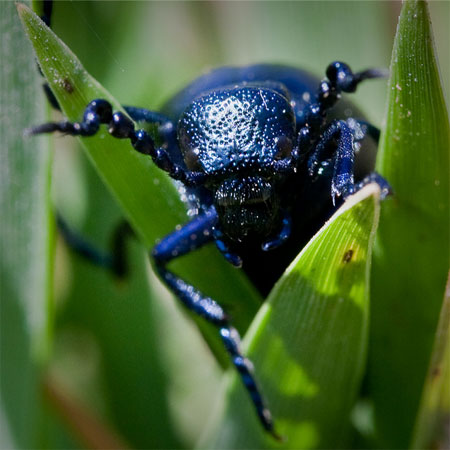
Oil beetles are great indicators of the health of our countryside and Buglife is hoping that your sightings might help confirm if there really are only four of the eight native species remaining in the UK.
If you want to go out beetle hunting this weekend, you'll want a sunny day and a wildflower-rich area with some open ground. Coastal paths are ideal as they often offer unmanaged vegetation providing shelter as well as bare soil in which the female oil beetles can lay their eggs.
When the eggs hatch the leggy larvae climb up onto flowers and lie waiting to hitch a ride on a bee's back. They live in the nests of solitary bees where they feed on pollen and nectar stores as well as bee eggs. They pupate through the winter and emerge as adults in the spring.
If you're lucky you might spot them mating or possibly even digging at the edge of footpaths to lay their eggs. The larger females can be up to 40mm long.
If you're out and about and happen across a sizeable shiny beetle capable of exuding unpleasant fluids, you might be forgiven for grabbing your camera and thinking of Buglife. But did you know that many of British beetles fit this description?
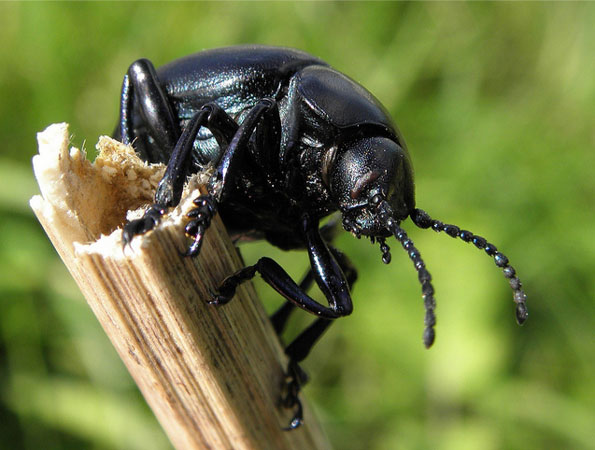
If your beetle is around 20mm long and produces a blood-red fluid from its mouthparts when threatened you'll be delighted to know you've found an aptly names bloody nosed beetle. These guys are often found in the same habitats as oil beetles as they enjoy grassland and heathland.
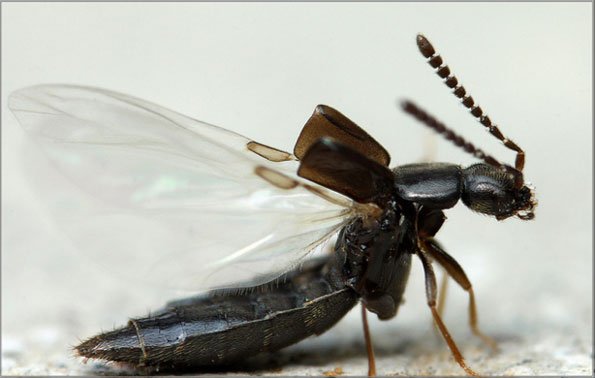
Another oil beetle lookalike is the rove beetle, possibly the most well-known of which is the Devil's coach horse. These black beetles also have a use for foul smelling fluids which they squirt from their abdomens to deter predators. They overwinter as pupae in leaf litter and will be emerging now in our parks, hedgerows, woodlands and meadows. Watch out though, as these have a powerful bite.
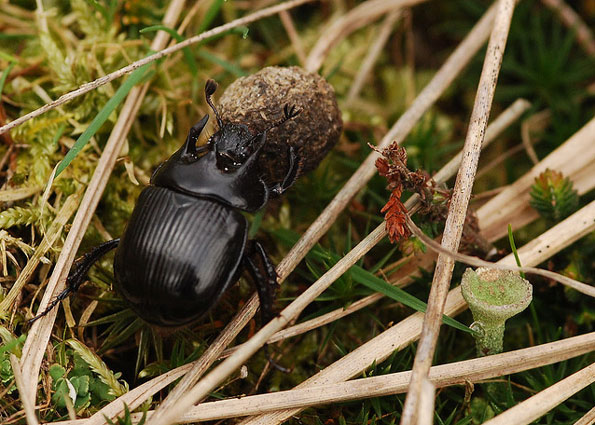
Dung beetles will be emerging soon as well. Their recycling behaviours play an important part in getting nutrients back into the soil. They commonly have grooved shields with large strong front limbs and elongated back legs for holding onto dung balls whilst rolling them along.
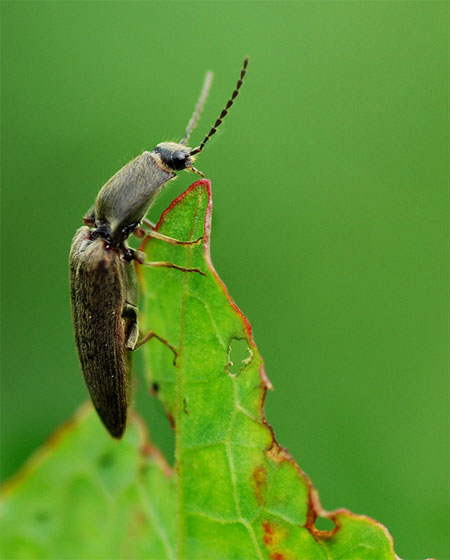
Click beetles are another wonder of the British bug world. If they are threatened or fall onto their backs they have the ability to propel themselves into the air by flexing the joint between their thorax and abdomen. This makes the characteristic clicking sound by which they have earned their name. Usually around 25mm long, they are also visitors to gardens, hedgerows, meadows and grasslands and will be most visible between May and July.
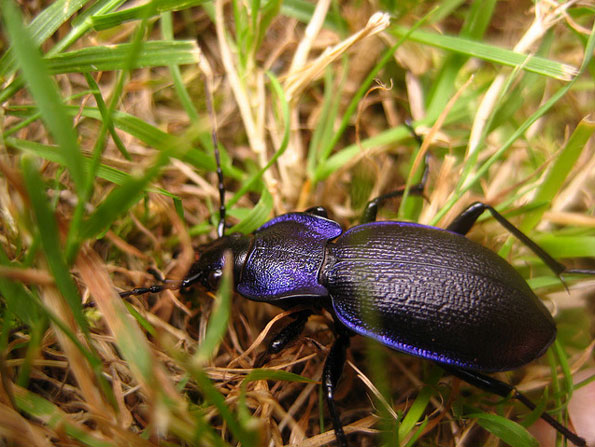
Violet ground beetles are large and shiny with long legs and can be distinguished from oil beetles by the streaks of violet down the sides of their bodies. You can find these in parks, woodlands and hedgerows and they quite like hiding under logs or rocks in the heat of the day.
If you're not confident of your oil beetle IDs print off the Buglife oil beetle ID guide. You don't need a net or any special equipment to be involved with the Oil Beetle Hunt. Just a camera and some enthusiasm. Let us know about your findings by commenting below or post your spring pics to our photo group.

Comment number 1.
At 20:04 25th Mar 2011, rimo wrote:The dung beetle pictured is a Minotaur beetle male (females don't have the horns), and far from 'emerging soon', their season is nearly over - January is the best time to see them as they feast on rabbit droppings.
Of course the other major beetle group people should be looking out for (and recording sightings of!) are the ladybirds, as scientists continue to track the spread and impacts of climate change and the Harlequin ladybird - sightings should be submitted at www.ladybird-survey.org
Complain about this comment (Comment number 1)
Comment number 2.
At 11:19 28th Mar 2011, Sam Unsprung Researcher wrote:Hi Rimo,
Thanks for your comment.
You're spot on with the ID! We've clarified that the dung beetle shown is a minotaur beetle. They are fantastic beetles so we thought it best to pick a picture to really show off these wonderful creatures!
Our entomologist friends tell us that minotaur beetles have two annual periods of activity in the spring and the autumn and that although they are about in the winter months, they should be visible right through to May. They go for rabbit droppings as you say and also sheep dung. A few things have been a little early this year with the warm weather so perhaps those in your area have gone a bit quiet!
Obviously ladybirds are out and about in force at the moment but we didn't think anyone would confuse these for oil beetles so we left them out this time ;) Thank you for providing the link though!
Sam :)
Complain about this comment (Comment number 2)
Comment number 3.
At 16:51 28th Mar 2011, kitenet wrote:Some lovely photos! For further help with beetle identification you can post your observations on www.iSpot.org.uk, a project to help people learn about British wildlife identification (developed by the Open University for the Open Air Laboratories project).
Complain about this comment (Comment number 3)
Comment number 4.
At 20:14 28th Mar 2011, rimo wrote:They should definitely still be about - just tailing off a little! I had a couple come to light last April and they're spectacular beasts, well worth watching - they're the only British species which actually rolls the dungballs around, before digging a tunnel nearly 2m deep and laying their eggs in the dung at the bottom of it.
The other spectacular group of beetles which can be regularly seen are the Sexton beetles - despite their terrible smell and corpse-o-philic behaviour, they're one of the very few insect groups to show parental care of the offspring, and their burying behaviour is pretty awesome as well!
I agree, incidentally - if Meloe and Coccinella are getting confused there's something odd going on! Also, your last photo should probably be 'a violet ground beetle' as there's 2 species under that common name, Carabus violaceous and C. problematicus - this is C. problematicus as it has longitudinal structuring to the ridges on the elytra and very upturned edges to the pronotum
Hope to see your entomologist friends on the programme - insects are so much more interesting than birds! ;)
Complain about this comment (Comment number 4)
Comment number 5.
At 02:32 29th Mar 2011, theSteB wrote:I'll just confirm what Sam says about Minotaur Beetles. I photographed this male on Warton Crag near Carnforth, Lancs on 23 May last year. It was I believe the first record for the site, and this is an extremely well surveyed site. Although I was told that later on others were spotted.
https://farm5.static.flickr.com/4054/4632050326_fe6c979780_o.jpg
Complain about this comment (Comment number 5)
Comment number 6.
At 09:55 29th Mar 2011, Sam Unsprung Researcher wrote:Thanks for the link Kitenet.
There's definitely enough Little Black Jobs in entomology to match the Little Brown Jobs of ornithology aren't there Rimo! :)
Fantastic photo theSteB!
Sam :)
Complain about this comment (Comment number 6)
Comment number 7.
At 16:35 31st Mar 2011, rimo wrote:Haha, given that there's 347 bird species seen >100 times in Britain in the last hundred years, and c. 350 species of beetle in the family Carabidae, I think it's clear that featheries are a comparitively tiny group which get an inordinate amount of attention!
I've mainly found Minotaurs when I lived in Devon - I suppose it's not really surprising that they're out that bit later up in the frozen north!
Complain about this comment (Comment number 7)