Sea eagles - back on the scene
Post categories: Autumnwatch
 |15:57 UK time, Thursday, 4 November 2010
The white-tailed sea eagles on Scotland's west coast are only there due to a reintroduction programme that began in the 1970s, sixty years after the UK's last native pair bred.
Birds from Norway were released in the Hebrides and in later years on the Scottish mainland too. The most recent phase has seen birds brought to areas in eastern Scotland.
Sightings and radio tracking have confirmed that the birds' ranges overlap - a bird was seen on Mull (west coast) just months after its release in Fife (in the east).
Now you stand a chance of seeing their enormous 8ft (2.5m) wingspan soaring over areas as far apart as the Outer Hebrides, Shetland Isles and Dumfries & Galloway.
The reintroduction programmes are a joint effort between RSPB Scotland, Scottish Natural Heritage and the Forestry Commission Scotland, working with many local community groups. For many folk it's a win-win situation, helping wildlife that in turn attracts tourism.
Moves to restore Britain's biggest bird of prey are not always welcome though. Farmers raise concerns about the effect of the 'flying barn doors' on their livestock – spooking poultry and killing lambs. The conservationists maintain that sea eagles prefer to eat fish and rabbits.
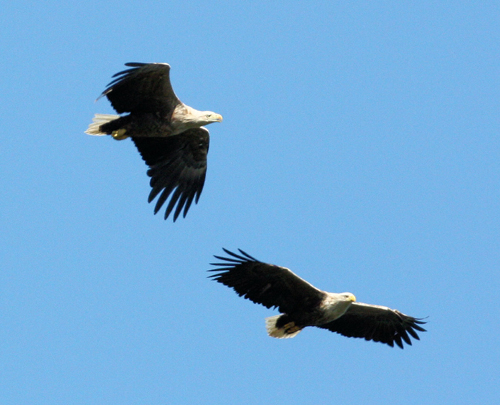
The sea eagles of Mull ©Iain Erskine
Research commissioned by SNH in 2009 sought to demonstrate whether the eagles were killing significant numbers of lambs in the Gairloch area of Wester Ross. Young lambs were radio tagged so their fate could be established if they disappeared. The investigation also conducted post mortems on carcasses found in the study area.
The research found that most of the livestock that sea eagles did eat was carrion that the raptor had not killed. There was evidence of one lamb killed by injuries consistent with the talons of either a golden or sea eagle. Download research findings from SNH.
The crofting community, whose livelihoods are on the line, continue to voice their unease (PDF link). Some feel they were not adequately consulted when the scheme first began. There are compensation schemes for some people who farm in areas that eagles inhabit.
Scotland is not the only part of the UK with habitat suitable for white-tailed eagles. Natural England and the RSPB have ambitions to see the birds flying above the wetlands of the Suffolk coast. Lessons do appear to have been learned about consulting people in the area. The programme there is far from assured and for now it is on hold. Natural England withdrew its funding in June 2010.
Many of the same arguments could apply of course whenever reintroductions are considered - especially larger creatures such as beavers or wolves. What do you think it's important for conservationists to do to ensure they're seen as good neighbours to all who enjoy and rely on the rural environment?

Comment number 1.
At 18:11 4th Nov 2010, LazyRizzo wrote:I think the optimum word is balance - not to err too much on the side of the reintroduced creature, not to be too fierce in rejecting it. But I am only a suburban amateur so I'd have to bow to expert knowledge.
Complain about this comment (Comment number 1)
Comment number 2.
At 18:19 4th Nov 2010, WoodsOfFallen wrote:Whilst there are some minor cases of livestock being killed the research just proves that it isn't that significant and shooting these beautiful birds isn't the answer. It seems still a lot of education is needed for farmers to understand what birds of prey really do and don't do and how to work with them most importantly. As LazyRizzo says, balance is key.
It is a pity that the plans to have a reintroduction on the East Anglia coast didn't go through, on the other hand I fear that with the prejudice they would have been culled out but this is happening to sea eagles up north anyway and indeed other birds of prey, I've heard many stories over the summer about poisonings and such which is dreadful to hear.
Complain about this comment (Comment number 2)
Comment number 3.
At 12:06 5th Nov 2010, Child of Herne wrote:Whilst accepting that large predators might take the occasional young lamb or piglet I would have expected the number taken to be very small if there was plenty of natural food or carrion around. White Tailed Eagles and farming co-exist in countries such as Poland and the Baltic States where agriculture is less intensive with far more livestock in the open than in Britain. I have seen two pairs of White tails around the Bialostck Fishponds which are on the outskirts of a large city. In fact on a visit to Eastern Poland in May we saw them most days, and similarly in Estonia. They would certainly cause panic at first but animals tend to get used to disturbances fairly quickly.
Complain about this comment (Comment number 3)
Comment number 4.
At 18:42 7th Nov 2010, remraf wrote:Think the important things are to respect that landowners have legitimate concerns over these introductions and schemes are put in place to compensate them for losses which occur,for sure I could understand poultry farmers concerns as poultry often crowd in a heap if frightened and maybe a big bird like Sea Eagles may frighten them until they hopefully got used to them.The land owners need lots of discussions with experts so that hopefully they go along with the schemes because for sure forcing them is not a option,any re-introduction needs their co-operation such as the Crane scheme seems to have and Sea Eagles on Mull.
Complain about this comment (Comment number 4)
Comment number 5.
At 13:23 8th Nov 2010, Mull crofter wrote:This comment was removed because the moderators found it broke the house rules. Explain.
Complain about this comment (Comment number 5)
Comment number 6.
At 13:31 8th Nov 2010, Mull crofter wrote:This comment was removed because the moderators found it broke the house rules. Explain.
Complain about this comment (Comment number 6)
Comment number 7.
At 18:58 11th Nov 2010, Helen Ap-Rhisiart wrote:My poultry is spooked by dunnocks and robins if one flies over suddenly.
Complain about this comment (Comment number 7)