Autumnwatch: Ask Darryl Grimason
Post categories: Autumnwatch, Autumnwatch guest presenters
 |19:58 UK time, Thursday, 18 November 2010
Our guest presenter for the final show of the series is presenter, producer and author Darryl Grimason and now's your chance to ask him a question about incredible migrants.
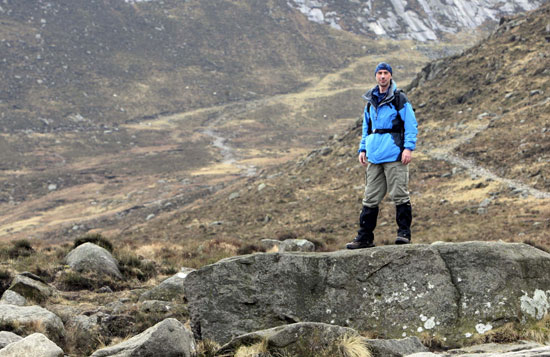
Darryl has a passion for the great outdoors.
For Autumnwatch Darryl will be looking at one of his favourite natural phenomena, the arrival of whooper swans to their wintering grounds in Northern Ireland. He'll be investigating the complex family relationships at work and sharing this incredible spectacle with us.
Darryl, from County Armagh in Northern Ireland, has a big passion for fishing and the great outdoors. His enthusiasm for the natural world has even taken him to Iceland and Greenland to follow the amazing 8,000km migration of thousands of brent geese.
His most recent programmes include Off the Beaten Track, a series about the exploration of Northern Ireland's countryside on foot, and Secret Gardens, where he went in search of the best gardens of Northern Ireland and the passionate people who own them. He has also investigated our eight-legged friends as part of Your Place and Mine, on local Radio in Ulster.
Do you have any questions about incredible migrants? Have you always wondered about whooper swans? Or do you have spectacular migration stories of your own that you'd like to share? Please let us know by commenting below.

Comment number 1.
At 20:37 18th Nov 2010, alan cooper wrote:We are alarmed by reports in the Independent last Saturday that there are many proposals that will adversely affect the protection of badgers, as well as concerns for de-beaking hens, along with other bird and animal issues. Any comments?
Alan & Anne Cooper
Complain about this comment (Comment number 1)
Comment number 2.
At 20:53 18th Nov 2010, mac1960 wrote:In all the viewers that watch your program Autumn watch, i have came up with the idea which i think it is quite similar to blue peter where you get a badge which i think will be rewarding for the people who watch your show and you will get alot more viewers because you are making the effort to give away a little prize really .However, you will also get the little children aged 7-11 watching then because they will think that if they watch your show and become and member on your website then you will reward them by giving them a badge.
Thankyou for your co-operation
Mark monaghan
[Personal details removed by Moderator]
Complain about this comment (Comment number 2)
Comment number 3.
At 21:15 18th Nov 2010, Wildlife Filmer Adam wrote:Great stuff, look forward to next weeks show a bit more than I did... shame it is the last, but looking forward to Springwatch in about 7 months time.
:-D
QUESTION: Eurasian Starlings in the USA, do they loose their migratory instinct & stay wherever they are, like how Canada Geese are here in the UK??
Complain about this comment (Comment number 3)
Comment number 4.
At 21:44 18th Nov 2010, basilbabe wrote:Would just like to say congratulations to everyone again for brilliant show. Thoroughly enjoyed this autumnwatch, sad that its the last one next week. Look forward to Springwatch next year. Early we know but merrychristmas and happy new year to everyone. Peace and joy to all.
Complain about this comment (Comment number 4)
Comment number 5.
At 21:46 18th Nov 2010, Awsome Johnno wrote:Guys
Starlings..........MMMmnnnn....
Our garden is small and we are priveledged with visits around the year and in no partuciluar order from Gold & Chaffinch; Blue, Longtailed, Coal, Great Tits, a Sparrow Hawk, Wood Pecker, Thrush, Black bird,Robin, Wren and even Jackdaws as well as Collared Doves and more not to mention the Starlings. We have a variety of feeders which satisfy most of the visitors however the Starlings take over every time. They decimate the fat balls, break into the squirrel proof caged nut feeder and when I put out he meal worm for the ground feeders lasted about 3 minutes.
I can put up with the fat balls being nicked but how do i provide mealworm to ground feeders without those theiving starlings scoffing the lot. I need advice as the other species are suffering...
Thanks
John & Angela in Hampsthwaite, N Yorks
Complain about this comment (Comment number 5)
Comment number 6.
At 21:55 18th Nov 2010, sarahm wrote:hello
my husband saw 17 squirrels in a tree eating little red berries, they left some of the berry, but were going mad for them! any ideas as it is intruiging us!
thank you
phil and sarah!
x
Complain about this comment (Comment number 6)
Comment number 7.
At 23:20 18th Nov 2010, Snaz wrote:How about a mention of bat migration? I have had three female Nathusius pipistrelles into East Dorset Bat Rescue this Autumn. This is unprecedented. These rare bats were almost certainly migrating and caught out during windy weather. How far do they travel? and why?
Complain about this comment (Comment number 7)
Comment number 8.
At 09:45 19th Nov 2010, Kev wrote:A question for Chris please. I thought that Heron's were solitary animals but over the last two weeks, whilst walking the dog, I have seen 3 birds all converge together and then at a different spot another two more. Surely it is not the breeding season yet?
Complain about this comment (Comment number 8)
Comment number 9.
At 13:51 21st Nov 2010, lizforwood wrote:i have heard a cuckoo calling today and was so amazed. i have never heard one this late in the year. could you enlighten me as to why this is. i thought i heard it last week but thought i must have misheard, but today it called twice.
Complain about this comment (Comment number 9)
Comment number 10.
At 16:13 21st Nov 2010, mhickman wrote:Usually there are flocks of Canada Geese in this area from early autumn onwards but there have been none at all this autumn - what has happened to them??
Mary Hickman,Redhill,Surrey.
Complain about this comment (Comment number 10)
Comment number 11.
At 17:10 22nd Nov 2010, Alex Berryman wrote:2 questions...
1) How did Canada and Egyptian gees escape into Britain, and have they had a bad effect on native wildfowl.
2) Why do Bewick's and Whooper swans leave the UK to breed???
Alex
Complain about this comment (Comment number 11)
Comment number 12.
At 17:42 22nd Nov 2010, Caroline in York wrote:Do pied wagtails migrate? Each time I go into York at this time of year I am amazed at the behaviour of what appears to be hundreds of pied wagtails. In the centre of York they swoop over Marks and Spencer's to roost in the plane trees favouring the ones with the most leaves. Sometimes the trees are laden with them, other times there are just a few hundred. Can anyone confirm whether they are pied wagtails and why we only see them behaving in this way at this time of year?
Complain about this comment (Comment number 12)
Comment number 13.
At 13:33 23rd Nov 2010, Kevan McCallum wrote:Hi Daryl
Why do the canadian brent geese migrate southwest to ireland instead of due south down to north and south america?
Kevan
Complain about this comment (Comment number 13)
Comment number 14.
At 17:00 23rd Nov 2010, Colneybird wrote:I know of a pair of Bewick's swan who divorced last year & re-coupled to spend their Winter at Slimbridge - have you any idea how common this is please?
Complain about this comment (Comment number 14)
Comment number 15.
At 17:03 23rd Nov 2010, Colneybird wrote:On being privileged to watch the Slimbridge Bewick's over the last few years I've learnt that Dutch ornithologists put ID & satelite tags on th necks of these birds - do you think this is good practice?
Complain about this comment (Comment number 15)
Comment number 16.
At 17:41 23rd Nov 2010, tedbun wrote:When young, I read "The Snow Geese" by the wonderful writer Paul Gallico, and the beautifully evocative imagery has stayed with me ever since. The sight and sound of a skein of geese flying across an evening sky must surely be one of nature's most precious offerings. Similarly, the sudden rush of air as a swan unexpectedly labours heavily - and somewhat implausibly! - right overhead is a really joyous treat. So, any footage of either of these birds in flight - and particularly some soundscapes? - would be more than welcome!
On the questions front, I believe that geese undertake some of the longest migrations of all creatures - so, are these birds record-holders in any way? and what is the greatest single migration distance ever recorded for a particular bird? You may well have already covered such queries in previous programmes, but it's still amazing to consider these feats, so any details concerning how the birds have adapted to endure their long journeys would be greatly appreciated; also any available information regarding changes to patterns of migration. By the way, do snow geese ever reach the UK??
As ever, I'm eagerly awaiting the next AW show - although feeling very sad that this is already the last of such programmes for a while ... I don't suppose you'll have the additional US show after this last main programme? - but I'm very glad to learn that you're planning a follow-up Christmas special - lovely! And here's hoping that current budget cuts allow for at least one more series of SpringWatch ..!!
This has been another great season, both on and off TV, so thanks to all involved and best regards for the future, TB/EB.
PS - Another great surprise, just whilst I was writing this - a young jay arrived on our tiny City fringe balcony to investigate the few acorns I had left out hopefully. "He"(?) stayed for quite a while, jumping around and loudly announcing his presence, and it was so exciting to see and hear him again, almost at touching distance!!! I first witnessed him in our "garden" for the first time last week - yet another amazing autumn audio-visual experience!! And what brilliantly keen senses these birds must have to spot a tiny new nut on a tiny balcony amongst all the tall buildings and numerous other distractions ... It's impossible to pick a favourite bird or other creature, but - Wow!! (And, any chance you could do a piece on these fabulous birds in a similar vein to the wonderful feature provided on the equally brilliant, beautiful, amusing, appealing, cheeky and highly intelligent starlings ..?!! Here's hoping ... maybe one for the "Christmas Special" ..?! (And maybe someone could also encourage those "tame" starlings to sing a few seasonal carols ... what a wonderful thought!!! - I feel sure the birds would love it as much as would we ..!!) Thanks again!! TB
Complain about this comment (Comment number 16)
Comment number 17.
At 19:13 23rd Nov 2010, Anthony Allen wrote:When geese are migrating (e.g. Canada geese) why do they always fly in formation and do all birds migrate in formations and in groups.
Complain about this comment (Comment number 17)
Comment number 18.
At 22:25 23rd Nov 2010, 122abcdefghi wrote:Where I live, am really over the moon to see an unusual wild bird daily in the garden, but filming in the wild as you do, do you much prefer seeing birds or animals in their natural habitat or your own garden/ home vicinity?
Complain about this comment (Comment number 18)
Comment number 19.
At 17:11 25th Nov 2010, Gill wrote:My partner Don and I eagerly await the swifts' arrival each May. Last year in April we had the privilege of seeing loads of them swooping and diving around the minarets of the main mosque in Damascus. Any ideas which other atmospheric cities/places we could find them as they travel here?
Complain about this comment (Comment number 19)
Comment number 20.
At 19:45 25th Nov 2010, tedbun wrote:When young, I read "The Snow Geese" by the wonderful writer Paul Gallico, and the beautifully evocative imagery has stayed with me ever since. The sight and sound of a skein of geese flying across an evening sky must surely be one of nature's most precious offerings. Similarly, the sudden rush of air as a swan unexpectedly labours heavily - and somewhat implausibly! - right overhead is a really joyous treat. So, any footage of either of these birds in flight - and particularly some soundscapes? - would be more than welcome!
On the questions front, I believe that geese undertake some of the longest migrations of all creatures - so, are these birds record-holders in any way? and what is the greatest single migration distance ever recorded for a particular bird? You may well have already covered such queries in previous programmes, but it's still amazing to consider these feats, so any details concerning how the birds have adapted to endure their long journeys would be greatly appreciated; also any available information regarding changes to patterns of migration. (By the way, do snow geese ever reach the UK??) And, on a similar note, although I believe this has similarly already been covered before, possibly on Spring or Autumn Watch, or elsewhere on the BBC science and nature offerings, I'd still be interested to re-learn - which geese can fly at the greatest altitude (and where and why), and how have they adapted to attain these great heights and in such cold, thin air?).
How do the great flocks of birds communicate - especially when flying? (And, in connection with this, how and why do geese (and also swans) make those wonderful sounds whilst flying? - truly magical!)
As ever, I'm eagerly awaiting the next AW show - although feeling very sad that this is already the last of such programmes for a while ... I don't suppose you'll have the additional US show after this last main programme? - but I'm very glad to learn that you're planning a follow-up Christmas special - lovely! And here's hoping that current budget cuts allow for at least one more series of SpringWatch ..!!
This has been another great season, both on and off TV, so thanks to all involved and best regards for the future, TB
PS - Another great surprise, just whilst I was writing this - a young jay arrived on our tiny City fringe balcony to investigate the few acorns I had left out hopefully. "He"(?) stayed for quite a while, jumping around and loudly announcing his presence, and it was so exciting to see and hear him again, almost at touching distance!!! I first witnessed him in our "garden" for the first time last week - yet another amazing autumn audio-visual experience!! And what brilliantly keen senses these birds must have to spot a tiny new nut on a tiny balcony amongst all the tall buildings and numerous other distractions ... It's impossible to pick a favourite bird or other creature, but - Wow!! (And, any chance you could do a piece on these fabulous birds in a similar vein to the wonderful feature provided on the equally brilliant, beautiful, amusing, appealing, cheeky and highly intelligent starlings ..?!! Here's hoping ... maybe one for the "Christmas Special" ..?! (And maybe someone could also encourage those "tame" starlings to sing a few seasonal carols ... what a wonderful thought!!! - I feel sure the birds would love it as much as would we ..!!) Thanks again!! TB
............................................................................................................................................
Sorry, AW - I didn't manage to post this earlier in the week, so imagine that it's all now too late to be of any use ... However, I'm sending it anyway, if only for future reference - and with some short "extra" questions appended ... hope this is okay and sorry for the delay!
1 - Do family groups of these birds re-form after being apart? and if so, how do they manage to find each other?
2 - What is the largest (and average) no.of swan eggs produced/hatched and the greatest (and again, average) no.of young to reach maturity? (And, what is the rough percentage of young swans surviving into adulthood - in relation to the size of the brood)? Are the figures similar for the different geese groups?
3 - What is the latest time in the year for UK swans to have young? (Some viewers may have seen a few of my Flickr posts of a young family still on a local pond here at the edge of the City of London - taken only a week or so ago using a mobile 'phone (not sure that I'm allowed to link from here, but the initials are EB ..!) - although the cygnet was finally missing from the parents when I went to check yesterday ...) So, related to this - Does anyone know how cygnets feel when kicked out of home by their parents!? ... and how well do they survive on their own after being in a family for so long?! (Is this young bird likely to be able to survive in this freezing weather, just as its trying to find a new home of its own?)
4 - Finally, any ideas on what can be done to reduce fishing-wire (and other human garbage) related deaths of and injuries to wildlife, particularly amongst water birds? Maybe you could put out a plea on tonight's swan/geese segment of the show for far greater care? We have on several occasions had to intervene to free the feet of young ducks etc horribly entangled in such detritus. Thank you.
Sorry again for the extreme lateness ..! Not long now till the last show starts! So ... All the best, TB/EB.
Complain about this comment (Comment number 20)