Migration news 13 October 2010
Post categories: Migration news
 |15:27 UK time, Wednesday, 13 October 2010
Weighing only as much as a 20p piece, you'd be forgiven for wondering how goldcrests manage to migrate at all. But migrate they do, and after a worryingly poor showing last autumn, last week saw a return to form for this diminutive traveller. As birdwatchers up and down the east side of the country over the weekend will testify, the easterly airflow has brought huge numbers of them across the North Sea, an arrival neatly illustrated by the BirdTrack reporting rate.
Nick was lucky enough to be out on the north Norfolk coast last Sunday, where both goldcrests and slightly larger chiffchaffs were in profusion, flicking out of every patch of brambles and even from the inhospitable marram-covered sand dunes.
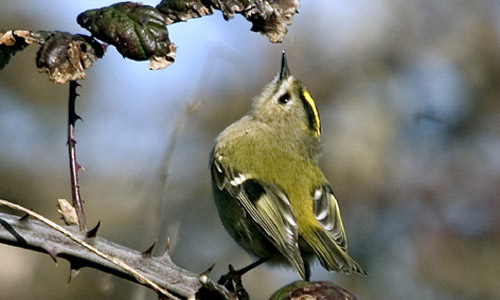
Goldrest copyright Stephen North
Whilst autumn migration always sends a tingle down birdwatchers’ spines, this autumn has already proved to be truly electric. The vast arrivals of birds that flooded in along the east coast in the past week were encouraged to leave their northerly breeding grounds by the high pressure weather system parked over Scandinavia, then pushed across the North Sea by the light easterly winds.
Our favourite window on the scale of the movement comes from AMikeA’s comment on our last post:
I am currently in the North Sea working on a seismic survey ship - approx 100 miles offshore from Yorks coast, in Dutch sector. We've been having some interesting sightings onboard, as flocks pass by and birds come down to rest.
Most of course will not ever be seen, but those that do give a snapshot as to what is happening. Currently on board we have chaffinches, bramblings, siskin - all of which happily are feeding on food I have put out - much needed.
There have been loads of meadow pipits - flocks of over a hundred, many of those die on deck, they will not eat [because they are insectivorous – Ed.]. Over 50 found dead so far (how many in the sea?).
Song thrushes, blackbirds, starlings - but as yet no fieldfares seen.
Great grey Shrikes have also been on board - saw one of those predate a chaffinch too, and an hour earlier I had that shrike in my hand as I had to catch it when it flew indoors!
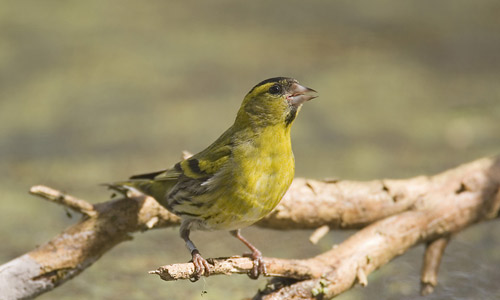
Siskin copyright Chris Mills/www.norfolkbirding.com
Although most of the action has been on the east coast over the last two weeks, the west has seen the arrival of a number of American vagrants. The high pressure system over eastern Europe blocked the westerly weather from reaching the UK with any force.
However, westerlies still raced across the Atlantic forcing birds out to sea from the east coast of North America and brought with them a solitary sandpiper (Devon), three red-eyed vireos (Outer Hebrides, County Cork and, surprisingly, Cleveland), a green heron (Cornwall) and two wonderfully-named hermit thrushes (both in the Outer Hebrides).
Towards the end of the coming weekend and in to next week the wind will turn northerly and temperatures will drop. Pink-footed geese that have spent the last couple of weeks in northwest Scotland will take advantage of the light northerlies and begin to move south and east to the beet fields of East Anglia, so this is the time to listen out for their 'wink-wink' calls overhead at night in places like Sheffield.
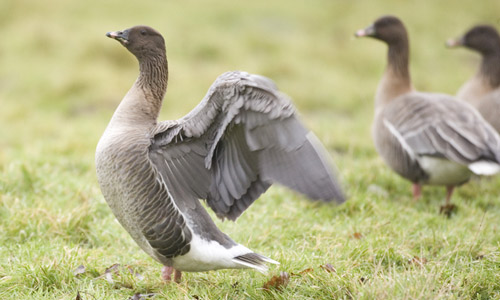
Pink-footed geese copyright Chris Mills/www.norfolkbirding.com
The northerly winds should also result in the first large arrival of whooper swans from Iceland, whilst the first rough-legged buzzards might also appear from Scandinavia.
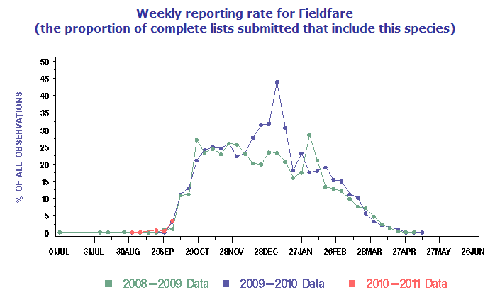
Thrushes will continue to arrive; in addition to the redwings and song thrushes that have already featured heavily we should now see fieldfares too, particularly if their migration follows the same pattern as the BirdTrack reporting rate for the previous two autumns:

Comment number 1.
At 22:41 13th Oct 2010, NaturalPoolie wrote:I have to agree, in Hartlepool on the East Coast of Cleveland, not only did we get the Red Eyed Vireo but also the 1st time i can remember having Red, Grey and Woodchat shrike in the same Autumn. Also numerous Yellow Browed Warblers, Barred Warblers and more Redstarts, Redwings and Ring Ouzels etc than in many a year. In Spring we had quite a few wintering birds staying late, Fieldfares and Redwings etc, could there be a link?
Complain about this comment (Comment number 1)
Comment number 2.
At 14:30 14th Oct 2010, Georgina Fiske wrote:I live in Gorleston, near Gt Yarmouth, on the Norfolk coast and I too have had the pleasure of seeing a goldcrest this week. I was so pleased to see this little vistitor in my garden, and I can only imagine the journey he had to make to get there. I've also seen and increase in the goldfinch population in my garden, going through over a kg of niger food in three days says something about that.
Complain about this comment (Comment number 2)
Comment number 3.
At 21:31 14th Oct 2010, Afcbpete wrote:Having just listened to the information about Nightingales and their migration, that does in fact answer part of the questions my wife and i were asking at the end of June, when traveling in our motorhome. We stayed a few days in a campsite on the Costa Brava and we treated to some wonderful song by this small light brown bird. we half suspected it was in fact a Nightingale, although never having heard one, let alone see, we were left perplexed. NOW, having watched Autumnwatch, we now know that was in fact what it was. The ONE remaining question really is whether it was on it's way to the UK or further up into France, or whether it would stay where it was.....
Complain about this comment (Comment number 3)
Comment number 4.
At 12:40 15th Oct 2010, Child of Herne wrote:The article about Nightingales was interesting as it suggests that they go round the coast of Africa rather than crossing the Sahara. However I would think that habitat problenms in Britain are a major cause of the decline as they are still remarkably common in parts of Europe where the agriculture is less intensive. Two years ago, on the Hortobagy, Hungary there seemed to be singing Nightingales in nearly every clump of bushes, and other songbirds equally common. and have also seen good numbers in Bulgaria where they sung in village gardens. Further norh and east their place is taken by Thrush Nightingale. Interestingly reading articles about the battle of Messines (1917)several slodiers letters comment on the singing of Nightingales in the ten minute lull between the barrage and the firing of the huge mines that accomparied the advance.
Complain about this comment (Comment number 4)
Comment number 5.
At 14:33 15th Oct 2010, BirdTrack Organiser wrote:Afcbpete - given that you were visiting the Costa Brava in late June I'm fairly sure that the Nightingale you saw would be at the northern-most point of its journey as the British breeders arrive here in mid to late April and would be incubating or even feeding young by late June.
Child of Herne - we certainly suspect that there are issues in the UK (such as increased deer-grazing removing the understory of a lot of our woodland) but we really don't know whether it is issues here or on their wintering grounds in Africa that are having the biggest impact on the population, hence the Out Of Africa appeal and research project. Its worth noting that southern England has long been at the edge of the Nightingale's range and so you'd expect these birds to be first to disappear as the whole European population declines (which it is doing in all but the east of its range - see the BTO Bird Trends for more information).
Cheers
Nick Moran
Complain about this comment (Comment number 5)
Comment number 6.
At 08:37 3rd Nov 2010, douglas wrote:On autumn watch Chris thought the reason for the abundance of berries and fruit was perhaps due to the very cold last winter, our local forester has told me in the past that the prolonged dry spell as we had this year would make the trees think that they could die the reaction is to produce as many seeds or fruits as possible to ensure the continuation of the species.
Complain about this comment (Comment number 6)