Why are there no wild lions or tigers in the UK?
 |10:09 UK time, Tuesday, 21 September 2010
Guest blogger: Paul Deane Senior Producer from bbc.co.uk/nature ponders.
Tonight's Lost Land of the Tiger (BBC1) treats us to the discovery of a previously unknown population of tigers at high altitudes in Bhutan, but why don't we have any lions or tigers in the UK? The answer is we did, until really very recently.
Cave lions died out in the UK around 12 to 14,000 years ago, a relative blink of the eye in evolutionary terms and their extinction coincides with the point humans were getting into farming as the ice retreated from northern hemispheres.
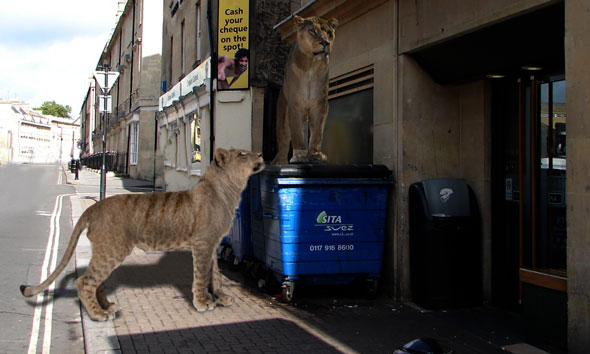
If cave lions hadn't gone extinct?
The earliest homo sapien fossils date from around 200,000 years ago, but our ancestors were making fire and hunting animals some 1.5 million years ago, so we lived alongside lions in Europe for quite some time and if circumstances had been different for the cave lion a trip to the high street might be a whole different affair.
From skeletons found across Europe, we know these lions were up to 25 per cent bigger than a lion you might see in Kenya and thanks to primitive man's desire to decorate his caves, we have a pretty decent idea what they looked like. Males had little or no mane, their tails were tufted and bodies had faint stripes.
They lived in prides, they hunted northern Europe's mega fauna (deer, elk, bison, horses) and while genetically they are considered a separate sub species, if you found one going through your bins, you'd be in no doubt what you were looking at.
Bad to be big
So what happened to the cave lion? As ice retreated from the northern hemispheres the quaternary extinction event took place but the jury is out as to what caused it. One thing is for sure, it was a bad time to be a big mammal. The woolly mammoth, woolly rhinoceros, Irish elk, scimitar cat, cave bear, cave hyena and the steppe bison all went extinct from northern Europe during this time. This era also saw the end of Neanderthal man.
There are 2 main theories (and a few, less well supported ones), behind the quaternary extinction. Firstly, it was us. We were certainly there at the time and the cave lion's extinction coincides with the start of our technological revolution. Also cave art and archaeological digs show that our ancestors hunted, or at least defended themselves from lions in Europe, and used their bones. However while these ancestors were developing fast, could they have wiped out quite so many species?
The other main theory is climate change. Temperatures rose by around 6C in 5000 years and leaving many large animals living in rapidly changing environments, still wearing their best winter coats.
Such a shame as being stalked by 600lbs of cave lion would certainly liven up a trip to the recycling centre.

Comment number 1.
At 09:57 22nd Sep 2010, snady lady wrote:Great piece Jeremy,how amazing would it have been if these cats hadn't died out in the UK? Down to us humans again,we've a lot to be ashamed of haven't we? I'd like to see that woman try to put a cave lion in a wheely bin,don't think she would even try or dare :D
Complain about this comment (Comment number 1)
Comment number 2.
At 06:40 24th Sep 2010, the longhairedgit wrote:I think we might have played a major part in the extinction of the irish elk, but most of the giant mammals of the period were simply deselected by nature due to massively changing temperatures, and in particular the big cats being the apex predators were lost through a major loss of prey species. The recent and excellent series "Lost land of the tiger" shows just how important a really diverse ecosystem and rich prey structure there needs to be for creatures as energy expensive as big cats.
Places that mirror tundra areas of the past are still remaining in north america and canada, asia and russia, and they still retain a selection of major predators, but they are still very much smaller than the major predators of the past, and often more generalist in their habits. Most bears for example remain, and have evolved but are fully omnivorous, and polar bears which tend to be predators of marine life are showing signs of environmental stress the cats that explore the colder places of the earth are again at the edge of their range. Pandas too are struggling not only because of the human factor, but because they too have become a little over specialised.
The britain of the ancient past was a place that was once attached to mainland europe, and in many cases its wont be a case purely animals dying out but simply relocating back to mainland europe gradually, and in turn expending their range increasingly east and south , and as they did so evolving to become new species, and of course new species outcompete older species and the wheel of evolution turns.
TBH though I too think of the loss of some species as a shame, after all who wouldnt want to see a similodon, a terror bird, or a mammoth, or any one of the ancient elephant, rhino, or giant sloths with their staggeringly different body shapes, but it is a trade off. For many of them were as transient as many modern creatures must also be, and which is more beautiful, a sabre-tooth or a modern tiger, the staggering size of the mammoth or the intense advanced emotional state and intelligence of a modern elephant? Nature must after all perfect itself and progess onward. Modern animals carry the characteristics of their forebears within them, in the genetic code.
In addition despite our human ancestors being tough, there were places that would have been difficult for them to survive in, and there were some big predators that were much more capable of surviving in intense cold and would have exceeded their range, so I'm personally pretty convinced that were were not soley responsible for major animal extinctions, it was just a fast period on climatic change that made things difficult for anything that didnt have generalist feeding and living strategies.
Overall though, I think we are very lucky. Not only can we enjoy the simply glorious selection of modern animals as the cutting edge of evolution, but also their ancestors, we can compare their differences , their flaws , and follow the map of changes that lead to either success or failure, and through our comparisons learn about modern life on earth, and appreciate it at a deep level of understanding, and in context the environments of the past.
This way we can add to the reserve of learning that helps us protect existing species adequately, giving creatures space enough, diversity enough, and ecological richness enough to prevent their genetic diversity becoming so small during times of radical environmental change that species are lost unecessarily. Our past can be used to protect our future. We have many of the lessons we need to prevent extinctions demonstrated for us in the fossil record.If the neanderthals and early humans could cause extinctions of ice-age species, then that power is as nothing compared to the power we have now as modern humans to cause much wider spread extinctions. If we mourn the loss of creatures past we should remember also that we are now exterminating a greater variety of creatures than we have ever done before at any point in history, and the only thing more threatening to life on earth than humans is basically a meteor strike.
But yeah, if we could bring back the creatures of the past, it would be a truly amazing thing to see.
Complain about this comment (Comment number 2)
Comment number 3.
At 15:07 1st Oct 2010, 122abcdefghi wrote:the longhairedgit
"we are now exterminating a greater variety of creatures than we have ever done before at any point in history"
Hmm ... Imagine these as headlines of the future: -
“Britain’s Greatest Export – Trees to the Amazon Rain Forest.
In a global last minute bid to bring back endangered animal species from the brink...”
Let’s hope we, as this generation, never leave the planet in such a state as to have future generations read something like that.
Thank you Autumnwatch, for all the worldwide wildlife you’ve so far helped, (also thanks to those viewers who’ve helped, too).
Complain about this comment (Comment number 3)
Comment number 4.
At 13:59 29th Jan 2011, U14767691 wrote:This comment was removed because the moderators found it broke the house rules. Explain.
Complain about this comment (Comment number 4)