Migration news 24 September 2010
Post categories: Migration news
 |11:07 UK time, Friday, 24 September 2010
The weather this week has been very changeable. The strong west and south-westerly winds during the early part of the week more or less brought passerine (song bird) migration to a halt. The comment from the Portland Bird Observatory log on September 20th says it all: "A bit of a dead loss today with, for example, not a single new bird caught and ringed at the Obs. The merest handful of migrants on the land included nothing at all unexpected."
This wasn't, however, quite the case everywhere. With the strong westerly winds came not one, but two North American songbirds: a buff-bellied pipit on Fair Isle in Shetland and a bobolink in Glamorgan, both discovered on the 20th September.
The wind dropped on the 21st and had a more southerly element to it. This was the signal for the hirundines to get moving. Thousands per hour were recorded migrating over Hengistbury Head in Dorset between 11am and 2pm, with birds swarming in their hundreds onto low bushes. The vast majority were swallows, closely followed by house martins and smaller numbers of sand martins.
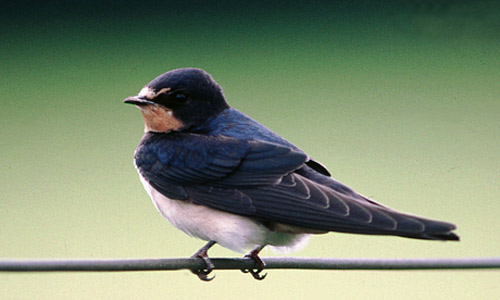
Swallow, copyright Tommy Holden/BTO
As predicted last week, sea watchers in the west were rewarded with good numbers of Leach's petrels, Sabine's gulls, grey phalaropes and the three regularly-seen skua species: great, Arctic and pomarine.
Looking forward to next week, the wind is forecast to turn northerly on Saturday and then through to north-easterly on Sunday. The first redwings of the season were reported on the 21st with two being seen on Spurn in Humberside. We're expecting these to be joined by more over the weekend and into next week. It will be worth going out into the garden an hour or so after dark to listen out for their thin 'tseep' as these nocturnal migrants wing their way above our rooftops to their winter quarters across the country.
Pink-footed geese have already begun arriving at traditional wintering areas such as the north Norfolk coast. Numbers of these geese reaching us from their breeding grounds in eastern Greenland and Iceland should also increase as the wind turns northerly, and the first whooper swans of the season can be expected too. Meadow pipit migration will begin in earnest particularly during spells of lighter winds, with these archetypal 'Little Brown Jobs' being joined by pied wagtails and the occasional Lapland bunting.

Meadow pipit, copyright www.grayimages.co.uk/BTO
Large numbers of swallows and house martins should be on the move towards the end of the week. With the north-easterly winds bringing cooler temperatures both here and in northern Europe, there is also a good chance of small flocks of bramblings turning up, particularly on the east coast.

Comment number 1.
At 16:51 27th Sep 2010, terrylaw1000 wrote:Little Auk patrolling Abersoch main beach from shoreline to 100 metres out for the past 3 weeks. Not seen before. Beautiful little creature. Have dived with it, following its flight like movements very fast under water. Not shy of people. Winter visitor but not supposed to be this far sout. Can be seen 'flying' under water from the beach in clear water conditions. Well worth an Autumn watch visit, dont know how long it will remain.
Complain about this comment (Comment number 1)
Comment number 2.
At 22:41 27th Sep 2010, mealworm wrote:Swallows swooping around Brighton Pier this morning in great numbers which I've never seen before. I guess they were leaving today for their incredible journey. It was an amazing sight.
Complain about this comment (Comment number 2)
Comment number 3.
At 16:56 30th Sep 2010, BirdTrack Organiser wrote:That's a really interesting sighting terrylaw1000. Little Auks don't usually reach our coasts until the second half of October and even then, rarely hang around for more than a few days. They are much more at home further out to sea and it is normally late autumn/winter gales that force them into inshore waters (where they sadly often starve or fall prey to gulls). I wonder if you have seen images of non-breeding plumaged Guillemots or Razorbills? Both these species breed round the coast of Britain (including your area) and would be much more likely to stick around in coastal waters at this time of year. There's a useful pic of a Guillemot here: https://www.dublinbirding.ie/pages/sightings/September2010/Guillemot%20SMcN.jpg
Complain about this comment (Comment number 3)
Comment number 4.
At 08:51 1st Oct 2010, Lakesha wrote:Leach's Petrel also known as Leach's strom petrel. This is a small seabird categorised under tubenose family. It breeds mainly found in the colder northern areas. It nest very close to the sea. They build the nest inthe areas such as rock crevics, shallow burrows etc. In Europe, you can see this bird in September month. [Unsuitable/Broken URL removed by Moderator]
Complain about this comment (Comment number 4)