Your summer sightings explained
 |17:11 UK time, Monday, 23 August 2010
Lilies under attack
The lily beetle, that nemesis of all lily lovers, first came to the UK in the 1930s, transported on imported plants from as far away as China. The guys at Buglife think the lily beetle population first settled in Surrey and then gradually spread across the south-east of England. Since the 1980s however they've ventured further and there are now pockets as far north as Glasgow and Edinburgh.
To identify them from cardinal beetles and rare scarlet malachite beetles, look for their shorter, rounder, bright red bodies.
Lily beetle © Shirley-anne Bainbridge
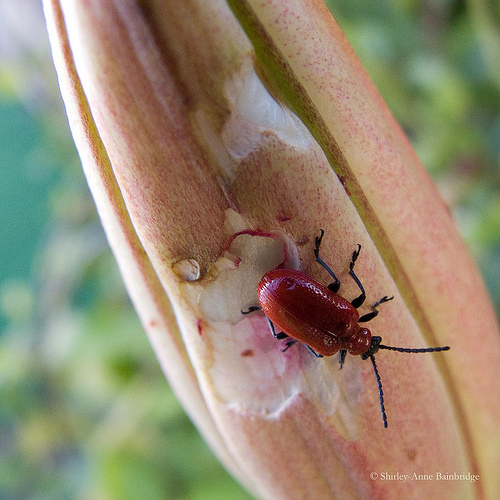
They're pretty but they also have some pretty bad habits. While adults munch on leaves and turn flower heads to lace, the lily beetle larvae disguise themselves as bird droppings by covering themselves in their own slimy black poo.
The Royal Horticultural Society think the hot start to this year's summer means adult beetles may have been more inclined to fly and spread to areas they haven't been seen in before. Hotter weather makes them more active as it's closer to that of their native countries.
If you've spotted lily beetles on your plants help the RHS map their distribution by submitting your reports.
Funnel-web spiders
A lot of people out and about this summer and have reported seeing funnel-shaped spider webs. Rather than the renowned Australian 'killer' funnel-web spider, the web is much more likely to be home to either a tube-web or labyrinth spider.
Tube-web spiders, visitors from southern Europe, are often found near to ports, having been transported here by ship. They make their webs under stones, in walls and fences and in the loose bark of trees. The webs are beautifully constructed tunnels with trip wires leading out that alert the spiders to their prey. Tube-web spiders are large by UK standards with females averaging around 2cm in size. They can also give you a nasty, though not fatal, bite.
Labyrinth spider © Kevin Loader
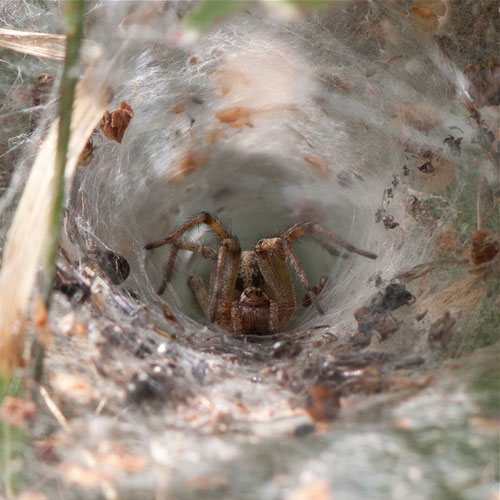 Labyrinth spiders are UK natives and build sheet webs that lead down to intricate, labyrinthine tunnels where they can eat their dinner in peace. Labyrinth spiders can be found on grassland and heathland and don't have a taste for human flesh, preferring to snack on grasshoppers and crickets.
Hummingbird hawk moths
Hummingbird hawk-moth © Grasping air
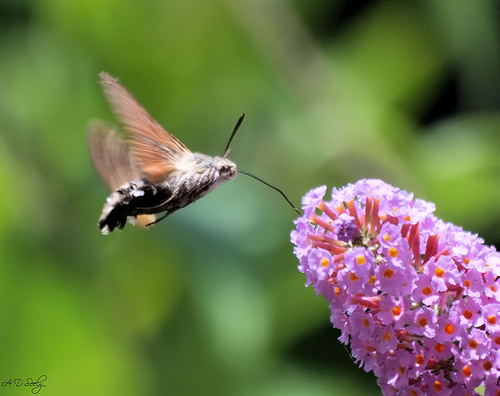 If you've seen a hummingbird hawk moth this summer, Butterfly Conservation would love to hear from you. Early results seem to show it's a good year for this moth with more seen so far in 2010 than in the whole of last year. If you haven't spotted one yet, you've got until the end of September to see them here in the UK.
Late summer is also a good time to see caterpillars of all shapes and sizes as they begin their journey to pupation. Amanda Skull was very fortunate to see this lobster moth caterpillar between its birthplace in the oak canopy and its preferred pupation spot in the leafy undergrowth.
Lobster moth caterpillar © Amanda skull
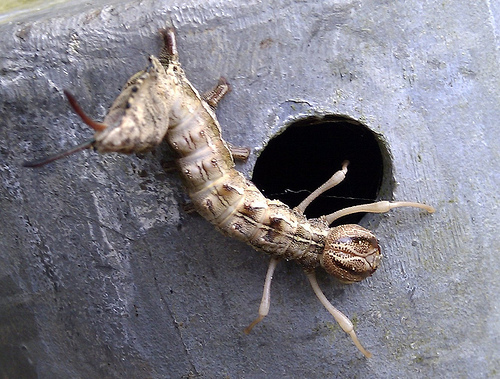 Surveys manager Richard Fox says the dry summer this year seems to have been beneficial for moths, or at least moth-spotting, as more nature lovers get out in the fresh air.
If you've seen something unusual or unidentifiable check Butterfly Conservation's ID guides and submit your sightings.
Lazy tadpoles
If the wriggly black tadpoles in your pond are showing no signs of becoming frogs it isn't time to despair just yet. Pond Conservation say tadpoles don't always mature in the same year they're hatched. In a small pond with lots of tadpoles, chances are there might not be enough food or room for them to become frogs. So they'll overwinter, emerging as frogs in spring when there's more food about.
Make sure there are plenty of submerged plants in your pond to give your tadpoles the food they need over the colder months. They will survive under icy pond surfaces provided there is enough light for the plants to photosynthesise. If we have heavy snow again be prepared to clear a patch for light to get through.
Black fox sightings
Thank you for all your black fox sightings. We had over 180 on the blog and Simon King was even able to film one of these elusive creatures for this year's Springwatch. The Autumnwatch team will have plenty of fresh challenges for keen nature spotters this year and there are still lots of surveys open that welcome your sightings of everything from snakes to sharks.
Have you had any unusual wildlife encounters that you'd like explained? Let us know what you've been up to this summer in the comments.

Comment number 1.
At 09:46 26th Aug 2010, Alan Carter wrote:Last night, at about ten o'clock, I was outside my back door. There is a concrete path and a line of rough concrete bricks separating the path from the garden. I saw what appeared to be a slim earthworm about twenty five centimetres long, attempting to cross from a brick to the path. Due to the rain, the front end could not get a grip on the path, whilst the back end seemed to be caught in the roughness of the brick. The body was at an angle of about eighty degrees so I found a smooth metal tube, inserted it into the gap with the intention of lifting the worm and putting it into the garden.
Immediately I touched the creature it snapped back into a three centimetre length, but much fatter than it had been. Curious, I touched it again; there was a soft noise and the creature disappeared, as though it had jumped up. In the dark, I could not see it again.
I am fascinated, never having heard or seen anything like it. Can you identify it for me please?
Complain about this comment (Comment number 1)
Comment number 2.
At 16:53 26th Aug 2010, jlmiller wrote:This morning we drove down to our relative and on her garage door, she had a moth/fly. It had bat like ears, and two white dots on its wings. What was it? We had no idea what it was.
Complain about this comment (Comment number 2)
Comment number 3.
At 17:23 26th Aug 2010, Sam Unsprung Researcher wrote:Thanks for your comments.
Alan - Without a picture it's tricky to guess. Not all british worm species can reach those lengths. The biggest UK worm species is the lob worm which is also one of the most common so this might be what you saw.
Alternatively if you have freshwater near by it could have been a leech as some british species will reach those lengths.
Jlmiller - Without its size and colour we're stumped! Definitely give Butterfly Conservation's Moth Identifier a go though, and let us know how you got on!
Sam :)
Complain about this comment (Comment number 3)
Comment number 4.
At 20:12 26th Aug 2010, brian wrote:i am one of the many people who feed wild birds in the garden. some time in early july i started to notice that the great tit population had developed some kind of parasite or bacterial/viral plague. the symptoms are ; swelling of eyelids to bursting. followed by death.
lumps around the neck and beak as large as haricot beans
loss of eyes , bleeding sores , blindness , death
i have allowed this part of nature to run it's course. only the great tits have this condition. all the other regular visitors are fine.
what is going on?
Complain about this comment (Comment number 4)
Comment number 5.
At 10:03 27th Aug 2010, Alan Carter wrote:Thanks Sam; since I saw it via artificial light, the colour is difficult. I assume that it was brown because that is what I expected.
The surprising thing about it was the speed with which it changed from 25cm to 3 cm in length - milli-seconds, Then it disappeared, I believe by springing; again at a very high speed.
Regards,
Alan
Complain about this comment (Comment number 5)
Comment number 6.
At 17:52 30th Aug 2010, Birdfan wrote:This comment was removed because the moderators found it broke the house rules. Explain.
Complain about this comment (Comment number 6)
Comment number 7.
At 18:18 30th Aug 2010, Birdfan wrote:I would welcome any suggestions anyone can offer as to what bird it was I saw in my garden this afternoon.
I live in SW London and though the area is typical inner city built-up, there are good local areas for birds, local commons, large hospital for high level perching, to say nothing of at least 3 large cemeteries within very easy flying distance.
While (very) small my garden is creature friendly, amid the neighbouring paving and decking and I have feeders which attract the usual garden birds in this area, starlings, sparrows, green and gold finches, great tits (no blue tits), local robin, occasional blackbird. May be more I don't recognise. This afternoon I was watching the feeding when suddenly an alarm went up. Not only the birds in my garden but neighbouring gardens flew in alarm. Something shot acrosss the garden and through the gaps in the braches/hedge. About a couple of minutes later - no more, a bird landed on the garden fence about 15' away and started pulling the feathers off its catch. I couldn't get a brilliant look as it was hidden under and within branches but I could hear it. As far as I could tell it was no taller than a wood pigeon tho' not as fat. It was v difficult to see but I did see tan/gold feathers around the neck. The tail was long - a good few inches beyong the wings as it stood on the fence. It ate for a few minutes and I could see the hooked shape of the beak but unfortunately it was scared off by a local cat. What timing!
I realise now this is the second time its visited the garden, as I saw it again shooting through the garden like a bullet earlier in the summer though didn't realise what it was at the time. Can anyone suggest what it might be, my books aren't v helpful. Should I be pleased that a bright predator has twigged that this is a good place for an easy meal or is this a bad sign, of insufficient food in more usual haunts ?
Sorry to have gone on. I'm sure may readers see this often but in this part of the city its an experience.
Birdfan
Complain about this comment (Comment number 7)
Comment number 8.
At 12:20 31st Aug 2010, jibby1 wrote:I noticed this insect near Lake Bala in June this year. The insect came to rest on the window of the lodge and I managed to take this photo:
https://www.flickr.com/photos/24308668@N06/4944964830/
Can anybody identify it?
Complain about this comment (Comment number 8)
Comment number 9.
At 12:17 7th Sep 2010, Child of Herne wrote:The bird of prey seen by Birdfan was almost certainly a Sparrowhawk. They hunt by fling low and fast between trees and take their prey by surprise. They have a long tail and short wings to give them manouverability. The golden colour on the neck suggests a male. They are now common in built up areas since DDT was banned.
Complain about this comment (Comment number 9)