The BBC Nature UK team's big butterfly count
 |16:55 UK time, Thursday, 29 July 2010
Jeremy's away so researcher Ella Davies gives a first-hand account of the BBC Nature UK team's big butterfly count.
With only a few days left to complete a Big Butterfly Count for Butterfly Conservation, the Nature UK team decided to practise what we preach. I ventured out with fellow researcher Emma Brennand to spot some flying beauties here in sunny Bristol.
To prove that you can spot butterflies anywhere, even in the middle of the city, we didn't venture far from the BBC offices. I was counting first and without a garden of my own I headed for Brandon Hill Nature Park. It's a vibrant green space in the heart of Bristol complete with wildlife pond and wildflower meadow. Unkempt grasslands are a key habitat for butterflies, how many would I see in this mini-meadow?
Butterflies are cold blooded insects that need heat from the sun to be active. This behaviour, known as thermoregulation explains why you so often see butterflies resting in full sunshine. Conditions yesterday morning were good for spotting butterflies: a warm day with plenty of sunshine and not too much wind.
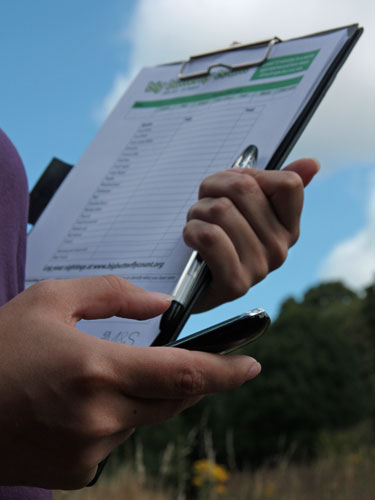
We had the weather on our side and a prime location so all we needed was the right kit. Armed with a butterfly ID printout and recording chart [pdf], pen, timer, camera and important-looking clipboard, I took up position in a sunny spot. With 15 minutes on the timer it was time to start the count.
Ella prepares to count
Right on cue a couple of meadow browns popped up out of the long grass. Soon after, a speckled wood fluttered over from the nearby trees and another brown winged character joined us. It was quite hard to identify this last one but Emma managed to snap it with the camera and we later identified it as a gatekeeper.
A gatekeeper butterfly
 To the left of my chosen spot I counted seven common blues. They certainly live up to the common title in terms of numbers but their intricate underwing patterns are really unique.
The beautiful underwings of a common blue
 Just as time was running out I caught a glimpse of a small black and orange chap perched directly in front of me. I hadn't seen one before so had to consult the ID guide and was pleased to find out it was a small copper.
With one count complete we moved on to our second location, heading down to Bristol's harbour area for a more urban experience. The New Cut is an artificial waterway created in the 1800s where buddleia and brambles compete with graffiti to catch your eye.
Emma goes urban butterfly spotting
 Emma's first species spotted amongst the early blackberries was the large white. We certainly found out how much skill and patience goes into photographing butterflies by our Flickr group as I failed to capture a single shot of the following three! Below is the closest I could get, can you see the butterfly?!
There's a large white in there somewhere
 As we continued along the waterside we moved nearer to a road flyover. Surrounded by looming red-brick warehouses, our urban habitat wasn't looking that wildlife friendly - until we found a signpost for 'butterfly junction'.
Where the harbour's old steam railway line terminates is a patch of ground left to grow wild to encourage biodiversity. It certainly lived up to its name as Emma recorded three more large whites, five small whites, four common blues and a small copper. The last butterfly of our count even posed long enough for me to take a photograph.
A small copper
 We throughly enjoyed doing our bit for science in the sunshine and have just finished submitting our results on the Big Butterfly Count website.
Can you top our results? Did you go to any unusual locations to count butterflies? Let us know what you saw in the comments below.

Comment number 1.
At 17:51 30th Jul 2010, michael wrote:at the end of june we were at tichwell fen, near Hunstanton and we were priverledged to see a Camberwell Beauty butterfly flying in and out of the trees. It almost landed on my wife's shoulder. It was my first time in 74 years that I was able to see one. We were told by the staff at the RSPB site that there have been only about 2000 sightings since the 18th.century.
Now that is what I call rare and i feel over the moon to be included in that small band of sightings.Unhappily I was unable to get a good photo of it but it is burnt into my mind
Complain about this comment (Comment number 1)
Comment number 2.
At 11:58 3rd Aug 2010, Ella Davies BBC wrote:@michael - what a fantastic sighting, you've made the office very jealous!
Complain about this comment (Comment number 2)