

Bin there
- 6 Aug 08, 11:40 AM GMT
Cutting out plastics has slimmed our kitchen bin considerably but it is very strange getting used to living without black polythene bin bags.
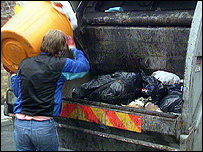 The bin has an inner unit so, in theory, we could put food waste in there unwrapped, tip it into the dustbin when full and wash out the inner bin with the garden hose. In theory.
In practice I don't fancy this at all so I am trying to protect my inner bin from the worst of the slops.
This has involved lining it with newspaper, wrapping food waste before chucking it and putting all my raw fruit and veg scraps on the compost heap.
But a knock-on effect of this is to divert newspaper from our recycling bin into the normal waste stream - which is destined for landfill.
This has major drawbacks: creating paper requires a lot of resources (wood, water, energy) so throwing it away is very inefficient. It also takes up a lot of space in landfill and biodegrades slowly.
And then, like all biodegradable material in landfill, when it does break down, it does so in anaerobic conditions, creating the powerful greenhouse gas, methane.
Wrapping waste in paper may also just be impractical. With rubbish collection day (today) looming, I started to worry that our waste-parcel-filled dustbin would be rejected by the bin men, so I called the council.
At first they were unsure. The woman on the "Cleaner, greener borough" hotline told me it would "ruin" my dustbin to put un-bagged waste in it and advised strongly against.
However, when I rang the recycling team they agreed, after some discussion, that the bin men should be able to tip the dustbin straight into the collection lorry.
As to whether the guys on the ground know about this policy, I will find out when I get home this evening.
If not, I'm going to have to apologise to my neighbours for a stinky bin and find some other solution.
The BBC is not responsible for the content of external internet sites
My name's Chris Jeavans. For one month I am attempting to live my normal life with one main change - no new plastic. That means no bags, no packaging, no plastic to hang around in landfill. In this blog I'll keep you updated to let you know how I'm getting on.
Archive
« September 2008
| Sun | Mon | Tue | Wed | Thu | Fri | Sat |
|---|---|---|---|---|---|---|
| 1 | 2 | |||||
| 3 | 4 | 5 | 6 | 7 | 8 | 9 |
| 10 | 11 | 12 | 13 | 14 | 15 | 16 |
| 17 | 18 | 19 | 20 | 21 | 22 | 23 |
| 24 | 25 | 26 | 27 | 28 |
Being Discussed Now

Latest from BBC News blogs
Nick Robinson: |  |
Douglas Fraser: |  |
Brian Taylor: |  |
 |
Richard Black: |  |
Jonathan Amos: |  |
Christine's Blogroll
- News Editors
- Sport Editors
- Journalism Labs
- BBC Internet Blog
- Radio 4 Blog
- Peston's Picks
- Nick Robinson's Newslog
- Stephanomics
- Mark Easton's UK
- Mark Mardell's America
- Nick Bryant's Australia
- Andrew Harding on Africa
- Gavin Hewitt's Europe
- Soutik Biswas' India
- dot.Rory
- Science: Jonathan Amos
- Richard Black on environment
- Today: Tom Feilden
- Fergus Walsh's medical files
- Newsnight: Paul Mason
- Newsnight: Mark Urban
- Torin Douglas
- Will Gompertz's arts
- Phil Coomes on photojournalism
- Magazine Monitor
- Mark D'Arcy in Westminster
- NI: Mark Devenport
- Scotland: Brian Taylor
- Scotland: Douglas Fraser
- Wales: Betsan Powys
- Martin Rosenbaum on FOI
- 5 Live Breakfast
- Newsnight
- PM programme (iPM)
- World Tonight: Robin Lustig

Page 1 of 2
Comment number 1.
At 11:54 6th Aug 2008, Elpachio wrote:You'll probably get an on-the-spot fine from the council! lol.
Compost heaps.......garden hoses......unfortunately those of us in flats don't have such luxuries! ;-)
Complain about this comment (Comment number 1)
Comment number 2.
At 12:03 6th Aug 2008, jimkennedy2003 wrote:Why not use biodegradable "plastic" bags. These are made from cellulose. These have a slight downside as they are made from materials that could have become food.
Complain about this comment (Comment number 2)
Comment number 3.
At 12:17 6th Aug 2008, AJS wrote:"Why not use biodegradable 'plastic' bags. These are made from cellulose. These have a slight downside as they are made from materials that could have become food." -- jimkennedy2003
Not without a long, circuitous trip, they couldn't! Cellulose is one of the things that human beings can't digest. It's why we're classed as non-obligate carnivores as opposed to true omnivores.
Complain about this comment (Comment number 3)
Comment number 4.
At 12:41 6th Aug 2008, johnhcrf wrote:Hi Chris,
The bin is the centre of attention for the Zero Waste enthusiast. Food waste can be removed from it totally and this transforms the waste into a cleanish collection of plastic material.
Home composting of veg/fruit peelings, teabags, coffee grounds, powdered egg-shell, card, paper.
Raw meat/rind/fish scraps and seeds can be cut to appropriate size, collected, stored, using a container in the fridge and put out every few days as a routine for the birds. Respect neighbours washing lines.
Cooked food waste, including bones, and all other remaining waste food material placed in Bokashi bin/Green cone for composting.
Home collection of food waste, to be composted using anaerobic digestion, can remove food waste from bin volumes. Superstores can deal with their food waste using the same technology.
When food is removed bin waste is transformed. My aim is to send the binbag to landfill in 4 years, 5 if I can manage. In the meantime new technology may arise to deal with the remaining plastic material. If that occurs Zero Landfill will be achieved also.
Complain about this comment (Comment number 4)
Comment number 5.
At 12:43 6th Aug 2008, Elpachio wrote:Lol, I think Jim was referring to the starch-based "plastics" developed by companies such as NatureWorks (using polylactic acid derived from corn starch). They effectively involve using crops that could otherwise feed people.
One company has even created a GM potato specifically for packaging purposes.
Complain about this comment (Comment number 5)
Comment number 6.
At 12:45 6th Aug 2008, jimkennedy2003 wrote:My statement wasn't completely true (and I am aware that humans cannot digest cellulose which is beside the point I was making). Biodegradable plastic bags are made from a variety of products some of which could have become food such as starch. Some of the other materials which they are made from may also compete for land which could have been used for the production of food.
Complain about this comment (Comment number 6)
Comment number 7.
At 13:46 6th Aug 2008, AJS wrote:Well, vegan propaganda used to claim that an area the size of Britain could feed the whole world on a vegan diet (although I guess coeliac and taurase-deficiency sufferers would be out of luck then).
So what's it to be? Can we grow plants or not? (And anyway, even food plants have inedible parts that could easily be used for industrial, non-food purposes.)
I'm reminded of the way certain people wanted "homes not roads" in the early 1990s, then seemed to segue over to "no new homes" after Labour pulled the plug on road building.
Complain about this comment (Comment number 7)
Comment number 8.
At 13:46 6th Aug 2008, theoriginalmrsgreen wrote:We don't use a bin now or develop anything 'sloppy' that can make a bin messy - it's been quite a revelation!
I think a bokashi bin could be the answer you are looking for, Chris - these will happily take on board your cooked food waste, including meat, dairy or fish and turn it into a useful addition to your compost bin.
Everything we put into the bin now is non recyclable plastic packaging, which is washed and stored.
Ah, I just read #4 johnhcrf's post and he's put a much more comprehensive post. So essentially I'm saying 'I agree' with what he has written!
Complain about this comment (Comment number 8)
Comment number 9.
At 14:22 6th Aug 2008, SunshineFr wrote:This experiment has really made me think about the waste I'm throwing out, thanks Chris.
I was just wondering does anyone have any suggestions about what to do with food waste other than compost? I live in a flat and therefore that's not an option for me. I try to do as much as I can to limit the amount I throw out so any suggestions would be really welcome.
Complain about this comment (Comment number 9)
Comment number 10.
At 14:25 6th Aug 2008, johnhcrf wrote:#8theoriginalmrsgreen
Great to hear from you and your additional details will help Chris. My only regret is the absence of Mrs Average. As the original Zero Waste enthusiast, her contribution would be very informative.
Complain about this comment (Comment number 10)
Comment number 11.
At 14:28 6th Aug 2008, shetats wrote:Look out for the biodegradeable bin liners OR give in, you do have to look at your health and you'll still be reducing your plastic usage.
Complain about this comment (Comment number 11)
Comment number 12.
At 14:30 6th Aug 2008, shetats wrote:Sunshine, I'm the same - I rent an apartment, I have no garden to put my compost onto. I'd love it if the council would collect this waste separately and use it on public gardens.
Complain about this comment (Comment number 12)
Comment number 13.
At 14:37 6th Aug 2008, smartplanet wrote:my suggestion would be to have a separate 'caddy' (a small plastic bin) for all your compost food waste.
Line that with biodegradable corn starch bags from a shop such as Ethical Superstore and simply throw the bags in your compost where they'll rot with oxygen (thus creating no greenhouse gases).
Back in your normal kitchen bin, you can now do away with liners (it should now just be plastic packaging and odds and ends) and empty the contents directly into your wheelie bin. Where I live, the bin guys don't have a problem with that.
Complain about this comment (Comment number 13)
Comment number 14.
At 14:38 6th Aug 2008, smartplanet wrote:PS. yes, corn starch plastics may in some cases take away land from food crops -- but are we talking about food prices here or cutting carbon emissions? If it's the latter, corn-based plastics are not a bad thing.
Complain about this comment (Comment number 14)
Comment number 15.
At 14:44 6th Aug 2008, msaunby wrote:For years we've been putting our vegetable waste, tea bags, etc. in a bucket that's then emptied onto the compost heap. There is a very simple way of eliminating smells, put a handful of dry soil in the bottom of the bucket. I suggest you try the same with your unlined bin.
The principle is sound, ancient, and works for very smelly waste - google for "earth closet".
Complain about this comment (Comment number 15)
Comment number 16.
At 15:18 6th Aug 2008, cambridgestuart wrote:I have a compost bin which I put food waste in, this is lined only with kitchen paper. It still needs cleaning and I empathise with you not wanted to clean it. The waste from this bin goes to a compost heap though, so I have never had to deal with the bin men but have often wondered about this type of situation.
Good luck and I hope you find it easier than you expected to encourage us all to be a bit braver.
Complain about this comment (Comment number 16)
Comment number 17.
At 15:21 6th Aug 2008, angelofthenorth wrote:You might not have a garden, but a compost bin can go on a balcony and the compost used for pot plants. I've seen this used in a number of flats. The trick is making sure the compost bin has a carbon lining (to absorb the odours) and that is well aerated so that it breaks down - worms help with this.
Complain about this comment (Comment number 17)
Comment number 18.
At 15:29 6th Aug 2008, Ed Loach wrote:I'd not heard of bokashi bins before, and having now done a quick bit of web research they look really good. However, they all seem to involve plastics, so would have been a good purchase before this experiment began, and will still be a good purchase afterwards, but unless anyone knows of one not made from plastics I don't see how it helps in this case?
Complain about this comment (Comment number 18)
Comment number 19.
At 15:58 6th Aug 2008, johnhcrf wrote:#18Ed Loach
Ed, don't get hung up on plastic generally. The point is plastic waste in landfill, mainly from packaging.
In a sustainable future, plastic will play an important part. Doing without it totally is not practicable.
The Bokashi allow the householder to remove food waste from bin waste. Surely you can see the value of this.
Complain about this comment (Comment number 19)
Comment number 20.
At 16:21 6th Aug 2008, xallxsewnxupx wrote:yes, biodegradable garbage bags are available at my co op, you should check yours!
Complain about this comment (Comment number 20)
Comment number 21.
At 16:28 6th Aug 2008, dardar wrote:Oh yes, I imagine a no-bag bin in my kitchen: the stench, the vermin, the flies, the rats, the dirt, the flying viruses and bacteria, disease and dihorrea. All this to save 1.25 g plastic from binning while adding 20 litre of water and 0.5 kg detergent for additional cleaning. Welcome to the wonderful world of inept green lunatics.
Complain about this comment (Comment number 21)
Comment number 22.
At 16:37 6th Aug 2008, johnhcrf wrote:#21dardar,
If you remove food waste from bin waste what is there for vermin etc to eat. In my situation, I use a binbag, currently 17 weeks in situ, with only cleaned plastic waste. There is no vermin problem or any related condition.
Putting food waste in the kitchen bin, you should use a bag, I agree. Otherwise, cleaning is essential.
Complain about this comment (Comment number 22)
Comment number 23.
At 16:38 6th Aug 2008, theoriginalmrsgreen wrote:#18 Ed Loach
The bokashi bin itself is nothing more than a suitable container, so anything could be used I should think, such as a crockpot or metal container with a lid.
Incidentally, most bokashis are made from around 80% recycled plastic :)
HTH
Complain about this comment (Comment number 23)
Comment number 24.
At 17:06 6th Aug 2008, HihoSilverLining66 wrote:Chris, this is a really interesting experiment! I'd be very interested to know what you're planning to do about menstrual products - I can't think of a single disposable product that doesn't involve plastic at all, and presumably you can't buy a mooncup or similar during the course of the experiment...
Complain about this comment (Comment number 24)
Comment number 25.
At 17:31 6th Aug 2008, hydroscooby wrote:I recently purchased a "paper" biodegradable bio-paper bag. It is guaranteed to have a reeinforced bottom for the leaky waste (if you throw in a tomatoe and a lettuce for example). I live in a flat, so I have to fight with bees and worms that come out of the building's compost bin. (by the way, worms crawl). The bag is sold in a paper box that is made from 100% recycled paper. The bag itself I am not sure, but it tells me in the instruction that I can throw it directly in the compost bin, probably some vegetable paper. It serves as a stand alone bin, and if you think it is expensive you can wait one week or so, just close it using a paper clip on several edges to avoid nets and flies.
now i noticed there are several eco people on the blog. If we are to live waste free, how would science advance? Most scientists will have to use plastic to do experiments. Glass would be too expensive and the water used to clean them, autoclave them, produce them would offset the benefits, not to mention autoclavable glass is non-recyclable. Once broken, it ends up in landfill?
Complain about this comment (Comment number 25)
Comment number 26.
At 17:34 6th Aug 2008, Sarah wrote:The Mooncup is made from silicon, does that count as 'plastic'? I think there's a natural rubber version as well (the Keeper?) though I'm not sure if that's available in the UK. Or there are always resuable cloth pads if you prefer. And I don't think tampons contain anything plastic, though they might be plastic-wrapped...
Complain about this comment (Comment number 26)
Comment number 27.
At 18:03 6th Aug 2008, PWS1950 wrote:"And then, like all biodegradable material in landfill, when it does break down, it does so in anaerobic conditions, creating the powerful greenhouse gas, methane.
The production of methane is surely a good thing in any landfill that is properly managed.
Here in Texas (and in many other states) methane is tapped from the landfill(s) and sent to generators on site that produce electricity for local homes.
Seems pretty logical and "ecological"
Complain about this comment (Comment number 27)
Comment number 28.
At 18:14 6th Aug 2008, johnhcrf wrote:#25hydroscooby
Your paper bag would help Chris avoid a plastic bag. Good.
Plastic free is not an option for the future. Again, plastic packaging waste is the issue here. Reducing it to Zero is a worthy aim.
What the future holds I hope is a sustainable system where waste is minimal.
Complain about this comment (Comment number 28)
Comment number 29.
At 18:14 6th Aug 2008, Suzanne B wrote:When living in London I got my fortnightly wheelie bin rubbish down to the size of a small paper bag. No, honestly. Everything else the council took for recycling or I shoved it on the compost heap (plus I'm a vegetarian so no waste animal bones or meat to dispose of). So John, four / five years will be a fantastic achievement.
Now that I'm living in a flat with no balcony on a second floor, and in a completely different area of the UK where (frankly) the council recycling isn't the best it could be, it's harder to do - although I think I've just realised where I could put a composter!
One of the issues is buying things like eco washing up liquid which comes in a (recyclable) plastic bottle - or else someone round here needs to grow some soapwort :-)
It does make me much more circumspect about what I buy though, seeing that disposal is more of a problem here. But that can only be a good thing.
Watching this blog with interest!
Complain about this comment (Comment number 29)
Comment number 30.
At 19:25 6th Aug 2008, MrSANMARTIN wrote:I think that what Chris is doing is great ! All the comments are great too but I think it is more important to learn from all of our input rather than prove us wrong or find downfalls to green activities or solutions. I say that whatever you do will certainly have a downfall, still it is important to do it as the activity itself is most of them times more beneficial than how the downfall isn't.
I am as green as I can, I am now starting a project in the company I work for called " X Company Mexico goes green ", maybe I'll start a blog on it and comments will be highly appreciated.
I'm impressed on all the recycling options you have in the UK, it is just a crime if people don't use them ! I wish I had them in MXC ...
I do use biodegradable bin bags ( they do have a weird smell, but I can live with that ), and green household appliances, there are several green cleaning products from CLOROX, yes they are more expensive but I guess you all can cut on your 20 coffees a day to buy them.
Complain about this comment (Comment number 30)
Comment number 31.
At 19:45 6th Aug 2008, joshhuds wrote:As mentioned in the news recently we as a nation waste a lot of food.
I think not having a plastic bag in the bin will help people to stop wasting food and if they do they will have to deal with the smell.
Not to be harsh, but i think harsh tactics are needed to change peoples attitudes and bad habits.
Complain about this comment (Comment number 31)
Comment number 32.
At 19:46 6th Aug 2008, mudgewah wrote:In a life without plastic, how does one write the blog?
Complain about this comment (Comment number 32)
Comment number 33.
At 20:34 6th Aug 2008, Elettaria wrote:The Mooncup is made from silicone, and is the only menstrual cup manufactured in the UK. There are a variety of other brands around the world, all of which are in silicone apart from the Keeper which is latex rubber. Most women buy their cups online and put up with waiting a while for delivery, which would probably take too long for this experiment. However, a number of high street stores now stock the Mooncup, including some branches of Boots and various health food shops. I'd suggest ringing round those if you want to find one.
There are two other alternatives for reusable menstrual products. One is to use sea sponges. These aren't terribly popular, as they are prone to leaking and getting ratty, not to mention there are concerns about the safety of something which has been grown in polluted oceans.
The popular alternative is cloth pads. I'm currently using some from lunawolf.co.uk (I've been using a Mooncup for years but cannot use internal products at the moment), and they are excellent. Cleaning is far less work than you'd imagine, and all round they are far, far more pleasant to use than disposables.
I can't remember whether the current Mooncup packaging includes any plastic, but certainly the cloth pads I've bought recently didn't, they just arrived in a jiffy bag, wrapped in tissue paper. Some brands of cloth pads do include a thin plastic layer, however, so watch out for that. Though if you're a heavy bleeder and your options are a plastic layer to prevent leaks or continuing with disposables, then pick the lesser of two evils!
This is a fascinating experiment, and if nothing else it's showing where it is and isn't possible to replace plastic. However, if it comes to the point where health or safety are being risked, I would consider it unethical not to use plastic if that is the only safe option. The bin bag dilemma seems to have reached that point.
I commented a few posts down so you may have missed it: have you looked into finding a local organic box scheme for fruit and veg? It's the best way I know of to cut down on packaging in that area, and it's ecologically preferable for a number of reasons (local food etc.).
Complain about this comment (Comment number 33)
Comment number 34.
At 20:49 6th Aug 2008, leafyshin wrote:We've got a green cone for all of our food waste that we can't put on the compost heap - cooked food, bones, dead mice that the cats bring in etc. Apparently it won't need emptying for 4 years, if at all.
The only stuff we put in our bin is dry packaging waste so no slop worry for us.
Unfortunately for Chris, the green cone is made out of plastic...
Complain about this comment (Comment number 34)
Comment number 35.
At 22:04 6th Aug 2008, groovycommentator wrote:Here in Germany we chuck our food waste (and all other waste) into unlined wheelie bins, with no bins ruined so far. They do need rinsing very occasionally, but since the biodegradable rubbish is collected more frequently in summer (once a week as opposed to every two weeks in winter) we have no problems with smells and vermin.
Complain about this comment (Comment number 35)
Comment number 36.
At 23:51 6th Aug 2008, tjosom wrote:It sounds as if putting veg waste on the compost heap is a new thing for you. No wonder you are having so much trouble.
Simply put your vegetable waste on the compost heap (since you have one); and wrap your meat waste in some paper (if you have two-weekly collections) and stick it in the bin. Sorted.
Suggesting that the bin men might not collect paper-wrapped waste, and spending time investigating the matter, either shows that you are too easily worried or demonstrates the depths that your council's bin snooping has reached. Paper-wrapped waste is still 100% waste!
Complain about this comment (Comment number 36)
Comment number 37.
At 07:57 7th Aug 2008, AdeJones wrote:Dardar wrote 'Oh yes, I imagine a no-bag bin in my kitchen: the stench, the vermin, the flies, the rats, the dirt, the flying viruses and bacteria, disease and dihorrea. All this to save 1.25 g plastic from binning while adding 20 litre of water and 0.5 kg detergent for additional cleaning. Welcome to the wonderful world of inept green lunatics.'
Separate out the food waste and you don't get any of these issues. It's that simple. Where does my food waste go? Into another small bin, without a bag. Once a week I empty it into the compost bin and rinse it out. Far from having flies around, I've hardly seen one so far this year. You also don't need detergent - a splash out with cold water will do the job - if you really want an aseptically clean bin (an odd request - it's a bin after all!), you can wash it out once a month. With about 5ml of detergent, rather than the 0.5kg you refer to.
Complain about this comment (Comment number 37)
Comment number 38.
At 08:23 7th Aug 2008, VikEvans wrote:I can't wait to see how Chris copes when she runs out of the following items:
toothpaste
wasing up liquid
toothbrushes
shaver replacement blades
cereals
dishwasher tablets/powder
ketchup/sauces
pasta
rice
All the above use plastic in their production and packaging - the majority of which the plastic packaging is pretty much essential! I have yet to find cereals in a shop whereby they too don't have any form of plastic in their packaging - the box may be card but inside its a plastic bag to ensure the food stays fresh.
How do you replace a toothbrush without it containing plastic, and how do you find an alternative to a razor without resporting to a curthroat Sweeney Todd version? Shaving her legs and armpits may become more interesting as a result! Wax strips are out - plastic backing. Hair removal cream - OUT. Comes in a plastic tube and even the spatula is plastic.
I don't honestly think she's thought quite so long and hard about this but it's fin seeing how she tackels each obstacle :0)
Complain about this comment (Comment number 38)
Comment number 39.
At 08:59 7th Aug 2008, Peter_Sym wrote:So in summary using a plastic bag is actually not such a bad option.
Look at it this way: its a form of carbon capture as the oil used to form the bag would have been burnt otherwise.
Complain about this comment (Comment number 39)
Comment number 40.
At 09:05 7th Aug 2008, lacerniagigante wrote:Dear Chris, your blog is a success! Congratulations. Even die-hard "skeptics" are sparing some time to "advise" you :-)
For 2 years now I've been using the "compostable liner bags" for my wet-organic waste (peelings, coffee, tea in leaves/bags, and other kitchen stuff). You can find them in (at least some) major supermarkets like (I use S***y).
We have 3 bins in our kitchen: wet, recyclable, landfill; plus a paper/cardboard basket in the study. All the wet stuff from the kitchen goes into our composter bin at the allotment (except for the occasional meat which goes to the neighborhood foxes). We use a small 3 litre container, which forces us to reduce waste, and empty it once or twice a week for 2 adults. As for the stuff that goes into the recyclable/landfill, we rince it (or even wash if it's something like an oily tunafish tin). We're so much used to this regime now, that if we don't do it, we feel like the kitchen's "dirty"!
Hope this helps.
Complain about this comment (Comment number 40)
Comment number 41.
At 09:56 7th Aug 2008, TheJux wrote:This is slightly off topic but I thought I'd mention that I found a great way to re-use ground coffee: I use it as a face and body scrub, means I need hardly any soap, smells wonderful, my skin is glowing ... I only use it in the mornings (sensitive to caffeine and worried I might not sleep well), and it might not work for people with thinner, more senitive skin...
Complain about this comment (Comment number 41)
Comment number 42.
At 10:01 7th Aug 2008, Freddie wrote:I have a couple of always hungry foxes in my garden so any meat waste goes to them. Other food waste goes on the compost.
I miss being able to leave all my packaging behind in the supermarket. In Germany they are obliged to take all packaging back and recycle it. I am still waiting for that to happen here in the UK.
VicEvans has a good point with everyday items like toothpaste and razors and I'd love to see a barber's face if a woman came to the shop and asked him to shave her armpits ;-) LOL
I don't think it is possible to cut out plastic completely, just imagine you live in a humid climate, you are very grateful for all your airtight containers that store your food.
Complain about this comment (Comment number 42)
Comment number 43.
At 10:48 7th Aug 2008, Peter_Sym wrote:#42. Why on earth do you feed foxes? They're just giant carnivorous rats that eat pets, howl at night and dump huge quantities of fould smelling droppings everywhere. Your neighbours must love you if you actually encourage them to your street.
urban foxes aren't 'wildlife' - they're a result of us leaving food around.
Complain about this comment (Comment number 43)
Comment number 44.
At 11:03 7th Aug 2008, Chantil wrote:Just a follow up to Elettaria's post regarding the Mooncup (#33).
I actually bought one of these online a couple of weeks ago (and don't think I'll ever go back to using anything else!)
It only took a couple of days to arrive in the posty having ordered online and the cup itself came in a cotton drawstring bag placed directly in the envelope! No plastic packaging in sight!
Complain about this comment (Comment number 44)
Comment number 45.
At 11:47 7th Aug 2008, andrew_17 wrote:I have 2 composters in the back yard which work very well for most of my veggie waste from cooking. I've noticed a decrease in frequency of putting out the rubbish.
For those of you wondering about what to do with cooked food waste, well a simple solution is to buy a Worm Compost Farm. We've had our worms for a year now and they are great fun. They love pasta, mashed potato, and most everything else that doesn't go into the outside composters. Just have to be careful about over-feeding them.
And here are my thoughts about he cornstarch plastic bags that we are starting to see: they don't compost. Sorry but I've tried and they don't degrade. Apparently they need quite high temperatures to break down...my compost is lucky to get into the 20sCelcius. So they get chucked out.
a
Complain about this comment (Comment number 45)
Comment number 46.
At 11:48 7th Aug 2008, Magscribbler wrote:If the problem is cooked food scraps, why not flush them down the loo? I've done so for years as it means the kitchen bin doesn't get smelly or soggy and vermin are not attracted to the main bin when I put it out to be collected from the street.
Or you could get a wormery to compost your cooked food waste. I live in a flat so don't have one and can't say if they're any good or not, but many people swear by them.
Complain about this comment (Comment number 46)
Comment number 47.
At 11:52 7th Aug 2008, hydroscooby wrote:To #28. johnhcrf: I agree. We should all make an effort to waste as little as possible, whilst considering hygene, health, and common sense. Plastic packaging is a product of our modern life style and finance.
Complain about this comment (Comment number 47)
Comment number 48.
At 11:53 7th Aug 2008, hydroscooby wrote:For shaving she can resort to making a home-made "waxing" dough, which she will use with a thick cotton pieces to 'wax herself', or just her hands alone. For eye-brows and other parts, she can try Threading or a tweezer. That is, if she doesn't already use an epilator
For showering she can use soap bars. I have yet to find one in plastic. Normally they come in a paper box with just the soap inside. For a lotion, there are several designer brands that come in a jar with a tin top. You can also use crystalized honey too for sensitive skin, let it soak, and then rinse of course :). Beewax is smell free and comes in a tin. For smelling nice, any desiner parfum will come in glass.
For sauces she can buy them in glass jars.
Cereals (rice, corn, weat, oats...) she can find them at a 'whole-food' store or 'farmer's market". These are typically only placed in large burlap or cotton bags, with burlap lace to close it. However, its contents may have been dumped into acrylic(plastic) containers for better presentation at the store. The cotton bags (unbleached if possible) are great for storing food, transporting, and I think buying food. You may want to take a few, together with a metal/wood scoop to the shop with you if you want not to use their plastic scoop.
For wine, I recently found some 'screw top' (not necessarily cheap wine), or cork with wax on top (more expensive wine).
As for the mooncup, I read on the website they are available at your local giant Boots, or you can use cotton tampons, packed in paper and 100% biodegradable applicator.
Complain about this comment (Comment number 48)
Comment number 49.
At 12:22 7th Aug 2008, Colin Bartlett wrote:Many recycling bins are made of plastic, as are the bottle banks. Allegedly made from recycled plastic products.
Complain about this comment (Comment number 49)
Comment number 50.
At 14:13 7th Aug 2008, VikEvans wrote:Hydroscooby ... an epilator is made of PLASTIC as well as metal!!!
Complain about this comment (Comment number 50)
Comment number 51.
At 14:28 7th Aug 2008, joethepack wrote:Is packaging reduction worthwhile??
There has been a huge emphasis on packaging as the environmental bogeyman. Every newspaper, pressure group and broadcaster, even government ministers have got it firmly in their head that packaging is the cause of the impending destruction of the ice cap, rain (and other) forests, the main component of landfill, and any other environmental ill you want to throw at it. Especially if it is plastic packaging. This blog is yet another example of the phenomena.
While the wisdom is questioned from time to time, the mantra is regularly trotted out. I have even heard packaging blamed when the discussion on food waste was brought up recently on the radio.
Packaging needs to make a contribution to ‘reducing our burden on the worl’ but to vilify it in the way this is helping to do is to miss far bigger contributors. Packaging is very visible (it is packaging, it's part of it's function) but it is a relatively small part of the total.
Biffa Waste Services ltd, one of the largest waste management co estimate landfill to consist of
Timber 30%
Food waste; pubs and restaurants 25%
Household; garden, kitchen and DIY 30%
Paper and card; 10%
Plastic; 5%, (this includes plastic packaging.)
Over 90% of world oil production is burned directly for transport or energy production, i.e. used once for fuel.
2% of oil is used for plastics packaging
Why not then burn the plastic packaging after use to recover the energy i.e. use it twice, once as a material and then as a fuel.
In Japan, Scandinavia and other parts of the world incinerators generate electricity and heat for the local community. In Tokyo they are dotted in all parts of the city, among downtown offices , shops and apartments. Pollution from the flue gasses does not seem to be a problem because it isnt. If you have ever been to Japan you will know how sensitive they are to pollutants, they will even wear a face mask to avoid passing on a cold.
Plastic is also long lived in landfill, it doesn’t break down…BAD….?? Ask a local authority or other waste disposal organisation and they will tell you that it is a good thing. Good ground stability, no anaerobic decomposition giving off methane gas to warm the climate at 20 times the rate for CO2 and no leaching of decomposition products into the water courses. In the last resort, plastic can be mined back out of landfill at some point in the future even if it is just to burn it for power.
I am involved in the plastic packaging industry so I have vested interest. Don’t take my ramblings at face value. The figures are available at the click of a mouse. Check them out for yourself.
What is packaging for?
While you are clicking away you might look for something about the reasons why packaging is there.
We are all aware of the WI view of the wrapped swede or cucumber; It is unnatural, our mothers did not need it. It should not be there!
So why are supermarkets so stubborn about wrapping everything. They are normally so keen to give the consumer what he/she wants. They pride themselves on responding to consumer needs.
According to the Cucumber Growers Association, yes there is such a thing!
‘An unwrapped cucumber becomes unsaleable after 3 days
A wrapped one lasts 14 days’
That might be a clue!
Luckily, if only by accident, wanting to make money (which is what all businesses really want to do) helps the environment. Reducing waste or energy use is good business, just as it is for you at home by helping you reduce your gas, electricity and petrol bill.
There are three purposes for packaging
Preserving; keeping the food longer, so it does not go off before we use it.
Protecting; avoiding the food being damaged or contaminated.
Promote or inform; yes the pretty picture telling you what is in the pack, but also the legal requirements, the nutritional information, the ingredients, the allergy and keeping instructions. Not to mention, where to complain.
It’s all about lifestyle.
Packaging has given us things our parents and grandparents, could not even dream of.
When a ‘woman’s job’ was looking after the home, they could do the shopping on a daily basis. The butcher, the baker, greengrocer etc could provide fresh food daily. Although you could ask yourself; just how fresh was it? How much got thrown away? Times have moved on. The majority of women now work outside the home and don’t have time to shop, cook and look after the home in the same way they once did. Today we shop once a week and expect the food to keep. Packaging has played a major role in allowing us to that
Over-packaging is bad. Under-packaging is very bad.
Let me give you a few other bits of raw information.
Measured by energy, packaging accounts for 3% of an average households environment impact
Production of household goods 34%
Heating 24%
Personal transport 15%
Food production 8%
Household appliance use 6%
Storing and cooking food 5%
Education and leisure 4%
Packaging for all goods (including foods) 3 %
Transporting and retail 3%
Greenhouse gas emission;
Energy production 86.4%
Agriculture 6.9%
Industry 3.9 % (including packaging)
Waste management 2.5% (mostly the food we throw away decomposing in land fill sites)
Other 0.3%
Defra figures
Energy use in the food chain
Giga Joules %
Food supply (farm, sea, as prepared food leaving the factory) 9 53%
Primary packaging 1.3 7.6%
Secondary packaging and transport packaging 0.6 3.5%
Factory to shop transport 0.6 3.5%
Retailing 0.5 2.5%
Consumer shopping (getting it home) 0.3 to 0.9 1.5 to 4.5%
Consumer cooling or freezing 3.0 15%
Consumer cooking 2.5 12.5%
Packaging saves more resources than it uses.
Consider the consequences of those energy figures above for food production. Food production is hugely expensive in resources and its environmental impact. Avoiding wasting it is worth a big effort. Packaging is a small price to pay for the conservation of food it brings about. In fact if you want to help the planet push for better food preservation at the enxt World Food summit not for higher food production
Taking packaging away increases the amount of food wasted. Food which has cost a lot of energy to grow, fertilize, harvest, clean and transport to the store.
As already said, I am involved in the packaging industry so you can dismiss this as the ramblings (or are they rantings by now) of someone with a vested interested.
All I ask is that you be critical of the received wisdoms and measure them against the real facts and figures.
The environment is too important to get it wrong. We should use only the packaging necessary and not more, but lets get it into proportion and look where we can make real environmental gains.
'Too many people drive their land rovers to the supermarket and think that 'paper or plastic' is a meaningful choice' - chairman Earth Day.
Complain about this comment (Comment number 51)
Comment number 52.
At 15:42 7th Aug 2008, hydroscooby wrote:#50. VikEvans. Yes, indeed, but it would be something she already has, and it is not something she will throw away. Just like the bin she is trying to line, or the trolley she uses at the supermarket. Therefore, according to her rules, she could use it :)
Complain about this comment (Comment number 52)
Comment number 53.
At 16:26 7th Aug 2008, VikEvans wrote:Hi Hiydroscooby - if she DOESNT have one though then she is up the proverbial creek.
All I am trying to point out is that whilst cutting out plastics is an admirable challenge, as so many others have poointed out already in the blogs it is not that simple and that more should be done in fact to be highlighting the whole REUSE and RECYCLE ethos as well as reducing.
I notice no-one has found a replacement for the good old toothbrush ;0) Now that is one thing she will have to replace sooner rather than later although even with that I recycle and reuse my old ones to clean our fish tank. They do a grand job getting into all the nooks and crannies.
Complain about this comment (Comment number 53)
Comment number 54.
At 17:04 7th Aug 2008, hydroscooby wrote:No she found a 'pre-plastic" toothbrush, made in Germany. She mentioned it this morning on her interview. But I didn't see anything about toothpaste :)
Complain about this comment (Comment number 54)
Comment number 55.
At 18:39 7th Aug 2008, ecosceptic wrote:joethepacks comments were the most relevent that I have seen.
I suggestyou look at the document "Waronwaste" which was commisioned by Essex County Council.
It is an analysis of different recycling rates for Municipal waste carried out by Arup. (They are to Engineering Consultancy what Price Waterhouse are to Accountancy)
They found that a 30% recycling target was cheaper than a 45% target and even cheaper still than a 60% rate.
However, there was an inconvenient additional finding
It found that the environmental impact of a 30% rate was better than a 45% rate and even better than than the 60% rate.
The essential message is that it is the TARGETS which are the problem.
If two solutions are available with different recycling rates, why not always favour the one best for the environment even if it has a lower recycling rate?
The reason appears to be that it is important to meet Government Targets.
Just consider one plastic recycle stream:-
Plastic milk bottles can be recycled - a typical product is "plastic fence posts".
Now apart from the obvious questions "do we really need these? Is there not a good alternative -? - Wood?", this is one of the few streams that currently operate.
There is an alternative package - the plastic pouch. It is used in other countries (certainly in Iceland and some parts of Canada - and I understand elsewhere). This pack weighs 5-10 gram compared to 30-40 for the bottle.
But if the Dairies/Supermarkets were to change to this pack, the total weight of these packs available for recycling would reduce by 80% - and this would make the processing unviable.
Now, to reduce the usage of this plastic, is, clearly"a good thing". But, to go this way would result in an inabilty to meet those targets.
There really are better ways to improve the environment than the "usual mantra" of "everybody knows we should recycle more"
Complain about this comment (Comment number 55)
Comment number 56.
At 08:10 8th Aug 2008, VikEvans wrote:What on earth is "pre-plastic" ?
Complain about this comment (Comment number 56)
Comment number 57.
At 08:52 8th Aug 2008, hydroscooby wrote:pre-plastic toothbrushes: they are made of a wood base and natural fiber-bristles instead of plastic handles and and vinyl bristles.
Complain about this comment (Comment number 57)
Comment number 58.
At 11:18 8th Aug 2008, Peter_Sym wrote:#57. Why is that better than a plastic one? I'd have thought the carbon footprint of chopping down the tree, carving it into toothbrush handles and making the natural bristles would be far worse than spitting out 1000's of moulded plastic ones.
I full support the idea tha we should force supermarkets to reduce their excessive packaging and use bio-degradable when possible, but not when the alternative is worse than the current products.
#55 Plastic fence posts don't rot and are less likely to snap (they're a bit more elastic). Given that they're made of recycled plastic its probably better than cutting down trees.
Complain about this comment (Comment number 58)
Comment number 59.
At 11:29 8th Aug 2008, johnhcrf wrote:#58Peter_Sym
Peter, A wooden toothbrush is better than a plastic one because it is compostable. As a Zero Waste enthusiast, I want to replace all landfill options, to reduce my waste and thus landfill waste.
In a sustainable future waste will be minimal. That will include plastic but it must be recyclable/reusable.
Taking responsibilty for your waste, and that includes packaging companies, will change the current wasteful system to a better wasteless system.
Complain about this comment (Comment number 59)
Comment number 60.
At 11:34 8th Aug 2008, jo_mojobanana wrote:#51 - joethepack
Thank you, thank you, thank you.
Far more eloquently and well-researched than I could have put. I have mentioned a cucumber challenge on another post, but no-one so far has taken me up on it.
I work in packaging as well and am sick to the back teeth of people complaining about "excessive packaging" when they clearly have no comprehension of the functions of packaging or the demands of the supply chain. Unfortunately, most of the people in support of this plastic-free-August seem to fall into this category. I've seen that quote before about paper or plastic when driving to the supermarket, too true, too true.
Complain about this comment (Comment number 60)
Comment number 61.
At 12:07 8th Aug 2008, johnhcrf wrote:#51,60
I, as a Zero Waste enthusiast, do not use your packaging. Like-minds follow suit. This may not be a problem for you just now but with the increasing interest in a sustainable future that may change.
The wise move for you would be to become part of the change. Recycling you waste would be a start. The kudos from this would attract more consumers.
I do not buy packaged food. However if your veg/fruit bags were recyclable, including provision of waste package uplift at stores, that would be a sustainable choice.
Complain about this comment (Comment number 61)
Comment number 62.
At 12:19 8th Aug 2008, Peter_Sym wrote:#59. I can appreciate that its compostable but my point is does the compost value of a wooden toothbrush offset the greatly increased production costs (and I mean enviromental not financial) of making it? I don't see that it can.
We shouldn't waste oil making plastic junk, but equally we shouldn't use 100 times as much oil making wooden stuff to stop us wasting oil! Thats just crazy.
My problem with landfill is that its poorly used. We should use our landfill to create new land (like Kansai airport in Japan) or combat coastal erosion. Make an asset out of waste.
Complain about this comment (Comment number 62)
Comment number 63.
At 12:38 8th Aug 2008, johnhcrf wrote:#62Peter_Sym
Why have waste. It is unnecessary. I do not use your wasteful products and growing numbers are joining in.
Using wood for toothbrushes is a sustainable cycle whereas plastic toothbrushes will provide a never-ending addition to landfill, a blight on the landscape. If you like landfill have the next one near you.
Complain about this comment (Comment number 63)
Comment number 64.
At 13:05 8th Aug 2008, Peter_Sym wrote:#63. I don't especially like landfill hence my point about using the waste for making new industrial land (like a replacement Heathrow in the North Sea). I live on a brown field factory site in the middle of an inner city a mile away from a rubbish incinerator.... frankly there isn't really room for a landfill site.
You're looking at the waste of a single plastic toothbrush produced by spitting a drop of hot oil into a mould.. I'm looking at the waste of some guy driving out into a forest in a diesel truck, using a petrol chainsaw to cut down the tree, trucking it to a factory where electric powered (i.e fossil fuel) machines trim it into little toothbrush handles. And thats before we get onto the brissles.
I don't approve of waste in any form but unless you can come up with facts and figures to re-educate me I'm presuming that the waste energy making wooden toothrbrushes is in excess of the problem of making and desposing of plastic ones.
Complain about this comment (Comment number 64)
Comment number 65.
At 13:32 8th Aug 2008, johnhcrf wrote:#64Peter_Sym,
Your landfill dream is a non-starter. We will run out of landfill sites eventually. What then? I say let us stop making so much waste, starting with unrecyclable plastic.
Sustainable cycles will result in less waste. That surely is important.
Complain about this comment (Comment number 65)
Comment number 66.
At 13:43 8th Aug 2008, Peter_Sym wrote:No.... we have a growing population and limited land area. We could extend right into the Thames estuary with landfill and get some useable land from it. Much of Holland, Japan, Singapore and even large parts of Manhattan (such as where the WTC stood) are built on reclaimed land.
In any case you're totally missing my point- 'waste' is more than end product. If you're using 100 times more fossil fuel to make a wooden toothbrush than a plastic one then the wooden one is much more wasteful.
Why not get a steel handle and a changeable tip? I don't throw my entire razor away when it goes blunt, just the blade.
Complain about this comment (Comment number 66)
Comment number 67.
At 13:44 8th Aug 2008, nickw3216 wrote:Since we started composting all our food waste we have found that our bin is a lot less smelly and mainly contains just, well, plastic. We don't see why we need to wrap that in yet more plastic so we don't bother with the ubiquitous black bag.
Complain about this comment (Comment number 67)
Comment number 68.
At 13:51 8th Aug 2008, jo_mojobanana wrote:#61 - johnhcrf
"I, as a Zero Waste enthusiast, do not use your packaging. Like-minds follow suit."
Rubbish, literally in some cases. As I've commented before (you evidently haven't taken it in) everything you buy has been transported in packaging. Just because you don't take it into your home, it doesn't mean you 'do not use packaging'.
I'm getting a bit frustrated with your 'holier-than-thou' approach. Yes, big pat on the back for all your efforts, well done, brownie points, etc. You just seem to be failing to understand that I, as a packaging technologist with a depth of understanding of the subject, might be looking at it from a different perspective. Yes, by all means, don't take packaging into your home. That's your choice. But don't think that by doing so you're providing a model for everyone to abide by. There are myriad facts and figures about food wastage around and that makes me personally feel sick.
Packaging's functions:
Protect
Preserve
Contain
Inform
Very simple. Packaging costs money. Businesses aren't stupid, if they see they can save money by reducing the packaging on an item, then they will. Glass milk bottles (to pluck an earlier blog entry) have reduced in weight by around a third since the 1960s. Plastic packaging has reduced in weight considerably due to better production techniques and material blends.
All plastics use around 2-4% of the world's oil every year. Packaging comprises less than half of that figure. Complaints about plastic bags clogging up the stomachs of tortoises has less to do with the 'evils' of packaging and more to do with people's attitude towards it and incorrect disposal.
If you want a sustainable future, think more about what you're buying, rather than what it's packaged in. Do you really need that new computer? People have far too much excess 'stuff' clogging up the world and moaning about packaging is peanuts when faced with a consumerist society intent on having the latest, newest, best new gadget to the detriment to the precious natural resources left on this planet.
Fyi, most packaging plastics are thermoplastics which can be easily recycled indefinitely. Consumer goods are made from thermosets, which are not.
Complain about this comment (Comment number 68)
Comment number 69.
At 13:53 8th Aug 2008, johnhcrf wrote:#66Peter_Sym
Wooden toothbrushes are Zero Waste products. I choose to buy this type rather than a plastic landfill type. You may not buy the wooden type. That is up to you.
Other examples which will arise eg all-metal razors, will be further advances to a Zero Waste future. If you notice the trend is only 1 way, less landfill plastic, more sustainable options.
Complain about this comment (Comment number 69)
Comment number 70.
At 13:57 8th Aug 2008, jo_mojobanana wrote:#66
"Much of Holland, Japan, Singapore and even large parts of Manhattan (such as where the WTC stood) are built on reclaimed land."
Nope, Manhattan is built on granite bedrock, not reclaimed land.
"In any case you're totally missing my point- 'waste' is more than end product. If you're using 100 times more fossil fuel to make a wooden toothbrush than a plastic one then the wooden one is much more wasteful."
I agree. Life Cycle Analysis would bottom out this argument, should anyone feel like investigating to the nth degree. There seems to be a general consensus that natural materials are better than synthetic and the truth is nobody really knows because the work hasn't been done. All we have is best guess and rough calculation. I'd rather a plastic toothbruch purely for hygiene reasons, it's easily cleanable whereas wood will retain moisture and bugs if the wood isn't treated, causing yet more pollutions issues, surely?
Complain about this comment (Comment number 70)
Comment number 71.
At 13:59 8th Aug 2008, jo_mojobanana wrote:#69 johnhcrf
How are wooden toothbrushes zero waste? I see lots of waste associated with this type of product. Interested to see your view.
Complain about this comment (Comment number 71)
Comment number 72.
At 14:08 8th Aug 2008, johnhcrf wrote:#71
jo_. Let us look at 2 examples.
First, the plastic toothbrush (plus plastic wrapper). This material will end up in landfill from now until the end of time, a never ending process of waste.
Second, the wooden toothbrush (pig bristles). This material will be put into the compost, producing useful compost, no waste.
I choose the second option as a Zero Waste enthusiast.
Complain about this comment (Comment number 72)
Comment number 73.
At 14:25 8th Aug 2008, jo_mojobanana wrote:#72 john
I think this is shortsighted. The wooden toothbrush has a horrendous amount of production wastes as opposed to the plastic toothbrush.
And the plastic toothbrush need not end up in landfill. You seem to have an idea that all plastic = landfill and that just isn't correct. Plus, the wooden brush would have packaging as well.
And, you're assuming that all wooden toothbrushes end up in a composter. I just don't think this is correct either. You can't guarantee that a certain product will be disposed of in a certain way.
Anyway, I have a suspicion that landfills may well be 'mined' for useful materials in the not-so-distant-future, so your "landfill from now until the end of time" statement is yet to be proven.
Complain about this comment (Comment number 73)
Comment number 74.
At 14:45 8th Aug 2008, Peter_Sym wrote:A wooden toothbrush is only zero waste FOR YOU. To actually make the damn thing requires far more waste than to make a plastic one. In effect you propose using a bucket of oil to save the disposal problems of a getting rid of a teaspoon full.
The same sort of logic applies to cotton shopping bags. These are made of the most enviromentally damaging crop on earth as the total destruction of the aral sea proves. It uses huge quantities of drinkable water and requires insane amounts of fertiliser. You'll trash huge quantities of the earth so that youc an smuggly claim not to be 'wasting' plastic.
#70. Manhattan is granite but it has been extended into the Hudson bay. Where the WTC stood was water 50 years ago. Google it.
Complain about this comment (Comment number 74)
Comment number 75.
At 14:50 8th Aug 2008, johnhcrf wrote:#73,74
Plastic landfill waste is an horrendous problem. Do not pretend otherwise.
If all consumers choose wooden toothbrushes think of the reduction in landfill. Truly a wonderful idea.
Cotton bags are excellent too. What is your hang-up with landfill plastic?
Produce recyclable/reusable/compostable types and there will be no landfill.
Complain about this comment (Comment number 75)
Comment number 76.
At 14:51 8th Aug 2008, Peter_Sym wrote:Incidentally if plastic bags last 100 years why did my 'real shaving company' aftershave moisturising gel in a white plastic tube crumble into dust in my hands this morning after 6 months in the bathroom?
As plastic bags haven't been aound for anything like 100 years this figure is clearly based on guess work not observation.
Complain about this comment (Comment number 76)
Comment number 77.
At 14:55 8th Aug 2008, Peter_Sym wrote:I'm not pretending there's anything great about landfill plastic. I don't think there's anything great about wasting fuel making things out of wood either. As for cotton bags... yes, they're great in the UK. Not so good if you drink from the same water that downstream of the cotton plantations. I suspect you know nothing of the problems of growing cotton. As I said in my first post read about the Aral sea and tell me its such a great 'natural' product.
You're either being deliberately objectionable and ignoring my perfectly valid concernns or so myopic that you think the magic bag and toothbrush fairies just pluck the things out of the air or make the toothbrush in the shop.
Anyone who GENUINELY cared about the enviroment would be concerned how and where their products are made, not just worry about getting rid of them once they're finished.
Complain about this comment (Comment number 77)
Comment number 78.
At 15:07 8th Aug 2008, johnhcrf wrote:#76,77Peter_Sym,
I care about the environment, particularly in the UK. Waste is a massive problem here. I want to address this problem. Obviously there are people with a vested interest in plastic who object to my stance.
Problems oversees are worth addressing too but if you are saying that I must use plastic landfill to save the planet, I must I say I doubt this.
This is the first time anyone I have spoken to , read about or emailed has mentioned cotton bags causing worldwide catastrophe.
Show me the proof of this assertion.
Complain about this comment (Comment number 78)
Comment number 79.
At 15:07 8th Aug 2008, jo_mojobanana wrote:75 johnhcrf
I'm taking myself out of this conversation as you're so landfill-orientated it's ridiculous. You're blatantly ignoring any other issue just so you can claim you're 'zero-waste'. Well, I and anyone else with half a brain can see you're ignoring every other problem and issue. I agree with Peter_Sym, you're myopic and deliberately objectionable.
I hardly think a couple of wooden toothbrushes will make a huge difference to landfill, considering the majority of people don't have access to a composter. I suspect throwing away less food might yield a better result, both for landfill and natural resources.
Go look up life cycle analysis, cradle-to-grave, the definition of sustainability and the figures on landfill volume in the UK.
Complain about this comment (Comment number 79)
Comment number 80.
At 15:12 8th Aug 2008, Peter_Sym wrote:Google 'Aral Sea' and see whats happened to it. This is solely from intensive cotton production. This is all the proof you need.
Complain about this comment (Comment number 80)
Comment number 81.
At 15:21 8th Aug 2008, johnhcrf wrote:#80
This is not the sole source of cotton in the world, is it? There are problems in world farming but this has nothing to do with Zero Waste here.
The truth is Zero Waste is an excellent thing. Our future generations will thank us for saving our country from landfill.
Yuo should try it for a month. Once you take up the challenge, I am sure you will see the benefit.
If I follow your trend waste plastic will again become a domestic nightmare. No thanks.
Complain about this comment (Comment number 81)
Comment number 82.
At 15:53 8th Aug 2008, Peter_Sym wrote:Its the sole method of cotton production- its a crop that needs intensive irrigation and intensive chemicals added. Everywhere that grows cotton on an intensive scale (Sudan, Southern USA etc) has these issues. The Aral sea turning to desert is just a rather visual example. The everglades in the USA are going the same way. Frankly using all this water in the third world when kids are dying from thirst just to make your feel good shopping bag is immoral and damn near murder.
plastic landfill waste isn't a nightmare...its an irritation. The ice caps melting, serious climate change or us running out of oil are nightmares. Millions will die if these things happen. No-one will die because I put a toothbrush in the bin. I've also suggested that we use the waste in a productive manner as many countries already have done and you'd just dismissed the idea.
The fact you say 'nothing to do with zero waste here' shows your short sightedness. What happens abroad has everything to do with what happens here. The brazillians cut down all their trees or the Russians keep dumping nuclear subs in the arctic ocean and you'll damn well know about it here. We have one atmosphere and one water cycle and what one nation does to it affects all nations.
Incidentally as with the vast majority of the UK my garden (and I actually have one) is so tiny I don't have anywhere or any need for a composter. I fertilise it quite happily with the ash from my barbeque and 1 bag a year of compost from homebase....which costs less than a new wooden toothbrush!
Complain about this comment (Comment number 82)
Comment number 83.
At 16:11 8th Aug 2008, singingspiderwoman wrote:coffee grounds go straight onto the garden.
You can line your kitchen compost collector with any cardboard (cereal packets, egg boxes etc) and the whole lot then goes into the compost bin in the garden.
Complain about this comment (Comment number 83)
Comment number 84.
At 17:59 8th Aug 2008, johnhcrf wrote:#84
Compostable material can be collected by councils to cater for flats, small gardens situations. The solutions must be comprehensive.
Similarly, use of recyclable plastics will reduce landfill costs, though entailing costs to package producers.
Demonising Zero Waste is a waste of time. It is a beneficial activity. Previously, I dumped all the packaging in the bin. It was a nightmare. Once you turn your back on this waste, going back is not an option. Instead you look for further ways to improve things, eg wooden toothbrushes.
Complain about this comment (Comment number 84)
Comment number 85.
At 18:06 8th Aug 2008, johnhcrf wrote:#84 refers to #82
Complain about this comment (Comment number 85)
Comment number 86.
At 18:29 8th Aug 2008, hydroscooby wrote:To Johnhcrf and Peter_Sym:
the comment I made about the wooden toothbrush was based on #38. Ideas for Chris to be able to go plastic free.
By the way, cotton is only a better choice, because you can use it, wash it, use it again. Assuming you are careful with the amount of water and soap you use, you will be fine for many many years with just a couple of bags.
Anyway, it is not the cotton, the wood, the plastic, the fuel, the petrol, it is our consumerism, which gets us 'needing' the latest shopping bag, the best toothbrush, the best plastic compost box, together with the mass production of cheap low grade products that should otherwise last us a lot longer. Everything polutes, destroy and takes resources, but common sense and hygene must prevail.
Complain about this comment (Comment number 86)
Comment number 87.
At 22:21 8th Aug 2008, jo_mojobanana wrote:#86
you're right, you can wash and reuse a cotton bag. But you can also do that with plastic bags, indeed most reusable plastic bags supplied by the supermarkets are plastic.
Agree with you on the consumerism though. I've been trying my best to avoid buying cheap, low-grade material products. I was very pleased recently when I was able to buy spare part and repair my vacuum cleaner as I'd feared I'd need a new one.
Complain about this comment (Comment number 87)
Comment number 88.
At 13:03 9th Aug 2008, johnhcrf wrote:#86hydroscooby.
You mentioned consumer "needs". Where do these arise. A lot comes from advertising where a "new" product emerges with all the latest features. Suddenly, the razor you use is obsolete, waste. This applies to many products, eg computers, mobile phones. Again, it is an unthinking chain of waste, as in other areas.
A better way would be to minimise the waste by reusing most of the materials from replaced products.
Alternatively, you could decide to ignore the advertising and choose a sustainable option. For razors, you could use an all-steel type with razor blades, to join your wooden toothbrush.
Complain about this comment (Comment number 88)
Comment number 89.
At 18:04 9th Aug 2008, trogette wrote:What if the wooden toothbrush was a UK or EU-made byproduct of furniture production? Where is the waste in the production then?
And what about organic cotton? Or hemp, or bamboo (gently processed, of course.) Arguments about looking at the wider picture from those involved in packaging seem to disregard the more eco-friendly non-plastic options. Hardly looking at the wider picture.
Complain about this comment (Comment number 89)
Comment number 90.
At 10:46 10th Aug 2008, hydroscooby wrote:#88: I don't use a razor or a wooden toothbrush. I use an epilator and a 'home-made' wax dough which uses a thick cloth. It is better in so many ways. (The epilator of course is something I buy every 5 years). Recently I discovered they sell separate parts for them. However, it costs about 35euros and a new one costs 25. This is where the industry plays a role on how much plastic we use and what we deem 'disposable'. They could just sell me the epilator for one price and then provide replacement heads for a reasonable price. The same philosophy goes with most household appliances and new technology.
I agree with #88 (trogette). Sometimes, probably due to advertising, we deem a product eco-friendly or not, by just looking at its face value. A lot of times just a label that says it is so.
I have seen many greenies suggest they are proud of wearing cloth shoes, with rubber or plastic, but they do not think of what happens to that plastic and the cloth (with paint and other treatment chemicals) will not be 'bio degradable'. There are certainly better ways to use the products we are not willing to give up, i.e. leather shoes will last you far far longer than plastic.
Complain about this comment (Comment number 90)
Comment number 91.
At 10:59 10th Aug 2008, johnhcrf wrote:#89trogette,
My first concern is reducing my waste. I have gone 99% of the way. A wooden toothbrush helps achieve that. The toothbrush makers are responsible for their waste too.
Do not be confused by plastic advocates who try "scare tactics" to back their viewpoint.
Similarly, with razors, A steel razor/blade combination does away with the current plastic waste system. Obviously a steel razor designed for the fair sex would be an excellent addition.
Complain about this comment (Comment number 91)
Comment number 92.
At 16:58 10th Aug 2008, johnhcrf wrote:Cebra sell wooden toothbrushes from a sustainable source of wood. They are currently out of stock with a week's delay in delivery. Seems like the good news is spreading.
Complain about this comment (Comment number 92)
Comment number 93.
At 23:33 10th Aug 2008, idontmuchbut wrote:landfill, landfill, landfill.........
You have spent recent years listening to endless govt dribblings of their commitment to the environment. They want to ban plastic carriers to save the planet yet sign off Heathrow T5 and the continuing expansion of airports for ever cheaper flights.
FFS, Prescott had two jags! Cameron got followed in by car when supposedly cycling to save the planet! Brown and the G8 enjoy a 17 course lunch the same day he lectured the nation on food waste!
You can stick your wooden toothbrush where the sun dont shine. Despiute the best of intentions on your part you ain't making the situation any better, and in fact are probably making it worse, as others have already pointed out.
Complain about this comment (Comment number 93)
Comment number 94.
At 07:30 11th Aug 2008, johnhcrf wrote:#93
The trend of Chris's blog is to reduce plastic. Choosing a wooden toothbrush, which she has chosen herself, contributes to this reduction.
This is a good way to reduce landfill, a very useful thing to do. More needs to be done to end the unsustainable chain of waste.
Other topics should be discussed, on other suitable blogs.
Complain about this comment (Comment number 94)
Comment number 95.
At 08:54 11th Aug 2008, Peter_Sym wrote:89. At 6:04pm on 09 Aug 2008, trogette wrote:
"What if the wooden toothbrush was a UK or EU-made byproduct of furniture production? Where is the waste in the production then?"
The waste is the energy required to make it as it stated elsewhere. Plastic is made from polythene which is a by-product of petrol production. To make a wooden toothbrush requires some guy to go out into the woods with a chainsaw cut down a tree, truck it to the factory, mill it down into little sticks, make brissles and truck it to the shop. It will use 10's if not 100's of times as much energy as spitting out a little plastic stick into a mould.
Its not sustainable because the huge amount of oil burnt to make the stick isn't replaceable. Find me a wooden toothbrush carved by hand and THAT will be sustainable.
This 'zero waste' business is like Arnies Swartzenaggers 'zero emmision hydrogen powered humvee'. It uses hydrogen produced with electricity generated from coal in Nevada. He's actually responsible for 4 times as much greenhouse gas tha if he drove a diesel powered 4x4 (and ten times as much if he just drove a normal car)
Claiming to be green when you're actually doing more harm than good is worse than consumerism.
Incidentally I might be more favourable on 'zero waste' if I wasn't forced to pay £150 a month to get my bin emptied regardless. As me and my wife both work full time and have no kids, refuse collection is the only benefit we get back from out council tax.
Complain about this comment (Comment number 95)
Comment number 96.
At 10:16 11th Aug 2008, johnhcrf wrote:In all the talk of the wooden toothbrush we have forgotten an important issue, namely the fate of the plastic predecessor. We cannot bury it (landfill), nor cremate it (incineration). Might I suggest we give it the same treatment as junk mail. Return To Sender (the manufacturer/packager) would be one choice. Send your used plastic toothbrush brush, with packaging, to the source of the waste. Any other possible choices?
Complain about this comment (Comment number 96)
Comment number 97.
At 10:26 11th Aug 2008, Peter_Sym wrote:Well we can and do both.
What you mean is that this isn't such a great idea. Actually your idea of including a pre-paid envelope with each plastic toothbrush is genius. It would cost pennies extra and may actually save the toothbrush company some money.
I'd also suggest that they make the handles from a single type of polymer and don't have rubber grips etc that serve no purpose. If the handle was made of polythene only with the bristles head attached with a simple glue that could be removed quickly it would be childs play to melt the polythene down and remould into new toothbrushes. The energy requirement would be quite low.
I've no problem with wooden products (and I think more houses should be made of wood- its a good insulator and a form of carbon capture) but not if the enviromental impact of wood is more than plastic.
Complain about this comment (Comment number 97)
Comment number 98.
At 10:44 11th Aug 2008, johnhcrf wrote:#97
Having a product which does not create waste ,ie a sustainable product, would be acceptable to Zero Waste enthusiasts. When the plastics industry has such a system running in a resilient fashion it will be worth revisiting the issue. Until then, wood is my choice.
Complain about this comment (Comment number 98)
Comment number 99.
At 11:03 11th Aug 2008, Peter_Sym wrote:Personally I'd push for the development of products such as old fashioned razors with changeable blades etc. There's no reason why you should have to buy a whole new toothbrush (either wood or plastic) just because the brush is worn out. It should be possible to buy a high grade handle and replaceable tips.
The immediate problem facing our planet is the oil running out, not least because we make most of our medicine from oil. Its too precious to burn.
Complain about this comment (Comment number 99)
Comment number 100.
At 17:19 11th Aug 2008, johnhcrf wrote:#99
Your shaving alternative is an excellent Zero Waste option. Can you think of any other examples, apart from the wooden toothbrushes which I already use? This is the type of thinking we need rather than the unthinking determination to mantain the status quo.
Complain about this comment (Comment number 100)
Page 1 of 2