BBC BLOGS - Barling's London

Archives for October 2010

7/7: Quest for justice

Post categories:

Kurt Barling|11:32 UK time, Thursday, 21 October 2010

In order to see this content you need to have both Javascript enabled and Flash installed. Visit BBC Webwise for full instructions

On 7 July 2005 Thelma Stober was still in an emotional daze recovering from the outpouring of emotion of the 6 July when London secured the bid for the 2012 Olympics. She had helped navigate the Games to a successful conclusion and signed on the dotted line as the senior lawyer on the bid team.

As she boarded the tube at Liverpool Street Station on the morning of 7th she and her fellow passengers had no clue they were about to become the targets of British-born terrorist Shehzhad Tanweer.

Seven people died in what has become known as the Aldgate tube bombing. Fifty-two innocent passengers in total died when the four suicide bombers claimed their own lives at Aldgate, King's Cross, Edgware Road and Tavistock Square. Many hundreds were injured, some very seriously.

Thelma herself needed a part of her leg amputated and lost some of her hearing and she still struggles with the trauma caused by the event. Ever since, London's tube has remained uncharted territory.

Many of the survivors she has remained in contact with have established a private support network to manage the constant reminders that they were part of this tragedy. Their lives have been scarred. For some their psychology tormented, for many there were hopes that the current inquest would provide a light of closure at the end of a very long tunnel.

She describes the last month as hellish; sleepless nights, a lot of traffic and angst on the survivors' social networking site.

Thelma believes she speaks for many when she says that her hopes of getting some closure are being dashed because she is unable to present her evidence in person in court.

This is inevitably a complicated inquest. The inquiry into the circumstances surrounding the murder of so many Londoners on 7 July was always bound to raise strong emotions.

The inquest has to establish the truth of how those killed by the bombings died. Of course that is potentially a very big question and the Coroner has needed to be quite strict in drawing the parameters of the inquest being conducted at the High Court.

This is how they responded to BBC London when we asked why some survivors and eyewitnesses to the events were not being allowed to present their evidence in person.

"The Coroner is very conscious of the important role that survivors have to play in these proceedings. Of the potential 700 plus survivors the inquest is hearing from 240 with a further 240 statements being read out in court.

This is a difficult process for everyone with some witnesses wanting to appear in person and others who do not want to participate at all. The Coroner's legal team has tried to deal sensitively with the wishes expressed by potential witnesses whilst keeping the appropriate focus of evidence and working within the strict timetable that the Coroner has set."

The inquest must use all the available evidence including the hundreds of statements taken by the police to determine the cause of death of those who perished.

Thelma, who is also a seasoned lawyer (she is Director of Legal Services and Corporate Governance at the Equalities and Human Rights Commission), argues that the quest for a just outcome in explaining these deaths must not ignore those who survived and want now to make their contribution to securing the truth of what happened.

In one important respect Thelma believes the Court may not fully appreciate the facts of what happened in her carriage. She believes there are serious discrepancies in her recollections and the evidence that is likely to be seen by the court. Only by witnesses closest to the bombers having their statements tested in court, she argues, can the truth be established.

Not everyone will want to take to the witness stand. It can be a daunting prospect, but Thelma is making a plea that survivors should be given the choice whether or not to tell the Court in their own words what happened to them.

At the very least there is evidence that by not allowing this choice some of the survivors are being brought to the brink of despair. More damagingly Thelma claims many survivors she has spoken to fear that by not being able to give their evidence in person we may not get as close to the truth and justice as many would have hope.

Thelma's written statement is due to be read to the court by a third party next week. The Inquest is expected to last at least five months.

UPDATE 1330:

The Coroner's office has this morning met with Thelma Stober. At midday they announced that on Monday 25 October Thelma will be able to give evidence in person.

Her plea to have her voice and evidence heard heeded by the Coroner.
Can a National Archive of black Britain change the story?

Post categories:

Kurt Barling|14:07 UK time, Wednesday, 13 October 2010

In order to see this content you need to have both Javascript enabled and Flash installed. Visit BBC Webwise for full instructions

I vividly recall watching Michael Parkinson interview the boxer Muhammad Ali as a 12-year-old; he was asked about his struggle to overcome the indifference of many to the plight of African-Americans.

His response, a very simple explanation of some of life's most difficult challenges, has stuck in my mind ever since. Ali said that the most precious insights and rewards in life are like mining for valuable minerals.

The deeper you go, the more difficult and dangerous the process, but the more precious the stones you find.

Establishing an archive is like creating a gigantic mine where gems of insight and intellectual genius can be mined by some of the liveliest minds in our communities. For researchers sifting through original documents can be much like the mining process.

The art, as powerful institutions like the British Museum and the Bodleian Collection in Oxford or even the National Archives in Kew have discovered over many decades, is astute and careful collection, sharp organisation and trust.

An archive is of itself nothing but a collection of eclectic papers. When the idea of a Black Cultural Archive was first mooted in the wake of riots across Britain's cities in 1981, it was essentially a response to the call for recognition by black communities.

At that point they felt unheard, unwanted and culturally adrift in a society that appeared reluctant to embrace the contributions made by black people to British society.

Since 1992 the Black Cultural Archives has quietly gathered a mixture of personal family archives, incredible records like that of slave holdings in Jamaica, early post-war research notes from academics on the emerging black community and early magazines and newspapers produced from within those emerging communities reporting their experiences.

A typical example is a magazine in December 1958 which headlined, "No Room at the Inn". A story which many from that period would recognise as new migrants sought to overcome prejudice in finding lodgings.

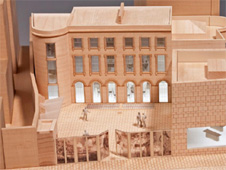
A model of the Black Cultural Archive in Brixton

A model of the Black Cultural Archive in Brixton

In recent years it has become more commonplace to see the stories of black Britons reflected in the mainstream media. They are as ordinary and extra-ordinary as any other community. However, in seeking to capture a moment and mediate that story to the maximum numbers of people, the media cannot possibly tell the whole story

By awarding the National Black Cultural Archive a sizeable grant of £5 million, the Heritage Lottery fund along with the Mayor of London (£1 million) and Lambeth council (the equivalent of £900,000), have secured a permanent location for this archive to take shape.

Located on the edge of Windrush Square in Brixton, the crucible of modern African and Afro-Caribbean migration and settlement, the new archive has the potential to stand as a testament to progress, inclusion and mutual respect.

Millions of taxpayers' pounds have already been spent on regenerating this location into a cultural meeting point. Making it a destination for those interested in understanding the emergence of modern diverse Britain is a challenge but also a sign that this story now matters to more than those who followed in the footsteps of the several hundred West Indians who first arrived on the Empire Windrush in 1948.

Of course this is only a beginning. Even a name has yet to be settled upon but any National Archive of black Heritage will be all about preserving, growing and protecting original source material particular to those communities of African and Afro-Caribbean origin.

In order to do that it will need to quickly secure a reputation and trust. There is plenty of competition for archives from established national institutions. People will not bequeath a lifetime's work to an institution that cannot demonstrate the potential for longevity and care.

The archive has the potential to act as the fount on which an inclusive story of Black Britain can be shared with many more people and new independent interpretations can be generated by scholars for future generations.

In this sense the announcement of funding is historic. But there will be little time for self-congratulation with the derelict building due to come on stream in time for the London Olympics.

Britain has a proud reputation of scholarship and that is built on strong traditions of intellectual rigour. Independent archives are at the heart of this. Protecting the open society from its enemies can sometimes seem like a thankless task for archivists.

The reward in this case could be a powerful sense of worth that black communities will generate in themselves and amongst others as the archive delivers its precious gems in the years beyond 2012.

Rickets makes a UK comeback

Post categories:

Kurt Barling|10:17 UK time, Friday, 8 October 2010

In order to see this content you need to have both Javascript enabled and Flash installed. Visit BBC Webwise for full instructions

So here we are in late 2010 and the wonders of medical science are all around us. And yet an ailment reminiscent of Dickensian London is once more being reported by GPs across the country.

Rickets is being newly detected in several hundred children each year. The cause is Vitamin D deficiency.

This is the tip of the iceberg of a Vitamin D deficit which is affecting increasing numbers of patients including both adults and children.

Some clinical studies are suggesting that up to 50% of individuals in some ethnic minority communities have Vitamin D deficiency.

Although not exclusively a problem for ethnic minorities it could be that migration plays a part in the high incidence amongst groups like Somalis.

Although there is no obvious research link as yet, but common sense tells us that as sunlight is the major source of Vitamin D, insufficient exposure to it may be causing problems.

Those who historically lived at lower latitudes where the sun is more intense may find this may be affecting them.

The symptoms are chronic tiredness, aching joints, dizziness, sometimes seizures or fits in young children.

Abdi Weli Osman who is an advocate for Somalis in Kilburn claims that as well as making it difficult for adults to hold down jobs, Vitamin D deficiency is showing itself in poor performance in school and even stress in relationships leading to marital breakdowns.

Some Somalis are presenting Vitamin D levels 10 times lower than the expected norm.

Unlike back in Victorian times, we understand symptoms and cause and we have a ready medicinal remedy.

GPs like Dr Stephen Nickless at the Brondesbury Medical Centre in West London say the problem is once identified they are struggling to treat the condition.

The reason; Vitamin D clinically prescribed supplements have been in shortage for over a year in some places.

Pharmacists like Mike Ritson of ABC Pharmacies say it has been nigh on impossible to get either the high dosage tablets or injections from the single supplier in this country.

Of course that begs the question why there is only one supplier and other European Union manufacturers have not had their product licensed in the UK.

What seems ridiculous is that Vitamin D supplements, the prescription variety, are declared an essential drug by the World Health Organisation.

You'd think that there would therefore be ready stocks of the medicine in a sophisticated country like our own.

Unfortunately the way the pharmaceutical market works is that the risk associated with producing the drug is with the commercial sector.

In other words, who bears the cost if the drug is produced in large quantities and it is not then prescribed? In the circumstances commercial companies only produce according to predicted demand.

As the problem of Vitamin D deficiency has become more widely recognised in the past few years production has lagged seriously behind rocketing demand.

The Department of Health told me they are in discussions with other suppliers to see if they might like to produce the drug. They blame manufacturers for not alerting them to the ongoing shortages.

They have at least publically, acknowledged that there is an ongoing problem.

The Department of Health went on to tell me that the Medicines and Healthcare Products Regulatory Agency should be doing something to rectify the situation. The MHRA told me that a supply problem is for the Department of Health to rectify.

Well, whilst they argue among themselves we can safely assume that the incidence of rickets will continue to rise and those with the chronic symptoms of Vitamin D deficiency will continue to suffer, creating untold costs for the economy.

In a word: bonkers.

BBC © 2014The BBC is not responsible for the content of external sites. Read more.

This page is best viewed in an up-to-date web browser with style sheets (CSS) enabled. While you will be able to view the content of this page in your current browser, you will not be able to get the full visual experience. Please consider upgrading your browser software or enabling style sheets (CSS) if you are able to do so.