BBC BLOGS - Barling's London

Archives for September 2010

Remembering one of London's civil rights pioneers
Post categories:

Kurt Barling|13:48 UK time, Monday, 27 September 2010

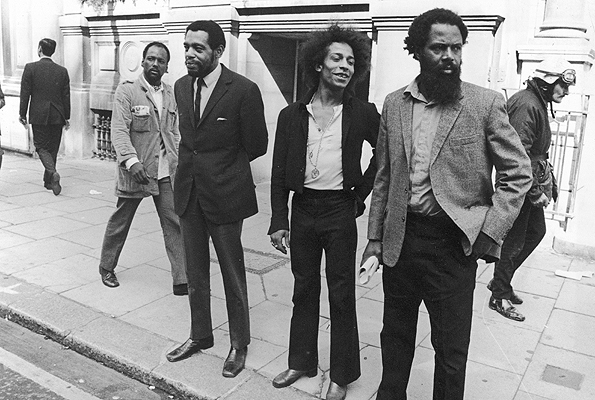
Thw owners of the Mangrove restaurant, left to right, Roy Hemmings, Jean Cabussel and Frank Crichlow

Looking back at a Notting Hill community stalwart, Frank Crichlow, who has died at the age of 78.

In the mid-1970s an old West Indian friend of my mother's - "uncle" John - took me to Notting Hill.

He wanted to introduce me, a North London Comprehensive boy, to the heart and soul of London's Black Community.

We ended up briefly at the Mangrove restaurant.

It was a pretty daunting place for a young teenager. People there had plenty of swagger and the venue had an intense but chilled-out ambience.

What really impressed me at the time was it was full of black and white people, who seemed to me to be very old (probably the same age as I am now!) who got on.

It seemed to defy the public conventions of the time that Black and White people didn't mix. It was a pretty intoxicating atmosphere.

"Uncle" John introduced me to the Mangrove as a place that had "fought the power" and won.

In terms of the emerging political consciousness of the black community in London, the Mangrove was a powerful antidote to the powerlessness that many young black Londoners often felt.

Within a few years that sense of frustration had spilled on to the streets of Brixton and later Tottenham in the disturbances in the early 1980s.

At the centre of the hubbub that day was a man with a scraggly beard who looked to me like a formidable figure.

I was briefly introduced, no words were exchanged, but I recall sensing that cool acknowledgement, familiar to some men who know and revel in their status.

By that time Frank Crichlow had become a well known civil rights campaigner whose restaurant had been targeted by Her Majesty's local constabulary on numerous occasions, allegedly as a drug den, only to be personally exonerated by the courts.

Unlike the modern besuited "activists", Crichlow came from a generation of people who became active because they felt the lick of a police truncheon and had become very familiar with the décor inside a police cell, mostly because they didn't appear to play by the convention of deference to police officers.

They demanded common courtesy and respect and when they didn't get it, they took to the streets.

In 1970 this led to the "cause celebre" at the Old Bailey, when the "Mangrove Nine", were tried for riot and affray.

The trial lasted for nearly three months and exposed a deep current of prejudice and dubious practice within the Metropolitan Police, long before Scarman and Macpherson.

When the "Nine" were acquitted many people thought it was a victory for common sense. In Notting Hill it was seen as a significant victory for the Black Community.

Crichlow's interest to the police didn't subside after this trail. Many saw his Mangrove Community Association, set up in the wake of this trial, as a red rag to the police bull.
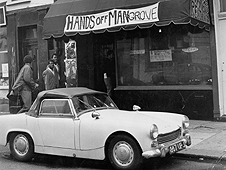
The Mangrove restaurant

He was back in the courts several more times all centred on allegations about the Mangrove.

In 1988 the Mangrove was raided again and the consequence was its demise as a Community meeting point after nearly 30 years.

Defended by the redoubtable, Gareth Pierce, Michael Mansfield and Courtney Griffiths (both the latter now QCs) he was acquitted and eventually awarded damages of £50,000 by the Metropolitan Police.

The following year I became a journalist for the BBC and one of my first films was for the programme Heart of the Matter about the criminal justice system.

Courtney Griffiths recommended I speak to the man I'd met more than a decade earlier to understand the root causes of black youth disaffection and the reality of the criminal justice system at the time.

He was gracious although sceptical of any besuited BBC journalist, although he softened when I reminded him of our brief encounter all those years before.

Frank Crichlow and his generation had to cope with the disappointment and identify the problem of racism.

We are still working towards the solution of the more tolerant, caring and diverse community that he and others like him aspired to.

What's in a name?

Post categories:

Kurt Barling|15:47 UK time, Tuesday, 21 September 2010

CLR James

CLR James

Quite a lot you would think if a local authority asks you and your family to use your name above a library because of your contribution to British literary culture.

Cyril Lionel Robert James, otherwise known as CLR James, remains one of the most illustrious men of letters to emerge from the Caribbean.

A row has broken out after Hackney Council has decided to ditch his name on one of their libraries.

Born in 1901 in Trinidad he came to England with his friend, the West Indian cricketer Learie Constantine in 1932. He settled in Lancashire for a time and wrote for the Manchester Guardian.

James' ambition was to pursue a literary career and in 1933 moved to London. The same year that Adolf Hitler came to power in Germany. That puts his times in some perspective.

He soon made a name for himself as an expert critic of the colonial system and a radical political activist. To be precise he was a Trotskyist who believed in trying to infiltrate the Labour Party to bring about social change. Later on he became a firm Marxist and with his childhood friend George Padmore became part of an afro-Caribbean intelligentsia.

This intelligentsia included future African leaders like Kwame Nkrumah and Jomo Kenyatta, first Presidents both of independent Ghana and Kenya respectively.

As a playwright he put Paul Robeson on the West End stage in 1936 taking the lead role in James' play on Toussaint L'Ouverture, the Haitian revolutionary who kicked the French, British and Spanish out of the west of the Caribbean island of Hispaniola in 1804.

He wrote the first novel to be published by a Caribbean author in the UK, Minty Alley in the same year. He went on to write the seminal study of the African Diaspora through the story of the Haitian revolution in his book The Black Jacobins in 1938.

His autobiography published in 1963, Beyond a Boundary, cemented his reputation as a man of letters and a lover of that most English of games, cricket.

Why the potted literary history? Well, in 1985 a library in the London Borough of Hackney was named in his honour, the CLR James Library.

He attended the dedication and opening himself, a big fuss was made of the importance of celebrating the contributions made by black Britons to our modern City. CLR James died in 1989.

The whole event was meant as a mark of respect for his contribution towards the British understanding of the Caribbean way of life and his literary accomplishments.

Well, in its wisdom the current arts gurus in Hackney have decided to expunge his name from their new library being refurbished on the existing site. Instead of the CLR James Library, it will be called the Dalston Library and Archive.

His widow, Selma James, who just a couple of years ago was invited to toast the continued success of the use of his name, has told me of her disgust at the decision to remove her late husband's name from this place of knowledge and learning.

Supporters of Selma have already started an international petition at what they see as a modern example of disrespect.

Actually there are no crass explanations from Hackney over the name change. They're not saying he was too much of a Marxist, or nobody knows who he is, simply they want to name it after Dalston because that's where the library is.

Nevertheless, crass is quite probably an apt description of the decision by Hackney Council to change the name it not so long ago bestowed on a public building for the contribution by an Afro-Caribbean scholar.

Of course it may be that old CLR and his rather left-wing views no longer fit the mould of the modern view the Labour Party has of itself. But that would be a sort of revisionist agenda unbecoming of a local authority who simply wants to honour individuals for their intellectual contributions to the life of the community.

There are hundreds of buildings all across London named after civic leaders and people who have made a significant contribution to communities in their lifetimes. It is often a small sign of recognition for a lifetime's work.

If we were to go around changing all these names we in some way would be divorce ourselves from our past and those who helped shape it.

You can follow me on Twitter @kurtbarling

It's time to escape the ghosts of the past

Post categories:

Kurt Barling|14:14 UK time, Monday, 20 September 2010

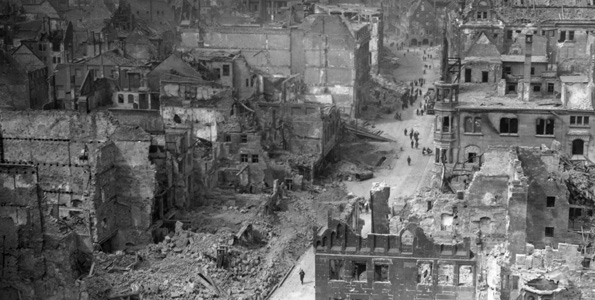
Nuremberg in 1945 after it was heavily bombed by the Allies. Getty Images

Nuremberg in 1945 after it was heavily bombed by the Allies. Getty Images

Once again we turn to the past to remember those in battle who preserved the freedoms we enjoy. I can remember every commemoration since the 25th anniversary of VE Day in 1970.

It seems that the further we get away from that conflict, the more intense are the feelings of nostalgia for those that were there. The longer my and future generations escape the tragedy of total war the more we revere those who survived the last.

These days we look back far less in anger. Nostalgia is more often the order of the day. The London Blitz spirit, so often regarded as resilience in the face of adversity, is evoked to remind younger generations of the privations but also the qualities that derived from that terrible air war.

It seems to me that it remains difficult to get the balance right between celebrating the heroics and expressing the sorrow, basking in the glory and comprehending the pain.

Over the past few weeks I've made several pieces for BBC London News to help cast an eye over the 70 years that have passed since the Battle of Britain and the Blitz in 1940.

These two events have shaped the perception of modern Britain as much as any others in the twentieth century.

In the course of this I have been speaking to dozens of survivors of the incessant raids on London which reduced large chunks of it to rubble. I also watched a German documentary made in 2005 entitled "Als Nurnberg Brannte..." (When Nuremberg burned).

Although the firestorm happened much later in 1945 the damage in the Bavarian city was even more devastating. The Old Town disappeared.

In my home, as I was growing up, I was familiar with both stories and the uncertainties it brought in childhood.

My mother was raised in London during the Blitz and endured the V1 and V2s. In Nuremberg, as the Americans by day and the British by night pummelled the spiritual heart of Hitler's Reich, my father survived.

What strikes me is the difference in tone of the people in these two cities, all in their late seventies or early eighties, mostly children during the war, when they reflect on the war from the air directed inevitably at civilians.

I have always been struck by the tone of unremitting regret and pain which shrouds the recollections of Germans and Nurembergers at what became of their cities and their early lives in the immediate aftermath of the war.

Here in London the tone has always been different, slightly more triumphal, slightly less inclined to apologise for the loss on the other side.

Of course it is the victors who write history and determine the emphasis of victory's purpose. Here in London even in the destruction, bitterness and penury that plagued much of Britain until the mid-1950s, we lived in the certainty that we were right and had just cause and the Nazis were certainly wrong. Over that there can be little dispute.

But there is a danger in deriving the source of our certainty and righteousness from events that are now a long way off, where there are ever fewer eye-witnesses and the truths that we held as self-evident are slipping from stories into myths.

We must increasingly deal with our own times without necessarily finding answers in that past.

The truth is there are two sides to every story and we must begin to recognise that the sacrifices made in London during the Blitz were equalled and surpassed several times over by our former civilian adversaries.

The pain and loss of war is universal.

BBC © 2014The BBC is not responsible for the content of external sites. Read more.

This page is best viewed in an up-to-date web browser with style sheets (CSS) enabled. While you will be able to view the content of this page in your current browser, you will not be able to get the full visual experience. Please consider upgrading your browser software or enabling style sheets (CSS) if you are able to do so.