Show me the ML-oney

Adriano Basso
Executive Product Manager, Datalab
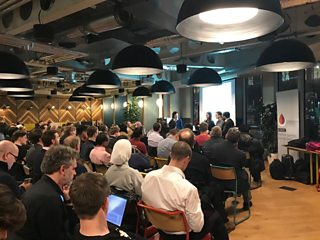
On Wed, 16 January 2019, a fine group gathered at WeWork Paddington to try to peel back the layers of the onion on the impact of VC funding on ML progress (and vice versa).
The headlines…
In 2017, according to KPMG, the VC industry doubled their investment in AI and ML to $12bn. While some argue that the VC investment into the space is plateauing, there is no denying that this is big cash.
The Provocation…
So what impact does this sheer level of spending have on the developments in machine learning? Does this mean that machine learning is only applied to industries that allow startups a quick exit? Or are we actually seeing the end of startup innovation as large tech organisations compete to pay large salaries to hire rare deep-learning researchers? And if the future is AI everywhere what impact does it have on most of us if this technology is mostly developed in privately-funded companies?
On the Panel…
Tong Gu, Investor @ Accelerated Digital Ventures
As an Investment Lead in ADV, Tong's job is to ensure investments reach the most promising tech-enabled startups growing under the leadership of ambitious founders. Tong has an MBA from INSEAD and an BEng in Information Systems Engineering from Imperial College London.
Meri Beckwith, VC Investor @ Oxford Capital
Meri is an investor with Oxford Capital, an early stage Venture Capital fund in the UK. He is particularly focused on digital health and the future of mobility, but above all looks to back ambitious teams tackling huge societal or commercial problems.
Linda Jiang, Advisor @ Baidu Ventures
Linda Jiang is an advisor at Baidu Ventures (BV). BV is an independent venture fund established by Baidu in 2017, focusing on AI and data-enabled companies. Linda was a co-founder of Comet Labs, an AI and robotics accelerator based in Beijing and San Francisco. Prior to Comet Labs, Linda was a co-founder of UMENG which grew into the largest mobile analytics platform in China and was then acquired by Alibaba. Linda has a MSc in Management at Royal Holloway University in London, she is now reading Cognitive and Decision Sciences at UCL.
David Kelnar, Partner and Head of Research @ MMC Ventures
David is a Partner and the Head of Research at MMC. David graduated with double First Class Honours in Philosophy from the University of Cambridge.
And of course our own Gabriel Straub (Head of Data Science and Architecture @ BBC) acted as moderator and agent provocateur.
The Discourse…
Gabriel led the panel through several lines of inquiry. To start with, when asked about overall thoughts of ML vs. investment, David spoke of his exercise in trying to understand the scene by creating an AI startup ecosystem map in Europe (1600 AI firms in total, with 500 in the UK alone). He claimed that there is now a “flywheel effect”, with funding events causing a positive feedback loop of talent and capital, and noted that AI companies are raising more than non-AI companies at higher valuations across the board.
Gabriel then prodded the panel to see if acqui-hiring, namely the purchasing a firm strictly for its employees, is a real or imagined phenomenon. David explained his view that acqui-hiring in the UK is a myth, stating “nine out of ten AI start-ups are B2B, looking for funding against a business plan and not for acquisition”.
Next, Gabriel asked about the theory of “killzones”, that is, areas of expertise and capabilities around the large tech players that are simply uninhabitable for startups. Both Tong and Meri disagreed with the theory. Meri cited NLP as an area well served by the big tech players, but with a plethora of nimble start-ups with offerings valuable to both the market and VCs. David then clarified that it is not capital, but talent that is limiting the growth and success in this area.
Gabriel sought the panel’s view on the different approaches to AI between US, European and China firms. David noted that Europe has become a powerhouse in creating $1B unicorns, but it was Linda’s focus on China that was most direct: she pointed to both high adoption rate of ML and the lack of GDPR as an advantage to harvesting and processing data. In fact she stated that “70% of Chinese companies have all their data in a single data lake already”.
Next, the topic of responsible (ethicial) ML surfaced, specifically how important it is to the market? Meri commented on the “tech-lash” response to recent breaches as being quite real. Tong concurred and spoke of firms attempting to anti-bias data and ML, with David pointing to new frameworks for setting rules, and checks & balances. He quoted Durham Constabulary’s ALGO-CARE as a potential framework for investigation.
What about the metaphoric student becoming the master: the automation of Venture Capital? All on the panel agreed it is coming, but had different views on the level of sophistication. David had the most interesting view: he is looking forward to it, with issues such as gender diversity being addressed through this. Meri commented on Google Ventures’ replacement of the investment committee with “the brain” (NOTE: this could not be confirmed through any official source, although he may have been referring to the rumoured “the machine” indicated here).
In the roundup, Gabriel asked for what each panelist thought would be key in 2019. Tong re-iterated her focus on Team/Time/Opportunity as the key to finding good opportunities. Linda and Meri agreed that the focus was to find firms that had access to unique data and could build cool products upon them. David pointed to healthcare startups in Europe, as intrinsic healthcare costs rise, the opportunities will follow.
The floor was then open to questions. We spoke of the merits of explainable vs black box AI, regarding which David said that approaches should be appropriate to the use case, citing loans, surveillance and bail as examples where explainability is paramount. And the panel was invited to cite companies that “blew their mind” in the past 12 months: Tong mentioned BeSecure, Meri spoke of LatentLogic, and David Snap40 (links have not been provided and names may be spelled incorrectly, and this should certainly not be taken as investment advice!).
After a few more questions the event was drawn to a close: it was a fine evening for one and all!
