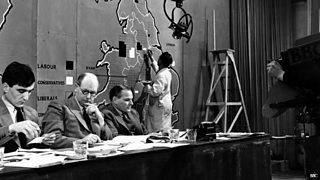
Where it all started - the BBC first covered a general election on television in 1950, where the graphics would have been up the creek if they had run out of paint
As the final results come in for the 2017 general election, which has ended in a hung parliament, news and analysis is being brought to BBC audiences on TV, radio and online. We look back at some historical election coverage, and five "firsts" in the history of BBC election broadcasting.
BBC general election coverage is virtually as old as the BBC itself. The BBC began broadcasting on 14 November 1922 in London (with the rest of the country following soon after), and a general election was held on 15 November.
Further elections followed in 1923 and 1924, where the BBC reported the results between items in a music broadcast.
First Radio Times cover
In 1931, for the first time, the election results were billed as a separate programme, although music was still used to fill the gaps between announcements of the results. The 1931 election was also the first where the event was given publicity on the Radio Times cover, as part of the evolving style of the magazine's presentation.
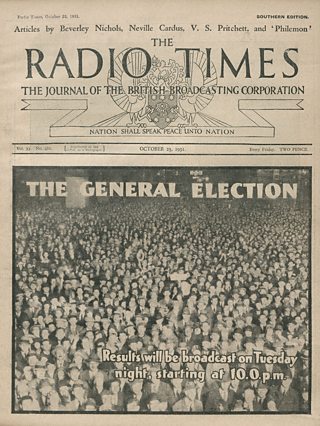
Radio Times featured the election as a cover image for the first time in 1931. This was the last time that a UK general election was held on a day other than Thursday (hence the caption)
First television coverage
Because of World War Two there was no British general election between 1935 and 1945, since television was barely functioning in 1935, and had not restarted after the war in time for the 1945 poll.
The first televised election coverage was in 1950. It was very basic, but from that seed the subsequent coverage has grown.
Richard Dimbleby hosted the 1950 programme, but in 1951 he was one of three correspondents covering the counts in Salford, Birmingham and Fulham in London, representing the three areas in which television could be received at that time - one more than in 1950. From 1955, however, Dimbleby became the main regular presenter of election night programmes, until his death in 1965.
First use of the "swingometer"
Another innovation in 1955 was the Swingometer, although on that occasion it was only used by the BBC in the West Region (Bristol) to show the fluctuations in party share in the two Southampton constituencies. However it obviously caught someone's imagination and was used to illustrate the national swing in 1959, after which it gradually developed into an essential tool of election coverage. The journalist Bob Mackenzie became synonymous with the device, one of those institutions which are loved and puzzled over in equal measure.
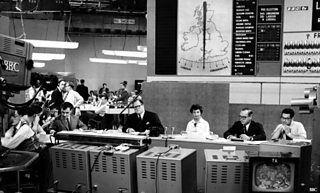
The 1959 election saw the first national use of the Swingometer - you can tell the Bob Mackenzie (second from the right) is dying to get his hands on it - if he can find a stepladder
1955 also saw the first use of a computer to help calculate the implications of the results, although the sizeable machine used then probably had less computing power than the average modern mobile phone. It was a while though before the slide rule was completely dispensed with.
First time in colour
Colour television started in Britain (other than test transmissions) in 1967, just missing the 1966 election, so the 1970 election was the first chance to see what difference it would make. Elections being what they are, they were perhaps not the greatest examples of the imaginative use of colour - other than in the colours of the rosettes of the political parties.
There were still relatively few people who could receive colour pictures then, so the two elections in 1974 saw a far greater proportion of colour receivers around (many bought so people could enjoy the pageantry of Princess Anne's wedding the year before). Colour did add a new dimension to the graphics used, with the new technique of Colour Separation Overlay (bluescreen) coming to the fore.
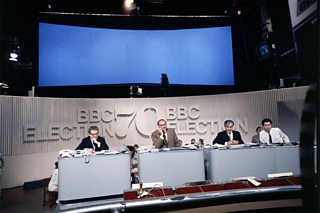
BBC election presenters in 1970 included Alan Watson, Cliff Michelmore and David Butler. One unusual feature of election night was Up the Polls, a comedy special written by Johnny Speight, shown just after 10pm
First computer graphics
By 1970 computers were becoming less miraculous (although it would be a long time before they became a household object). Their applications were becoming more diverse however, with the very earliest computer graphics introduced in that year's election, in the form of a caption generator. Election graphics started as hand-painted results put onto cards by graphic designers in 1950, with teams of students acting as runners to get them in front of the camera in time. Computerised captions made everything a lot quicker and less frenetic.
As David Butler admitted during the 1970 election results programme, computers were a vital tool as more and more results came in to tabulate the numbers of votes cast and to work out the implications of what was happening around the country.
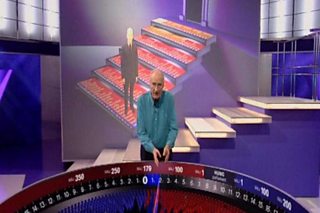
By 2001 the Swingometer (here explained by Peter Snow), which had been retired temporarily in 1979, had returned as part of the arsenal of virtual reality aids which are an essential part of modern election coverage
Elections are a nice way of looking at the progression of broadcasting techniques and technology. Watching election coverage has become a cult interest with many amateur psephologists staying up till the small hours to see which party is on its way to power (though sometimes it is not that simple). Television election coverage has become part and parcel of the occasion, with rival channels vying for the largest ratings.
David Dimbleby, son of Richard, has become the new face of BBC election coverage over the last few decades, supported by a large team of reporters and correspondents. Jeremy Vine has succeeded Peter Snow as the maestro of the computer graphic displays used to illustrate the projections and the results as they come in. While the old style Swingometer was phased out in its physical form, it is still sometimes resurrected as a nod to the familiar tropes of this very British expression of democracy.
