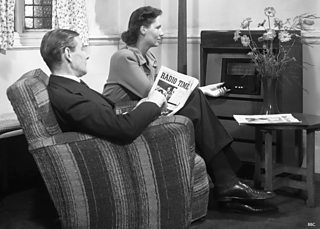
Two members of the BBC's radio audience tune their radio in the 1950s. Audience correspondence was published in the Radio Times magazine from its earliest editions
Here at Genome, we love to find out what our audience is looking at and enjoying in the listings – and you tell us on social media, by posting on our blog and by sending us emails. Please keep at it - we try and reply and we love to get your feedback.
Delving into old copies of the Radio Times we come across the feedback of BBC audiences past. Numerous letters have been published by the magazine through the years. These have appeared under various headings – including What the Other Listener Thinks, Points from the Post, and with the advent of TV, Viewers’ Views.
Here’s a selection of our favourites…
A new format
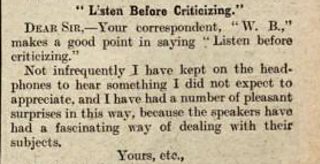
Earliest letters to the Radio Times show an audience still getting to grips with radio broadcasting. This one, from 1925, encourages critics of BBC programmes not to switch off: “Not infrequently I have kept on the headphones to hear something I did not expect to appreciate,” wrote DBW from Sheffield, “and I have had a number of pleasant surprises in this way, because the speakers had a fascinating way of dealing with their subjects."
There was also interest in BBC announcers, with one listener even going so far as to suggest they should perform in their own concert. This correspondent in 1939 asked: “Would it be possible to have a concert with the various BBC announcers as the artists? I am sure there must be a considerable amount of talent among the announcers. Might we not hear some of it?”
There’s a good fellow…
In the days before the BBC became “auntie”, this listener from the Isle of Man certainly thought of the corporation as a man. “Discussing your programmes the other day I heard you had Jane Eyre on the air,” said Henry, in 1939. “Will you, like a good fellow, repeat it?"
One for the sound department
It's hard to imagine requesting this now, but whistling as a form of entertainment played its part in the early schedules. In fact there are 2545 references to whistling in Genome. In 1939 Ursula from Yorkshire asked “May we have more whistling in broadcasts? The very little we hear is so charming – and many people are especially fond of that form of music.” It's possible Ursula may have recently tuned in to a BBC Orchestra programme that went out in March of the same year, and contained "Merryheart's whimsical whistle, which provides the material for a series of mood pictures and dreams, amorous, heroic, and playful in turn."
In defence of mothers-in-law
One listener in 1951 commended the portrayal of this famously tricky relationship in BBC radio serial, Mrs Dale’s Diary (Later The Dales). The programme was broadcast from 1948-1969, and imagined daily life from the point of view of a doctor’s wife. “As a mother-in-law,” said Ethel, from Essex, “I would like to say how much I appreciate the favourable light in which Dr Dale portrays his. It is truly delightful.”
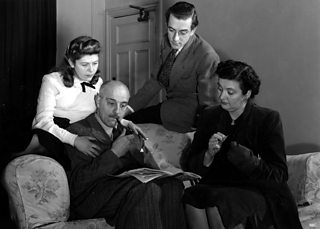
Happy families: From left to right: Viirginia Hewett as Gwen Dale, Douglas Burbidge as Dr Dale, Hugh Latimer as Bob and Ellis Powell as Mrs Dale. But not a cat to be seen...
Who, exactly, is Mrs Freeman’s Cat?
The same serial elicited quite a different response from a listener in 1959. "I enjoy many of the letters published in Radio Times, but why such interest and so many letters regarding a hypothetical character and an even more hypothetical cat?" asked IM, about a cat belonging to Dr Dale’s mother-in-law, Mrs Freeman. The episode which elicited a flurry of correspondence touched on the feline's diet. A note from the editor under IM's letter remarks: "The Letters provoked by ‘Captain’s’ diet seem to have been from non-hypothetical people about even more non-hypothetical cats.”
Parents cowed
Nowadays parents unsure of their facts can easily check information online, but in the pre-internet world, this letter from a parent in 1955 shows the perils for parents of missing informative broadcasts for children. "In Children’s Television recently, there was a programme explaining the technique and equipment of Outside Broadcasting, since which my ego has suffered a considerable blow!," remarked JM. "Instead of being counsellor and adviser to my two sons, I am now in the position where I do the asking, and the lads proudly say: ‘No, Dad, it’s not a bit like you think.’ Please, oh please, repeat the programme for evening viewers, so that I and doubtless thousands in like circumstances, may once more regain our status as knowledgeable parents."
Broken records
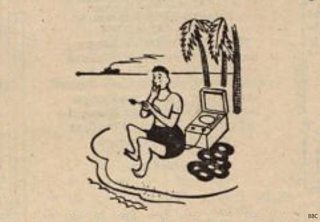
In the same issue, we love this illustration of a confused Desert Island Discs castaway with a broken gramophone. “When I hear Mr Roy Plomley say ‘assuming of course, that you also have a gramophone’ I sometimes have a frightful feeling that [the below] might happen’, said Maurice.
One other lateral-minded listener asked in the same edition whether the BBC gave its castaways specially made one-sided records. “And if not,” asked Angela, “are they honour-bound never to play the reverse side of the records?” We're not sure that even the most self-denying castaway could promise that…