
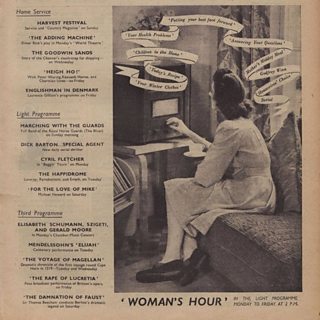
The cover announcing the launch of Woman's Hour, October 1946
Woman's Hour first went on air in the Light Programme on October 7th 1946. It made it to the cover of the magazine, and a feature inside explained the programme would include "talks on household management, cookery, fashion, beauty culture, child care, housing, and pensions." The presenter was Alan Ivimey, a "London-born journalist who specialises in writing for and talking to women" - he was replaced three months later by Joan Griffiths.
The first week of programmes featured subjects such as "putting your best face forward', "how to take care of your feet", coupon savings and pensions. The listing for each day of that first week on air was highlighted in a beautifully illustrated box.
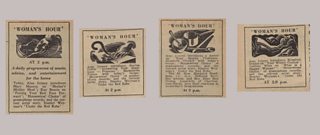
The listings for the first editions of Woman's Hour, October 1946
The first programme was followed by a special listeners' panel hearing the programme in Broadcasting House. The panel consisted of "Miss Margaret Bondfield, who was Minister of Labour from 1929-1931, Miss Deborah Kerr, the film star, and Mrs. Elsie May Crump, a butcher's wife from Chorlton-cum-Hardy."
Five years later, deputy programme editor Joanna Scott-Mancrief summed up some of the controversies stirred by the programme through their listeners' letters. She describes how an item in which Dr. Joad discussed English cooking "brought hundreds of brickbats and bouquets" including the letter from a listener at Gorleston-on-Sea: "Englishwomen cook what their menfolk want to eat. The average husband, faced by some delectable French concoction, will view it with grave suspicion and enquire: 'What's this?'"
She also highlights a letter asking Woman's Hour to start a "vigorous campaign". "We as women of the country are everlastingly referred to as 'housewives.' The Government, the newspapers, the BBC, the shopkeepers, all and everyone call us housewives. Couldn't we find some more attractive noun for ourselves? Please talk it over and see what you can do."
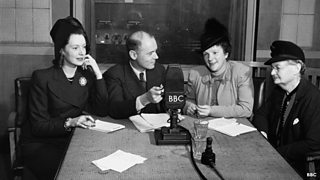
T. Holland Bennett interviewing Miss Deborah Kerr, Mrs. Elsie May Crump and Miss Margaret Bondfield
The deputy editor wrote again in 1956 about how the programme had evolved in the first ten years of life: "In 1946 housewives' problems were so many and pressing that the stress in the first programmes was inevitably on practical matters. In ten years listeners have, however, shown us that their interests are as wide as the world itself: accordingly, the programme has travelled abroad and acquired its own correspondents in five different countries."
Fast-forward to 1967, when Woman's Hour decided to celebrate its 21st anniversary with a series of "birthday fortnight" special editions. "Although those of us who produce the programme had not planned any special celebration, listeners have been writing to us throughout the year to remind us of our birthday, sending greetings and suggesting items they would like to hear", wrote Monica Sims, editor of the programme at the time.
Items that week included a talk from Dr Benjamin Spock about parenting, a couple undecided about marriage, and being a grandmother.
She announced some favourite guests and broadcasters would be "looking ahead to life in 1988" and hoped that for the next 21 years listeners would "enjoy many happy returns of Woman's Hour."
Woman's Hour did indeed continue on air in 1986 and made it to the cover of Radio Times for its 40th anniversary. The main article described the programme as "the first to break the BBC taboos surrounding such things as the Pill,homosexuality,impotence and frigidity". Programme editor Sandra Chalmers added that "we would never do something purely for the sake of shocking people, "but if it's in the interests of our listeners, there's nothing that can't be discussed."
The 50th anniversary was celebrated in 1996 with a cover featuring a semi-nude photograph of actor Helen Mirren, at "50 & Fabulous". Presenter Jenni Murray told how in 1992 "the programme came under threat. It was suggested that in a 'post-feminist' era its time, title and focus should change, you the listeners gave the reasons why it should continue - in an unprecedented furore directed at the then controller Michael Green (who now openly admits to travelling in permanent terror of being handbagged wherever he went)".
"You told him the programme celebrated, informed, entertained and educated women, filling in the gaps that other programmes ignored. Some of you wrote to say how Woman's Hour had changed your life - giving you the courage to apply for a job, cope with a difficult teenager or take out the pension fund you'd been putting off. Some of you spoke of smears or mammograms you'd had because you heard it on Woman's Hour. The programme had saved your life. Men, too, wrote in to save 'their' programme - explaining how they loved to hear a female perspective, or how they now understood their wife's illness considerably better after hearing it described.
Woman's Hour will be celebrating its 70th birthday with a live audience show from the BBC Radio Theatre on October 10th. The panel will discuss the results of a poll specially commissioned to find out how life has changed for women at home and at work from 1946 to the present day. In the meantime, our suggestion is to search for different topics + the term "Woman's Hour" and organise it by Oldest First - this gives you a fascinating glimpse at how the programme has tackled different subjects through the decades. We've tried "job" and "sexual." What have you found?
