When BBC daytime television fully arrived

Heather Lewis
Guest blogger
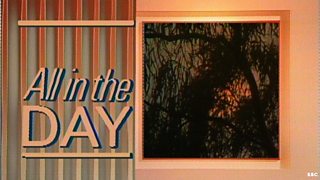
BBC Daytime was launched on October 27th, 1986, along with its pastel hued promos
Guest blogger Heather Lewis grew up with a love of television, with a particular fascination for continuity and idents from the 1980s. In-between looking after her two young children she celebrates Children's BBC in her blog The Broom Cupboard and Me and contributes guest posts for the Curious British Telly website. She writes about the launch of the BBC's full daytime television schedule 30 years ago.
There are a great number of us waxing lyrical in blogs and websites about television shows and schedules of the past. The 1970s and 1980s are now a fondly remembered age when the majority of us had a maximum of four channels to enjoy and the BBC1 nightly channel closedown sequence is worthy of a nostalgic discussion among enthusiasts on social media.
Less talked about though, is the BBC1 daytime schedule in the early and mid- 1980s. There is a reason for that of course and the words 'daytime schedule' are perhaps a little misleading due to a huge gap in the morning hours of programming until October 1986, now 30 years ago.
A delve into the pages of BBC Genome for Friday, October 24th 1986 paints an interesting, if baffling picture of daytime viewing options, or rather lack of options. With BBC Breakfast finishing just after 9am and a repeat showing of Will to Win (a documentary previously shown on BBC2 in 1985) we were treated to a selection of pages from the BBC’s Ceefax text service for a whole 55 minutes before that cornerstone of children’s programming Play School was aired. Pages from Ceefax appeared again afterwards for a lengthy 2 hours and 10 minutes until the lunchtime news bulletin at 1pm. So… where were all the programmes? Was that really it?
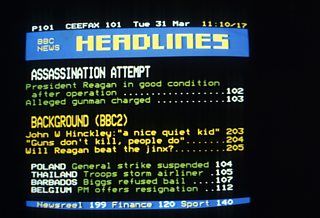
On the morning of October 24th, 1986, viewers were treated to a selection of pages from the BBC’s Ceefax text service for a whole 55 minutes... (image is from 1981)
We need to travel back to 1983 first of all. The BBC took a significant step forward in launching Breakfast Time early in that year, at that time it was followed by the familiar countdown dots of the schools and colleges strand just after 9am. More change was to come, however, from late in June 1983 as the schools programmes slowly ambled their way over to BBC2, leaving a few holes during the morning hours. By the 19th September 1983 the game of 'scheduling musical chairs' meant that Play School was now moved across to BBC1 and the schools and colleges programming occupied BBC2 for much of the day.
Until 1986 the odd programme creeped in to interrupt the weekday Ceefax and Play School dominance on BBC1. Repeats of Sunday teatime staples included Antiques Roadshow and Songs of Praise; the annual political party conferences filled up the Autumn months with Play School solidly standing its ground every mid-morning throughout (presumably to give the keen politics viewer a chance to take a tea break). The summer of 1984 brought us extended Grandstand, showing highlights from the Los Angeles Olympics.
The school holidays usually saw BBC1 with a slightly more jovial schedule, particularly in 1986, when with the new Children's BBC branding in its infancy, in-vision presenters (Debbie Flint and Andy Crane) appeared on screen during the morning introducing cartoons, the holiday staple Why Don’t You…? and special editions of Newsround. By September 1986 the kids were back at school and pages from Ceefax reappeared, much to the delight of some enthusiasts and the frustration of others.
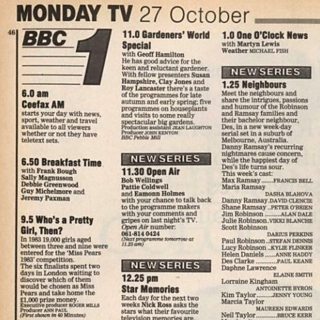
The Radio Times listing for the launch of daytime television
At last, on the 27th October 1986 the new look BBC Daytime finally arrived. It didn't exactly explode onto our screens, but lightly skipped on, complete with pastel hued promos that included an animated peachy coloured curtain and window for added scenery. Featured in the new daytime line up were the 'filler repeats' of classic comedy and films, but more importantly there was a significant number of brand new shows introduced on to our screens for the very first time.
Children's BBC presentation, now just over a year old, was rewarded with a small mid-morning slot either side of Play School where Phillip Schofield sat with his mid-morning coffee in one of the BBC’s small presentation studios, reading out birthday cards for his under-5 year old audience. It started off as a relatively simple, humble affair, as in addition to the hand-drawn cards, there were birthday messages hastily scribbled onto scraps of paper and shop bought cards! Nonetheless this is a format which was hugely popular and is still going strong every day, now on the CBeebies channel.
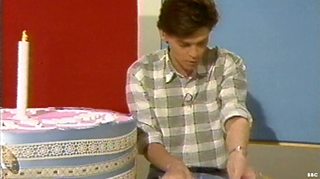
Phillip Schofield reading out birthday cards on the day of the launch
Open Air bore a striking resemblance to the BBC’s long running show Points of View, but expanding the concept into a live broadcast magazine. Originally presented by Pattie Coldwell, Bob Wellings and Eamonn Holmes each daily edition covered all aspects of television programming in an interactive (for the 1980s) way where viewers could telephone in and be given the opportunity to praise recent shows, or grumble about them. Various show creators, producers and presenters were put in the firing line to answer their questions. Enjoyably, we saw fascinating behind-the-scenes features of the workings of the BBC, for example in 1987 when Richard Straker talked the Open Air audience through his duties as a BBC continuity announcer. Some of Open Air was even dedicated to the new BBC1 Daytime schedule itself, and one of the programmes given notable attention was the lunchtime soap opera called Neighbours, which in terms of peak viewing figures became one of the BBC Daytime schedule’s most successful shows.
The story of Neighbours coming to the BBC was recalled by Roger Laughton who had the task of finding a drama suitable for a lunchtime audience. His choice was made simple when faced with a selection of numerous identikit American soaps, or a lone Australian drama centred round a small street of houses and a handful of families. Neighbours had an immediate appeal to many people, sitting down at lunchtime for 25 minutes of daily television escapism to a friendly world of warm sunshine and backyard swimming pools. Its popularity wasn't restricted to just frazzled mums of young toddlers and the retired, in school and college common rooms all over the country it became essential viewing for teenagers and students, too.
Throughout the latter half of the 1980s the daytime schedule evolved to bring us more new and long-running shows including the topical debate programme Kilroy, and Going for Gold, a quiz with an international flavour hosted by Henry Kelly.
There was even a Daytime magazine and a Daytime Club, complete with a flashy membership card. The phenomenal success of Neighbours continued to grow and the combined lunchtime and teatime repeat each day (from 1988 onwards) had audiences of 18 million upwards glued to Ramsay Street's unfolding dramas. The long, enduring stretches of selected 'pages from Ceefax' became a distant memory, much to the wistful sadness of some; but also to the joyous relief of many!
