Braden's Week
Andrew Martin
BBC Genome
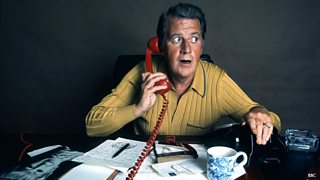
Hello, is that George Dixon from last week's blog? Bernard Braden here...
This week’s post features someone who brings together threads touched on in earlier entries, including early BBC stars, appearances on ITV, schools broadcasting, replacing talent, and long hair…
Following the Second World War among the people who had arrived in Britain from the 'old' Commonwealth Countries of Australia, New Zealand, South Africa and Canada, and ended up getting involved in the television and radio industries, were Canadians Bernard Braden and his wife Barbara Kelly. Braden, an actor, presenter, writer and producer, had worked in radio in his home country, and before long both he and Kelly became regular broadcasters on BBC radio.
During their careers they sometimes worked together and sometimes separately, their joint appearances including Starlight Hour, Bedtime with Braden and the 60s television sitcom B and B. Alone, Barbara Kelly was a regular panellist on What’s My Line, while Bernard Braden began hosting a succession of shows beginning with Breakfast with Braden. Other radio series followed, and Braden and Kelly both also made numerous appearances on BBC television. Braden’s television shows included The Brains Trust (as questionmaster), and a late-night entertainment called Early to Braden, and was even one of the commentators for the Queen’s Coronation in 1953. Four years later he presented the first ever BBC schools television programme, Living in the Commonwealth (which was about Canada).
Braden was an innovator, and made a television series in late 1958 called Personal Playhouse, in which he appeared on his own, and provided the voices of any other characters. It was made on film by an independent company – one of the earliest instances of this happening on the BBC.
Braden did not work exclusively for the BBC once ITV began, and after a couple of other commercial TV ventures, he hosted a programme for ATV called On the Braden Beat from 1962-1967. This had a mixture of political satire, comedy sketches – introducing Peter Cook’s character E.L. Wisty to a wider public – and music, including the comic folk singer Jake Thackray.
In 1968 Braden and Barbara Kelly came back to the BBC with the sitcom B and B, which had arisen from a successful pilot in the Comedy Playhouse series. At exactly the same time as this series went out, Braden started appearing in a new programme called Braden’s Week.
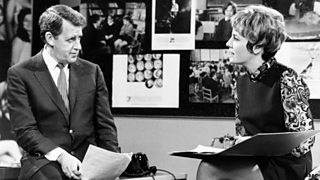
It's the Bernie and Esther show! Braden and Rantzen compare notes.
Virtually a new version of On the Braden Beat, Braden’s Week was made by the production unit of documentary series Man Alive, and largely dispensed with topical commentary, which was less in vogue by this time. Instead it had the kind of stories featured in newspapers that don’t involve politicians or celebrities – such as, in the first edition, a dispute between two neighbouring householders supposed to build two halves of a road, which didn’t meet; a school building that had been condemned as unfit in 1944 but was still in use, while another school was being built in an area with no children; and an item about the ‘white slave trade’ – there was an element of seriousness in such stories but the tone was wryly amusing and reassuring.
Interspersed with this were comic sketches, and more songs by Jack Thackray. The programme’s two reporters were John Pitman, a newspaper journalist, and Esther Rantzen, who had begun her BBC career as a clerk, before becoming a researcher on the satire series BBC3 (more TW3 than W1A). In a way Braden’s Week was a successor to the satire shows that had been a feature of Saturday night television since 1962 – but there was little to worry the establishment, other than in the sense that there were a lot of dodgy businessmen and faceless bureaucrats around, who were not being sorted out effectively by existing laws.
Many of the stories were sent in by the public, including the tussles with officialdom, complaints about faulty goods and poor service, various scams and dodgy deals, or just the humour and eccentricity of the British. There were also vox pops, filmed interviews with the public in the street, on topics such as long hair in men – a constant bone of contention in the sixties and seventies.
The consumer affairs element was relatively ground-breaking, although the BBC had screened a programme comparing goods in the early sixties, called Choice, which was made in association with the publishers of Which? magazine. Braden’s Week tended to concern itself more with the small niggles in life rather than anything earth-shattering - and this in the era of Ralph Nader and David Frost's 'Trials by Television'. However from the beginning it found itself being threatened with writs, and many of the episodes of the series which survive were those where there was legal action pending. The programme soldiered on, and there were no major court defeats to worry the BBC.
One memorable feature of Braden’s Week was a regular filmed item by Harold Williamson, where primary school children talked on various subjects in a ‘cute’ and precocious way. This was a continuation of Williamson’s series Children Talking, which had begun in radio on the North of England Home Service in 1961, was repeated nationally the next year, then transferred to BBC2 television in 1967.
In the second series of Braden’s Week, a third presenter was added, a representative of ‘youth’ called Sean O’Reilly. There was also a feature in which songs of the past were revived by the original singers, for example Lita Roza with ‘How Much is That Doggy in the Window’ or Dick James with the theme from Robin Hood.
Series 3, transmitted in 1970-1971, saw O’Reilly replaced by the avuncular Ronald Fletcher, who had worked with Braden on radio. His job was to sit in a padded armchair and read the humorous misprints from newspapers, and incomprehensible official forms and letters, previously been handled by Braden and the team. The ‘old song’ item had been replaced by ‘Surprise Performance’ in which ‘prominent people entertain us’ – these included Lord Soper, and Patrick Moore (which we imagine involved him playing the xylophone…)
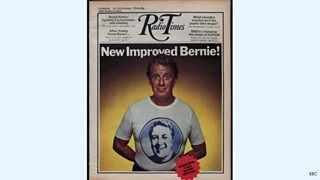
A cover star for series 4 of Braden's Week in '71.
The fourth series ran from 16 October 1971, and while the format and cast was remarkably unchanged overall, the quirkier ‘special’ items had been dropped. However a major fly in the ointment was about to emerge. Braden had agreed to front a series of television advertisements for a well-known brand of margarine, and though he was a freelance (he was, ahead of his time, paid through his own company, Adanac) it was felt by the BBC to be incompatible with his position as the host of a programme which might be called on to investigate any commercial company. And so, the edition of Braden’s Week on 29 April 1972 was to be the last.
Braden did appear on the BBC again, but his career never really recovered from his being dropped. In later years he gave more time to his business activities, such as an agency for after-dinner speakers.
In May 1973, just over a year after the demise of Braden’s Week, a new series called That’s Life premiered on Saturday nights. It featured a mixture of consumer complaints, scandals, faulty goods, funny vox pop items, and light-hearted or comic songs, and amusing press cuttings and misprints read out by a man in a comfortable leather armchair. The man reading out the cuttings was veteran comedian Cyril Fletcher; the reporters were actor George Layton and television journalist Bob Wellings; but the main host of the show was Esther Rantzen, who would remain in that role for 21 years.
