
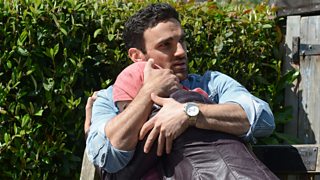
Tonight we saw Shabnam and Kush learn that their unborn has died. Sands, the stillbirth & neonatal death charity, has worked extremely closely with EastEnders to ensure that the story is portrayed as truthfully as possible. Below, Erica Stewart (Bereavement Support Services Manager at Sands) talks about working with EastEnders on this storyline.
Stillbirth is sadly nowhere near as rare as people think. In 2013, one in 216 pregnancies ended in stillbirth, that’s around 10 every day, and in total over 5700 babies died before, during, or soon after birth.
It is a devastating experience, but still a story that needs telling, and so we at Sands were very pleased when EastEnders approached us to tell us they were tackling this sensitive and difficult subject and ask for our help and guidance.
It has been a delight to work alongside the EastEnders researchers, and the actors Rakhee Thakrar and Davood Ghadami. We really appreciate their commitment and dedication in wanting to portray this sensitive storyline in a way that many bereaved parents will identify with. There has been a mutual respect from the very beginning.
Some of the other characters’ reactions to the death of Shabnam and Kush’s baby, again reflect how it is for parents in the real world. It’s a major bereavement and needs to be acknowledged as one. EastEnders has a vital role in bringing this awareness beyond those who have directly experienced the death of a baby.
Sands offers bereavement support to anyone affected by the death of a baby. We run a telephone and email helpline, publish a wide range of support booklets and information and have around 100 local support groups across the UK run by dedicated volunteer befrienders, the vast majority of whom are bereaved parents themselves. We also offer comprehensive training and guidance to professionals, in particular midwives and other healthcare professionals, to better equip them to work with people whose baby has died.
Sands firmly believes that many more of these deaths can and should be prevented. Other countries, such as Sweden and Norway, have a stillbirth rate that is much lower than that of the UK. We believe this is also achievable here so we promote and fund research to better understand why babies die to try and avoid further deaths.
There are also things mums-to-be can do to help towards a safer pregnancy. It’s quite common for mums, like Shabnam, not to ask for help when they feel something is wrong for fear they might be bothering their health professionals unnecessarily. Our message is – always call straight away if you are worried. That is what your midwifery unit is there for and they will welcome your call. Lots of information about having a safer pregnancy is available on our website [http://www.uk-sands.org/why-babies-die/advice-for-a-safer-pregnancy] and we will be launching a dedicated website for expectant mums soon too.
We would like to thank the writers and researchers, Rakhee and Davood for getting in touch and for having faith in our experience and knowledge around this subject. It’s a huge opportunity to lift the taboo around baby death, and give viewers a glimpse of what parents experience even before they leave hospital without their baby.
- For further information please visit: www.uk-sands.org
- Office 0207 436 7940 info@uk-sands.org
- For Bereavement support Helpline 0207 436 5881 helpline@uk-sands.org
