
We caught up with actor Rudolph Walker recently to discuss Patrick's stroke storyline.
How did you feel when you were told about the storyline?
First of all I thought “What an honour,” because this is a massive storyline, and because it’s something that, as far as I know, hasn’t really been tackled on television before a lot. As an actor it’s a hell of a responsibility. I hope I took the sensible route in that I did research and visited a hospital and spoke to patients. So I sincerely hope that comes through and my portrayal is something honest and true.
“And that it will make some sort of contribution to create awareness of the signs that we shouldn’t ignore and that there is no age limit. You can be young as forty, thirty and as old as whatever. But most of the time, there are warning signs and we have to acknowledge that and be aware of that.
So should Patrick have heeded the warnings when he had his TIA (Transient Ischaemic Attack) before the stroke?
An important message that the show is going to put out is that whenever you get the slightest warning signs - that something isn’t natural and doesn’t feel right - you really should have a check-up.
Do you know anyone who has had a stroke?
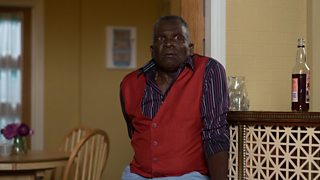
Yes, my father and, nearer to home, John Bardon (Jim Branning). My father died at 96, but he had a stroke in his late seventies. He completely recovered from it though. He lived to 96, so there is hope for me then!
Does the stress of Patrick finding out about Ian and Rainie have an impact on what happens with his stroke?
That’s a hard one to answer. When I was doing some research I spoke to a stroke victim and he said he had lost his grandson in the lead up. I asked if that had contributed to it and he said he’d never thought of it. The thing about strokes is there’s not one thing that you can pinpoint as responsible for it. It could be his lifestyle, it could be what he’s eating, what’s he’s drinking. It’s all sorts of factors. Yes, stress does play an important part in some instances.
So when he actually collapses, does he think he’s dying?
I don’t think he thinks that. I think he is thinking, “What is happening? I can’t move. I’m weak. I need some sort of help.” I don’t think that death has come into the picture just yet.
Can you talk about the effect that the stroke initially has on Patrick?
Strokes affect different people in different ways. I spoke to a lot of specialists and visited King’s College Hospital and tried to speak to patients. And they were all different. Some were able to regain their speech within a short space of time - within weeks - some months, some would take years; some were still working at it. Patrick has lost the use of his left leg, left arm and the ability to speak.
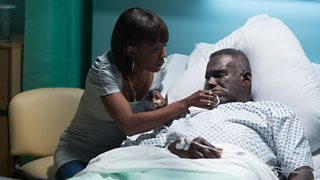
Whether it’s something that will carry on is a question you’ll have to ask the Executive Producer. I know it’s going to be a slow process and the Producers want to take Patrick through a realistic experience, through the pain, the suffering and the fight to regain his speech and his normality. He will face obstacles and for every patient there are different obstacles. I spoke to a grandmother who didn’t tell her family she had had a stroke for quite some time. She decided to not use a walking stick and fought her way up the stairs slowly but she did it. You need a lot of determination and strength.
Is it difficult as an actor to portray the effects of stroke?
Yes. It’s very challenging and requires a high level of concentration. Even when you are just sitting there you have to be aware that your left side is meant to be weak.
So how do you achieve that?
Well, part of it was make-up and part of it was what I did as an actor and responding to other actors - which was again challenging. But that’s what makes it exciting.
As someone who is quite active, can you appreciate how awful it must be for people who have a stroke to lose that?
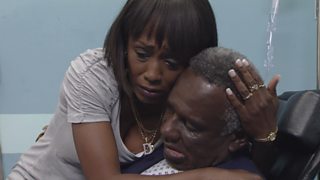
Yes! Oh gosh yes. I think what I would be like if I suddenly went from being an active individual to not being able to do anything at all and having to rely on other people. But that’s the psychological thing of accepting help.
Has this storyline made you think about your own health?
Yes, definitely. And so does my involvement as an ambassador for prostate cancer. I’ve always tried to look after myself from a very young age. I do a bit of exercise; I play a lot of tennis and a bit of cricket. I try to swim occasionally- with the word ‘try’. I become the laughing stock of the pool because I have a snorkel, because when I’m swimming I’ve got to swim with my head below water. The minute I try to put my head above I panic, so an instructor suggested I use a snorkel to eliminate the fear. I must admit I’m enjoying it now!
