
To find out more about medical issues surrounding Patrick’s stroke in tonight’s episode, we caught up with Stroke Association Information Advice & Support Co-ordinators Andrew Jones and Harriet Ingham, who were part of the team who advised on the storyline.
"A big part of Rudolph Walker’s preparation for the storyline was understanding how stroke can change someone physically – particularly their speech," revealed Andrew.
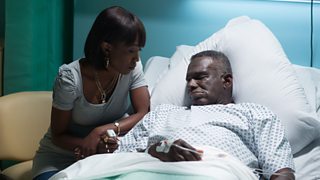
"I was able to talk about aphasia, a speech disorder which affects a third of all stroke survivors. I also explained the more 'hidden' effects of stroke, such as the emotional impact the condition can have."
"There are lots of common misconceptions about stroke, and Patrick’s stroke will really help to address these,” he added. “Lots of people think stroke won’t ever happen to them – I certainly didn’t think I’d become a stroke survivor at the age of 40.”
Harriet assisted both Rudolph and a researcher from the production team by taking them to visit to the Friends Stroke Unit at Kings College Hospital. "I was able to show Rudolph what happens within the hospital setting from a stroke patient arriving down in A+E to rehabilitation on the stroke ward.
"Only a handful of staff had been told that I would be bringing an EastEnders cast member onto the ward, so Rudolph’s visit was a real surprise to all the patients. On arrival, the EastEnders team were immediately instructed to roll their sleeves up above their elbows and take off any jewellery below. Infection control is crucial on a stroke ward and there are no exceptions. Several staff have commented how pleased they are that stroke awareness will increase because of the EastEnders storyline."
"It would be amazing to think that, as a result of this storyline, more people will understand how important it is to call 999 as soon as stroke symptoms start," said Andrew. "It has the power to save lives."
Look out for the warning signs and get help FAST
Every year, at least 46,000 people in the UK have a TIA or Transient ischaemic attack (also known as mini-stroke) for the first time. Although the symptoms may not last long, a TIA is still very serious. It’s a sign that a person is at risk of going on to have a stroke.
- Know the signs of stroke and TIA http://www.stroke.org.uk/FAST
- If you, or someone else, show any of the signs of stroke you must call 999.
- The symptoms of TIA often pass very quickly so the people may mistake them for a ‘funny turn’. Rapid access to specialist assessment, investigation and treatment is still important even if the symptoms have stopped.
- If you think you have had a TIA and have not sought medical attention, see your GP urgently.
For much more information from The Stroke Association about their involvement in the storyline, together with practical advice on how to deal with a suspected stroke, head on over to their website.
You may also be interested in a Stroke Association video which tells the story of a TIA survivor who took the right action when he had a TIA, and thus avoided a stroke.
You can also find out more about other bodies offering support in the Health section of our Help and Information Database.
