

Airbus cargo plane flies - straight into a diplomatic firestorm
"It was a bit like having a baby," smiled Paul Evans, "although it took a bit longer."
In order to see this content you need to have both Javascript enabled and Flash installed. Visit BBC Webwise for full instructions. If you're reading via RSS, you'll need to visit the blog to access this content.
Engineers, especially aircraft engineers, have a way with words. 127 tonnes of cargo plane, six years in the making, is some baby. Still, all the complicated carbon fibre development and international wiring diagrams faded away when the 700 people at Filton watched the A400M leave the ground.
"Just fantastic," continued Paul, "to see it in the air at last makes it all worth while."
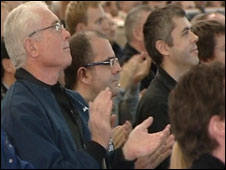
Airbus don't mess around with these events. The huge 'Wing Assembly' factory at Filton, near Bristol, had been converted into a small stadium. Giant screens showed live pictures from the test flight in Seville. Production stopped, and every member of staff got a new polo shirt emblazoned "LIFT OFF".
 As ever, Filton makes the wings. The entire assembly is made here, with components from across Europe. But the clever stuff is the carbon fibre they designed here.
The carbon fibre wings are strong enough to lift armoured cars and helicopters into the air, yet light enough to cut fuel consumption by a third. But to use the new "carbon fibre composites" in a plane this big means literally re-inventing the wings.
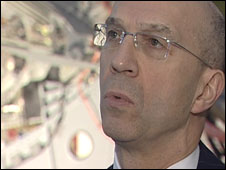
"It's a great day for the guys here," Tom Williams told me. He's the UK man on the Airbus board, and he always gives credit to the men and women who actually make the planes. But he knows the first battle this military plane will have to fight is in the boardroom.
A400M is late. No question about that. They thought it would fly 2-3 years ago. Then when I watched it 'Roll-out' in a grand ceremony in Seville last summer (June 2008), they said it would fly by Christmas (2008).
So why the delay? Our old friend, pan-European co-operation.
"They could have bought an engine off the shelf from Pratt & Whitney," explains local aviation expert Prof Philip Lawrence. He's watched this project for ten years, when it was the "Future Large Aircraft", and knows what held it up.
"The governments who are buying the plane insist - quite reasonably - on sharing out the work. So they set up a pan-European company to make the engine. It's a great engine, there's no problem with that, but it's definitely caused a year or eighteen months of delay."
 This is not normal business. As Tom Williams put it to me, "commercial customers don't tell us where to buy our landing gear." But even though the delays can reasonably be blamed on the politics of pleasing seven defence ministries, the bill stops with Airbus.
For some inexplicable reason the original contract signed six years ago made Airbus liable for any costs of over-running. Now the plane is in the air, serious discussions will be had about who picks up the bill. "We can't produce the aircraft unless the contract is renegotiated," Tom Williams told me, "it's just not viable for us. And the the military need this plane, right now. So something will be worked out."
The RAF can't wait. The Hercules fleet that fly out of Lyneham, in Wiltshire, is ageing. The new Airbus plane can fly lower and slower, ideal for dropping food, medicines, disaster relief. It can fly higher too, becoming a tanker for air-to-air refuelling. So they need the MoD to sort out the paperwork fast.
Sceptics out there said the plane would never fly. As recently as the spring, articles were appearing claiming the whole project was too expensive and would be scrapped. Well, today the engineers proved them wrong.
"We like solving problems, that's what we do," Paul Evans told me on the assembly line. Now we'll see if the civil servants and Airbus management are as good at sorting out the contract.
 Hello, I’m Dave Harvey – the BBC’s Business Correspondent in the West. If you’re making hay in the markets or combine harvesting; scratting cider apples or crunching tricky numbers – this is your blog too.

Comment number 1.
At 17:24 12th Dec 2009, plane_spotter wrote:The original A400M contract drawn up with Airbus was 'fixed price' which makes them liable to any additional costs in the event of the project going over budget. Airbus should therefore have factored in contingency for risks arising from introduction of new material technology (ie carbon fibre composite) and the choice of a new turbo prop engine.
'Fixed price' is a quite normal process used by the MOD for procurement of military equipment.
Therefore I'm not sure the MOD would agree with the wording "For some inexplicable reason the original contract ..... made Airbus liable for any cost of over-running."
In the short term there is no doubt the A400M will cost the partner countries (of the original project) dearly if they decide to fund the overrun. However if the aircraft quickly proves itself to be a superior product (compared with the C130J) then it will attract significant orders from air forces around the world and I am sure prove a commercial success in the longer term.
Complain about this comment (Comment number 1)