

Can Bristol weather the storm? Go figure...
Sometimes a number tells a story. As Bristolians wonder what 2011 has in store for them, some number-crunchers may have a story to tell.
It’s not a bad story. In fact, parts of it make quite cheery reading for Bristolians, at least in comparison to other cities round the country.
The storytellers work for an outfit for the Centre for Cities. They take all the numbers produced by Britain’s ten biggest cities, and crunch them to death.
In words, they say things like this:
“Cities such as Bristol and Edinburgh are well positioned … to build on their diverse industrial base and high skills levels…”.
But I prefer the numbers.
Numbers like 74.2, 17 and 32.4.
There, I knew that would get the pulses racing.
What story do these numbers tell?
74.2is the percentage of Bristolians, of working age, in work.
We often talk about unemployment numbers, but it is working people who will bring the UK out of prosperity. And when the Centre for Cities drew up a table, guess who’s at the top of it?
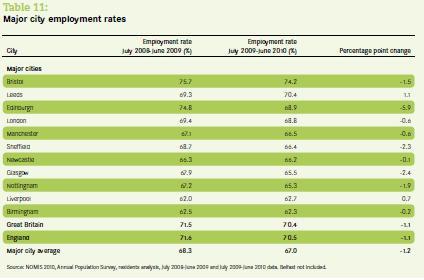
This is a table on which you want to be at the top.
Here's one where you want to be firmly towards the bottom.
It shows how much cash in a city comes from welfare.
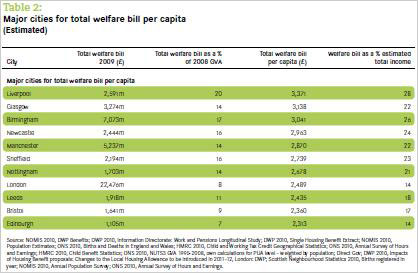
17 is Bristol's second special number. You can find it second from bottom in this table. Only Edinburgh gets less of its cash as a welfare handout.
Some of these numbers are jaw-dropping. Did you realise a quarter of Merseyside’s total income started out as a benefit cheque? Astonishing.
Clearly, with benefits being squeezed, cities that draw more cash from welfare will be squeezed too. So Bristol has a little more insulation. Its shopkeepers and hairdressers can relax just a little, knowing that fewer of their customers depend on benefits.
So much for two numbers. Bristol has more people working, and fewer claiming.
Are you asking why yet?
The answer, in a number, is 32.2.
What on earth is that? It’s the percentage of Bristolians with high level qualifications ( NVQ 4 or above).
In Birmingham that number is 22.4%. In Gloucester, it is even lower – just 18.8%.
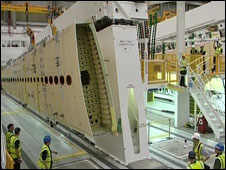 It means more people work in places like this, Filton's aircraft factory, than in many other cities. And so they are better paid. And their businesses are more likely to grow, less likely to be beaten just on price.
So, Bristolians are better educated, more likely to be in work, and less dependent on welfare.
In words, the Centre for Cities puts it like this.
“Buoyant cities like Leeds and Bristol, which have been fast-growing and have lots of private sector jobs, are best placed to lead the UK’s recovery.”
Stories with words often have a twist at the end. So here’s a number twist.
3,100
That’s the number of jobs likely to go in Newport, just across the water, as public sector cuts take effect. The calculation was done by clever chaps at the Office of National Statistics, based in, erm, Newport. 1,700 people work there, and they face a 50% cut themselves.
So they should know.
 Hello, I’m Dave Harvey – the BBC’s Business Correspondent in the West. If you’re making hay in the markets or combine harvesting; scratting cider apples or crunching tricky numbers – this is your blog too.

Comment number 1.
At 18:07 24th Jan 2011, Martin wrote:I am sure this welcome news to many people living in the Bristol area. But it is, I fear, a double-edged sword.
While I am fortunate to be in a reasonably well-paid job (in the private sector), I am also a first time buyer. House prices in Bristol and the immediate surrounding area are just unaffordable.
Today's report from Centre for Cities can only mean one thing, house prices will continue to remain out of reach of ordinary people, mainly young first-time buyers.
I am sure for many this will be a silver-lining, but not for me.
Complain about this comment (Comment number 1)
Comment number 2.
At 13:09 25th Jan 2011, Baldeeheed wrote:Great news for jobs and for the recovery for Bristol. However, none of this addresses the massive infrastructure deficit that Bristol has compared to other major UK cities.
Because of Bristol's robust private sector and relative wealth, we always do very badly when it comes to handing out central government money for our city's infrastructure.
That's why despite being a city of 600k+ inhabitants we have one of the worst urban public transport networks in Western Europe, no Arena, next to no public sports facilities - athletics tracks, 50m swimming pools, ice skating rinks etc etc, poor funding for drug addicts, poor funding for our police force compared to other cities, incomplete ring road.....the list goes on.
Bristolians are getting increasingly fed up of working hard and seeing the fruits of our labours, in the form of taxation, being siphoned off to regenerate places like Merseyside and South Wales whilst our infrastructure lags so far behind.
With Bristol leading the way in what is an increasingly fragile recovery, I can't see this situation changing anytime soon.
Complain about this comment (Comment number 2)