Twirlywoos: creating the characters
Kate
CBeebies Grown-ups
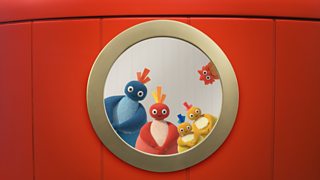
Have you ever wondered why the characters on CBeebies shows look the way they do? We quizzed Steve Roberts (Lead Creative and Writer on Twirlywoos) to find out how he went about designing a whole crew of new CBeebies favourites.
Hi Steve, how did you come up with the ideas for how the Twirlywoos characters should look?
Their body shape, legs and feet were inspired by the ducks I saw on my walk to work. The way they hurried along the footpath in front of me and then sploshed into the canal just made me smile.
The Twirlywoos’ bibs are based on a Robin’s markings, while the crests on their head have a bit of the Cockatoo about them. Just as Twirlywoos are ‘sort-of’ birds, Peekaboo is a ‘sort-of’ sea urchin. Meanwhile, The Quacky Birds and the visitors to the boat were all inspired by classic toys.
As they have no wings, we liked the idea that the Twirlywoos could be lifted up and out of their boat by their crests, which spin like propellers. They’re not in control of their own crests, though, and this was a great device to help with the writing.
They're dropped off in the real world to have fun and then picked up by their spinning crests and brought back home to their boat.
How do you develop the characters’ look from the initial ideas to the finished article?
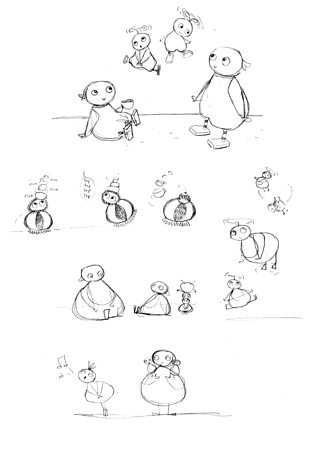
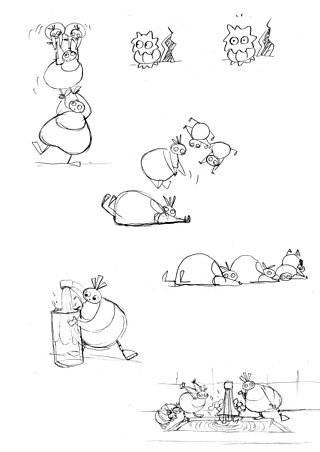
There were lots and lots of drawing and discussions with Anne (Wood, the show’s creator). We worked together for quite a while to fully develop the way the Twirlywoos characters look.
When I’m designing characters, I like to draw them as much as possible until their design feels comfortable and right. After a while they just seem to ‘click’ and you arrive at the finished look.
During the process of creating the Twirlywoos, aspects of the characters’ design did change, but their thin, stripy legs, flat feet and the big round eyes remained constant throughout.
Once we had the Twirlywoos designed on paper, Mackinnon and Saunders (the animators) had to turn them into puppets ready to be animated. That was one of my very favourite parts of the production – it was really fascinating to see how they built the puppets and being able to work with the model makers so closely on the design was great fun.
What did you want to achieve with the overall look and feel of the Twirlywoos?
With Dipdap, we’d found that a simple flat background colour worked well and didn’t distract from the action and story so we wanted to continue this idea with Twirlywoos.
We made the boat interior as simple as possible; like a minimal theatre set, so painted wooden boards seemed right.
Then we decided that any ‘furniture’ on the boat, like the Fruit Tea Machine and the Table, could disappear back into the floor, so that the boat interior could be plain, non-specific and the Twirlywoos would have a big space to run around in.
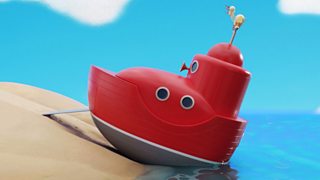
I think the boat looks really friendly; it’s almost as if it is smiling. When we filmed the opening title sequence we used a model boat on real water.
It looked like toy boat in a bath, so I thought that to complement that, the clouds in the sky could be made of bubbly bath foam.
How did you come up with the concept of Peekaboo and his fence?
Peekaboo lives in the walls of the boat and peeks in and out through a gap in the planks.
My original design was more like a simple mouse hole, but when it came to building the actual set for animation this caused a problem because Peekaboo has to be able to bring large objects through the gap.
The way I’d drawn it wasn’t practical for this, so the animators came up with an excellent solution; the planks in the wall would swing outwards to allow Peekaboo to take things in and out. I actually think this works much better than my first design.
Do you have a favourite character in the Twirlywoos?
I don’t. I think it would unfair to have a favourite!
Find out more:
