Introducing Twirlywoos: Anne Wood and Professor Cathy Nutbrown
Kate
CBeebies Grown-ups
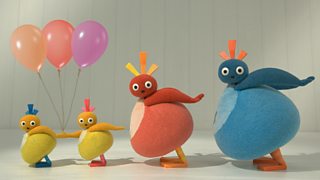
We spoke to Anne, the creator of Twirlywoos, and Cathy, the programme’s educational consultant, about the ideas behind this new CBeebies show for toddlers…
Hello, can you tell us a little bit about yourselves and your new series?
Anne: I’m Anne, the founder and creative director of Ragdoll Productions, the company that makes Twirlywoos. We’d previously made several other shows for CBeebies – most recently the BAFTA-winning Dipdap – and we wanted to build on some of the early learning concepts that we’d seen children respond to in our earlier shows. Steve Roberts (writer and designer, Dipdap) and I were ready to move on to a longer project, and that’s when the idea for Twirlywoos came along.
Cathy: I’m Cathy, and I’m a Professor of Early Childhood Education at the University of Sheffield. My work there is mainly focussed on early literacy development, children’s schemas and the role the arts play in children’s learning. I’m the educational consultant on Twirlywoos.
Anne, what happens in Twirlywoos? What’s the format of the programme?
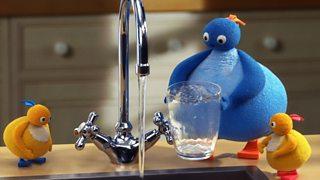
Anne: Each episode of Twirlywoos is based on one central concept, for example ‘up’, ‘through’, ‘underneath’ or ‘over’. The Twirlywoos fly out of their Big Red Boat into the world of humans, and they observe and intervene in some activity that helps to illustrate that idea.
Afterwards, they return to their boat, and the main idea is developed even further – often with help from a visitor, from the Twirlywoo Screen or the Fruit Tea Machine, or through Peekaboo, a secret character who hides in the boat and watches the Twirlywoos.
The end of the programme is heralded by the arrival of the Twirly Rings (these are like docking devices that keep the Twirlywoos safe when their boat moves off). Finally, The Hooter and the Quacky Birds on top of the boat signal that it’s time to go.
What age-group is Twirlywoos aimed at?
Anne: The show was specifically designed for three and four year olds, although we know that it is likely to reach beyond that age group. Cathy advised us on the age-appropriateness of the stories at every stage of the production.
Cathy: Yes, the thinking behind the programme draws on research into children’s Schemas (pronounced ‘skay-mas’), or patterns of learning that are based on actions.
Cathy, can you tell us a bit more about what Schemas are, and how they are used in Twirlywoos?
Cathy:Schemas are the behaviours children go through when they are exploring the world and trying to find out how things work.
Small children may pay lots of attention to a particular action – or actions – in their play and everyday life, and these actions will help them to learn about the world.
For example, a three year old who become interested in ‘things inside things, inside other things’ for a while will be gaining experience about relative size, volume and capacity, as well as having fun with concepts like ‘hiding’ or ‘disappearing and reappearing’ – this is often called an ‘enclosure’ schema.
Each Twirlywoos programme relates to a different such concept or action, such as ‘round and round’, ‘up and down’, ‘inside and outside’, or ‘over and under’.
Education research over the last 20 years tells us that 3-4 year olds pay attention to things that adults might not necessarily notice – and the focus of this attention is often related to movement.
You’ll often find that your young child will become particularly absorbed in programmes that support their current schematic interest, and will often find it especially funny when these ideas are shown in a comical way.
How do Schemas help children learn?
Cathy: It often comes as a surprise to parents to realise that their child’s fascination with the slide in the playground is as much to do with going up, up, up the steps and sliding down, down, down the slide as it is with the actual physical sensation of sliding.
It helps the child to reinforce the idea of up and down if we actually say ‘up, up, up’ and ‘d-o-w-n’ to accompany the action.
Once absorbed (after much repetition), ideas like ‘up and down’, or ‘round and round’ or ‘over and over’ begin to be used by children when they progress to making marks on paper, which eventually leads to more conventional writing.
Understanding how young children learn in this way is important, because Schemas lie at the very heart of a child’s play, but often go unnoticed.
How might children react when they see Schemas being brought to life on Twirlywoos?
Cathy: By concentrating on the structures (or schemas) that underpin the way small children think, Twirlywoos is constructed in such a way that 3-4 year olds can start to predict what might happen.
You might notice your child talking about what the Twirlywoos are doing while they watch.
Anne: The Twirlywoos deliberately don’t have words because we’ve designed the programme’s soundtrack to give children opportunities to talk back to the screen.
We want children watching the show to begin to predict what might be about to happen.
You may also see your child re-enacting some of the things that the characters explore, and enjoying repeating those actions again and again.
Different children will become absorbed by different things, so while the programme might concentrate on one concept or action at a time, there’s always more in the stories to engage children’s attention.
Read more about types of schemas and how you can support your child’s play
Explore articles about the pre-school age group on CBeebies Grown-ups
What does your little one make of Twirlywoos? Have you noticed them joining in while they watch? Share with other parents in the CBeebies Grown-ups Facebook or Twitter communities.
