
Cream
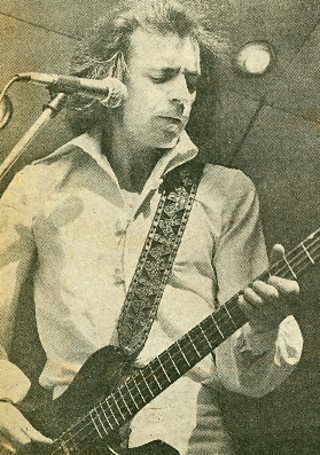
Jack Bruce, the bassist from 1960s band ‘Cream’ has died aged 71. The group which included Eric Clapton and Ginger Baker are now considered one of the most important bands in rock history, selling 35 million albums in just over two years and given the first ever platinum disc for Wheels of Fire. Bruce wrote and sang most of the songs, including "I Feel Free" and "Sunshine Of Your Love". The band performed live at the Royal Albert Hall for the last time in their 1968 ‘Farewell Concert’. The concert was filmed and broadcast on the BBC, and here they are performing the legendary ‘Sunshine of Your Love’
Cream perform 'Sunshine of Your Love' from Tony Palmer's 'Cream Farewell' 1968
From Tony Palmer's Cream Farewell 1968
Arena’s series editor, Anthony Wall began his career as the Morning Star’s rock critic from 1974-78. We dug out an interview he did with Jack Bruce in 1975, where he talks candidly about his political and musical roots, and on the formation of 'Cream’.
Cream article
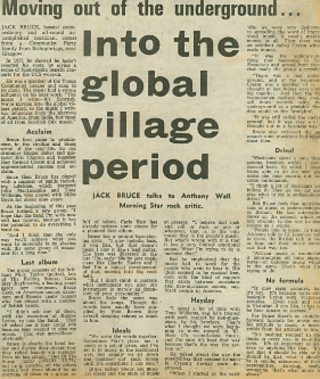
INTO THE GLOBAL VILLAGE PERIOD - Jack Bruce talks to Anthony Wall, Morning Star Rock Critic
Jack Bruce, bassist extraordinary and all-round accomplished musician, comes from a Communist Party family from Bishop Briggs, near Glasgow. In 1971 he showed he hadn’t rejected his roots, by giving a series of fund-raiding benefit concerts for the UCS work-in. He was a member of the Young Communist League and sang in its choir. The music had a strong influence on his later work. “The music I write – it’s Scottish. We’re moving into the global village period, so the music I write has influences from the ghettoes of America, from India, but most of all from Scottish folk music”.
Bruce first came to prominence in the rhythm and blues scene of the mid 60s. So did drummer Ginger Baker and guitarist Eric Clapton and together they formed Cream and achieved unprecedented success and acclaim. Since then Bruce has played with a number of bands including Lifetime, which featured John MacLaughlin and Tony Williams, who played with Miles Davis for about nine years. At the beginning of this year Bruce formed a new group. ‘I hope that the band I’m with now will last forever, because it has the potential to do everything I want to. And I think that the only way you’ll achieve what you want to musically is by playing with the same group of musicians for a long time”.
The group consists of brilliant Mick Taylor (guitar), late of The Rolling Stones, Carla Bley (keyboards), a leading avant garde jazz composer, Bruce Gary, an American session drummer, and Ronnie Leahy (piano) who has played with a number of British bands, ‘I didn’t ask any of them, with the exception of Ronnie Leahy, to join the band. They all asked me if they could join because they wanted to play my music. This is marvelous – obviously”. Bruce is clearly the band leader and during their recent tour they relied heavily on material from his latest album “Out of the Storm”, but he is insisting on the others writing and there should be no shortage of ideas in a group so full of talent. Carla Bley has already written some pieces for a planned first album. Bruce has a unique bass playing style. “I play melodic bass, if you like, but that doesn’t mean I play it like a lead guitar. The bass was liberated in the late ‘50s, early ‘60s by jazz musicians like Charlie Haden and I feel I’m a logical development of that, moving into the rock field. “But I don’t think it matters what instrument you play. An instrument is merely an extension of your personality”. Bruce feels the same way about his songs. Though the words have usually been supplied by Pete Brown their overall meaning relates as much to him
“We write the words together. Sometimes Pete’s given me a poem or a set of lyrics, and I’ve set it to music in the traditional way, but usually we sit down and hammer out each image until it’s something I can sing”. Bruce talked about his musical ideals and the state of music at present. “I believe that rock and roll or rock or pop or whatever, that is, is the only music that is the people’s music. But what’s wrong with it is that it was a very limited emotional scope. What I’m trying to do is increase that.”. But he emphasized that the music had to work for the people who want to hear it. His ideal seemed to be musical freedom with the kind of rapport that exists between musicians and non-musicians among, say, black people in America.
“I spent a lot of time with Tony Williams, and he’s treated with such respect by non musicians, by his brothers. That’s what I thought we were beginning to move towards in ’67. Here it’s second class music, and I’m sure it’s kept that way because that’s the way the system is”. He talked about the way the possibilities that seemed to exist in Cream’s heyday, were destroyed. “When I started in the early 60s, we were very dedicated to spreading the word of improvised music, it wasn’t making money at all. Then there was an accident called Cream which made money. “It was the underground thing that happened in San Francisco and spread from there that made the group successful. There was a real underground, and at the beginning Cream was a member of it. I thought at last things were coming together. And then the big businessmen realized they could sell more records using the underground as a gimmick than they could to the ‘straights’. It was still called the underground, but it was very well thought out in a business way”. Bruce also criticized the approach some musicians had taken since then.
“Musicians spent a long time gaining freedom within a commercial basis, by which I mean being able to do the net gig, make the next record, not become millionaires. I think a lot of musicians are killing it. They go too far and play what to me is undisciplined drivel”. But Bruce feels that appreciation of music is underdeveloped in Britain. He has interesting views on the subject, which relate strongly to the way he sees society as a whole. “People talk in music, in time. Africans talk in 12, Japanese talk in three the British talk in two or four and their music comes out that way too. Africa music is wonderful, it incorporates all time signatures – or Balinese music which is the same. That’s what I’m trying to do”.
“It may seem complex, but it’s not. It’s because we’re still basically living with Victorian scruples. Even rock and roll is Victorian if you like, it was to be four square to succeed”. For Bruce there’s no straightforward formula for music and his attitude to music is inseparable from his attitude to life. “It’s pushing yourself to the limits in every way, in your life style. It’s as important as science or anything like that. It’s not that it should be this or it should be that, what is should be is people, extensions of their personalities, striving, really struggling, that’s what music is about”.
