
Are giant multinationals good for Africa?
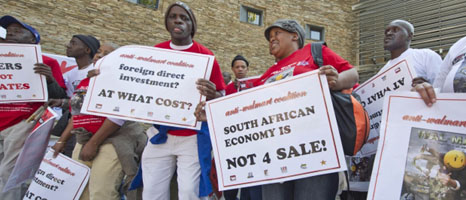
South Africa workers marching to protest Walmart's takeover of Massmart in Pretoria.
The world's biggest retailer Wal-Mart is to set up shop in Africa after being cleared to enter the South African market. Are giant multinational retailers good for Africa?
Several government ministries and trade unions had opposed Wal-Mart's bid to buy 51% stake in the South African company Massmart, saying it could undermine local suppliers.
South Africa competition authorities did impose conditions,such as a ban on firing workers in the first two years and said that Wal-Mart must have a programme for developing suppliers.
But would you welcome a giant retailer such as Wal-Mart in your own country?
What impact do you think it would have on the local economy? Can multinational corporations boost a country's economy or do they do more harm than good?
If you would like to debate this topic LIVE on air on Wednesday 1 June at 1600 GMT, please include a telephone number. It will not be published.


Comment number 1.
At 15:18 1st Jun 2011, lanis wrote:South Africa is a lovely country. The impact of MNC's in South Africa in recent and time past cannot be over-emphasized. I think the major question is what policy is designed to allow the MNC's into a local market. These policies such as: technical skills, re-investment policy, training and education all have an impact to play if the local economy is to benefit from multinationals. Already, there are lots of foreign presence in South Africa and I do think that the local suppliers can rival that of walmart or any other foreign retail store.
Olalekan Olanisa, Los Angeles-USA
[Personal details removed by Moderator]
Complain about this comment (Comment number 1)
Comment number 2.
At 15:40 1st Jun 2011, BluesBerry wrote:What has Egypt won? Financial aid (even debt forgiveness) confirms intervention by Western governments into Egypt's revolutionary process. Large infrastructure projects & other economic mega-schemes may provide some employment, housing, educational training and likely appearance of a return to stability given the long-term crisis. This investment, however, comes with typical IMF strings - a liberalization of the Egyptian economy.
They will only be undertaken concomitant with measures such as a deepening privatization (& reducing social programs), deregulation (opening up of sectors to foreign investment), the reduction of trade barriers (connected to access of US and European markets)...They will rapidly expand Egypt's overall indebtedness – tying the country ever more firmly to future IMF structural adjustment packages.
If this process is not resisted, what has Egypt gained? As the decades of the Egyptian experience of neoliberalism illustrate, these IMF measures will further deepen poverty, austerity & an erode living standards. Simultaneously, the financial inflows will help to consolidate Egypt's narrow business & military elites as the layer of society that will gain from further liberalization of the economy.
Are giant multinationals good for Africa? Is it the African way? Do Africans have a say...or just the elites?
Complain about this comment (Comment number 2)
Comment number 3.
At 16:41 1st Jun 2011, Pal Gatkuoth Deng wrote:Introducing such a multi billion business will create many job opportunities for many unemployed people in Africa. But the problem is the Inequality, political conflicts that have generated elites those live above laws and doing courruption by misusing public funds. Wal Mart lts present in Africa will make no much different from past because in many African countries 25% of populations are employed mean while 75% are jobless and will have no money to purchase stuffs from Wal Mart store. In Us Wal Mart make money because each family atleast has little or more incomes to make living.It will be hard for Wal Mart to make huge progress in Africa where majority of people live with less than $2.00 per/day.
Complain about this comment (Comment number 3)
Comment number 4.
At 01:07 2nd Jun 2011, AKPAN wrote:This is obviously the tail-end of the age-old ideological debate about which economic model might be good for Africa - as if we were an alien breed living on some planet of our own, detached from the globalized world and all that goes with it. That debate, in any event, ended with the collapse of the Soviet Union, which was supposed to be a communist regime, but whose ruling elite dined on the finest Black Sea caviar, lived in Dachas, and ran around town in chauffeur-driven ZiL-115 limousines. But before this, those of us with an irredeemably cynical disposition had always suspected that the so-called capitalist, free-market West was neither of these: not with the massive subsidies without which its industries (e.g., agriculture) would have ceased to exist, or the generous welfarism which guarantees a basic minimum of living standard for its peoples.
This of course means the ideological debate was always quite phoney. But here we are in Africa, in 2011, still debating whether foreign investment by a multinational corporation is a good thing, when all that should concern us should be jobs (and working conditions).
Complain about this comment (Comment number 4)
Comment number 5.
At 18:56 2nd Jun 2011, Katama80 wrote:There is no problem with a foreign company investing or buy out an existing company the jobs will still be done by south-Africans. I'm South-African and the thing that really gets me is that the government allows the foreign companies to buy up the rights to mine our natural resources. The only way Africa can grow is by taking back these rights and mine the resources ourselves. A good example of this is that De Beers our all diamonds in South-Africa even one that you would pick up on your land. Another is Malawi just gave all mining rights to China. This is where the problem is our politicians get rich of these deals by selling our resources to foreign powers and it does not benefit the local population.
Complain about this comment (Comment number 5)
Comment number 6.
At 11:45 3rd Jun 2011, missnyamponela wrote:investment is good in africa because they are creating alot of job opportunities in a situation where jobs are very scarce. ofcourse we have to consider the fact that investors also take alot from places where they invest in but as for now they are creating alot of job opportunities for the jobless in our societies which is also very important
Complain about this comment (Comment number 6)
Comment number 7.
At 11:02 4th Jun 2011, Artur Freitas wrote:Multinationals can also promote local products internationally. However, when a country is not competitive (education, skills, productivity, innovation, etc.) then it should look inwards than creating a “make believe” economy based on laws that protect incompetence.
Complain about this comment (Comment number 7)
Comment number 8.
At 23:53 4th Jun 2011, Sura M wrote:The actual answer to this question cannot solely be confined to jobs and working conditions as some commenters have suggested. Walmart will enter the SA market by acquiring Massmart and the question would be, how does Walmart intend to extract value and build a profitable enterprise? The company is not known for being the employer of choice and achieves profitability mainly by ruthlessly controlling costs and undercutting its competitors.
Studies have suggested that Walmart workers earn up to 20% less than other retail workers on average. The idea of employment creation begins to seem less enticing once you factor in the unemployment that will arise from local retailers closing down as Walmart sets out to gain market share through its ruthless practices. According to research from Loyola University, the opening of one Walmart store on the West Side of Chicago led to the closure of one quarter of the businesses within a four-mile radius.
Additionally, how much of Walmart’s earnings will actually remain and be reinvested in the country or on the continent in general? I would wager that it would likely be a very small percentage.
Finally, let’s not forget Walmart’s monumental failure in Germany due to its lack of understanding of local work ethics and societal norms. There’s no evidence that the same will not happen in SA leading to lay offs and disenfranchised communities where once, local stores thrived and reinvested their earnings.
Complain about this comment (Comment number 8)
Comment number 9.
At 12:27 5th Jun 2011, Obama wrote:The Problem we have in Africa is political interference in the busines of Multinational corporations. Most of these are used to profit ruling parties in Africa. They crack high level deals that only keep political parties interests. So their presence may not realy be felt by communities were they operate from.
Complain about this comment (Comment number 9)
Comment number 10.
At 01:07 7th Jun 2011, yemti ndienla wrote:Left on our own we africans will fall heads down! We need this type of giant investments through out the continent to weed out the numerious jobless youths from the streets. But as the case may be, political interest will play a negative role.i remember when i giant mutinational company entered the agricultural sector in Cameroon a couple of decades ago, thousands of jobs were created and the compay paid far more than the state owned company producing similar produce.But when politics came in, the multinational company was forecd to scale down its payments and slamed huge taxes which almost sent the company parking.
Complain about this comment (Comment number 10)
Comment number 11.
At 13:05 7th Jun 2011, slord182 wrote:I think people fail to see the true impact of this. While in theory it is good thing in terms of job creation, some people have note taken into account that Walmart have already admitted into looking at sourcing food from other countries, such as apples from China to reduce costs back to the consumer. South Africa relies a lot on selling fresh produce (especially apples) into the local economy and this could potentially have a devastating effect on jobs in the agriculture sector.
Complain about this comment (Comment number 11)
Comment number 12.
At 13:54 7th Jun 2011, Gavin wrote:giant multinationals are good for giant multinationals - anything beyond that (such as benefit to a country) is simply coincidental to this fact.
Complain about this comment (Comment number 12)
Comment number 13.
At 20:37 8th Jun 2011, AKPAN wrote:To Sura M: I do actually share your suspicions about multinational corporations generally and am aware of the concerns expressed about Walmart. The fact, however (which I wish I could change), is that in today's globalized economy, anyone who ends up working for such organizations (McDonald's and Starbucks being a few other examples) in certain capacities must be prepared to accept low wages: if s/he isn't, there are thousands of others queueing up to replace him/her. In other words, it's good old demand and supply at work.
At any rate (and paradoxically), your thesis seems to support mine generally, at least by highligting the fact that Africans are not/would not be alone as victims of exploitation. Like you, I wish this wasn't the case, but the time has come for us face the world as it is, not as it should be - like the rest of the world, except if you wish to suggest that we are somehow different, which would amount to a racist view, in my opinion.
Complain about this comment (Comment number 13)