
Do you care where your rubbish ends up?
How does your town or city manage its rubbish?
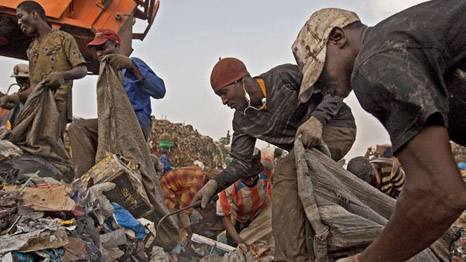
For some 20 years now, Nairobi City Council has been struggling to cope with the amount of rubbish produced in the Kenyan capital.
The biggest dumpsite in the country has been located in Dandora, on the outskirts of the city, but now the council is to spend more than $7m (£4.7m) on turning it into a recreation park, and moving the dumpsite to Ruai, about 20 minutes drive from Dandora.
But does this mean the rubbish will be dealt with effectively? Do you care what happens with refuse once it leaves your house?
Do you find it difficult to dispose of your household waste?


Comment number 1.
At 16:45 16th Nov 2010, caesarbbc wrote:Nairobi like most African cities has grown without proper planning. The city is lacking in sophistication of managing garbage disposal, building code, sewer systems, housing, cemetries, emergency response, traffic lights, city transit, hygienic food markets, clean water management (clean, treatment facilities and sewage).
All the buildings use septic sewers since the city planning has not found a way of cordinating and providing city sewers. In Nyeri for instance there was a case of medical waste being dumped close to an estate. There was incidences the facilities that had dumped the waste burning it.
Infrustructure development must underground and above ground.
Complain about this comment (Comment number 1)
Comment number 2.
At 22:01 16th Nov 2010, Olulere Adewale wrote:Waste Management, is what we've not been taking seriously.
This shows in the numbers of response, until we realise, the potential in environmental,health, recycling.Town planning.Energy&job creation in waste management we won't take it seriously.
Our leader suppose to take this industry seriously.It could save & generate resources, if well managed!
Complain about this comment (Comment number 2)
Comment number 3.
At 00:38 17th Nov 2010, Elizabeth Kuranchie-Mensah wrote:I think as the name suggest "Rub", meaning not wanted,scratching off.If it is not wanted, I'm very sure it should really be the concern of all and sundry.I think they should be interested in doing away with the problem and forget about the recreation park
Complain about this comment (Comment number 3)
Comment number 4.
At 13:40 17th Nov 2010, Joe- Nairobi Kenya wrote:I think the caring about what happens to the waste once it leaves ones house is never A THOUGHT that would remotely bother many.
Leaving the fast, expensive and tedious life in Nairobi; many people are frustrated and thinking of "more" important issues. To crown it all, we do pay a lot of taxes and city council rates to have this taken care off.
To be honest, the real problem is that those charged with taking care of the very garbage deserve to be dumped alongside the garbage. What do I mean? They are a useless lot, political comedians, a public liability and simply bring rot to another level. Once we sort this out, we will get the garbage sorted out.
However, the DREAM...oops! IDEA of a recreational park is a welcome and timely comic relief thought for many in Nairobi. Will it ever be achieved...huh! Not so comical after-all!
Complain about this comment (Comment number 4)
Comment number 5.
At 14:38 17th Nov 2010, Adokters wrote:Disposing of household waste has become a problem here in Ghana. Apart from the fact that government has designated places where rubbish is put, people just throw away rubbish anywhere and anyhow, making the city so filthy. This must be due to lack of knowledge in what it means to have a clean environment or they expert that the authority which they pay their tax to, would come out to clean the place up.
Complain about this comment (Comment number 5)
Comment number 6.
At 23:34 17th Nov 2010, LambethG wrote:Refuse is a global problem though the "developed" countries have tried to enforce recycling, plus waste disposal management - landfill and incineration - all of which costs money to implement.
There are carbon credits for energy saving processes, why not extend/introduce such "credits" for prudent disposal of waste/refuse!
Complain about this comment (Comment number 6)
Comment number 7.
At 01:00 18th Nov 2010, Paul Sumanu Islam wrote:Every sane person in today's world should be very concerned with rubbish disposal because in one way or the other, whether if its in your house or has left it, the end result is that if the rubbish is not properly disposed off, it would affect the environment, which in turn would affect you. The world should be made to be aware that there is no hiding place for humanity if we fail to protect our environment.
Complain about this comment (Comment number 7)
Comment number 8.
At 07:36 18th Nov 2010, kigada wrote:I listened to the programme with interest but it ended before I could give in my thoughts. I disagreed with most commentators on one point:
Waste management in my opinion works best when the responsibility of recycling is placed more on the manufactures side than on the consumers. The consumers main responsibility should be to make sure that they dispose of waste correctly...all of it should be in one bin. Nothing should be pre-sorted. The reason for this is that consumers are not waste management experts nor can they conclusively tell the more than 6 types of plastics or are bottle tops with plastic crowns to be put with metal or plastic or is tetra pak paper or plastic? This and many other questions should not be answered by consumers but by the manufactures.
Manufacturers produce the products, thus they should know best how to recycle / dispose of it. The municipal council main responsibility should be to strive to collect all waste then bringing it back to the manufactures for recycling or disposal. If a product must be disposed of, then the manufacturer should pay for it's disposal.
Complain about this comment (Comment number 8)
Comment number 9.
At 14:17 18th Nov 2010, Mark K Torokwa wrote:This is no solution without putting in place good waste management schemes.
Also there has to be a change of the mindset of the waste management authorities and users in the city i.e. to look at waste not merely as rubbish but rather as a resource that can be turned into something of good economic value e.g. through recycling, incineration for renewable energy or composting for fertilisers. Investments into such processes might not be as huge as some might fear and they are worth every penny.
Complain about this comment (Comment number 9)
Comment number 10.
At 16:28 18th Nov 2010, UkayUmar wrote:I think the whole issue boils down to responsibility on the part of the governments and discipline on the part of the citizenry
Complain about this comment (Comment number 10)
Comment number 11.
At 03:35 19th Nov 2010, Yemi Ayodele Ayeni wrote:Disposing of refuse should be a paramount importance to the government in any country,county and local council because of its hazardous effects on the community if not properly managed.Its negative effects on the health of the residents resulting from polution most especially air polution can only be managed from the resources emanating from government.Waste management schemes have been developed in many societies to combat this societal hazard and in most cases,it has been utilised or transformed to positive end in developed contries.Refuse can be recycled for renewable products,fertilisers and power incineration.This is when it is properly managed by well established waste management board.I am always cautious of my actions and inactions in refuse disposable behaviour because of its impact on the society.Individuals have a lot to contribute in this area and it can be poperly ensured through appropriate legislation that can anchor necessary punitive measures on violators.
Complain about this comment (Comment number 11)
Comment number 12.
At 13:07 19th Nov 2010, Sh Manzar wrote:I worked for three years in a large slum next to this huge dumpsite. We used to walk to teh edge of the slum to see this huge area with rubbish being brought and dumped, truckload after truckload. It was a lot of hard work in teh slums to educate the youth who scavenged this site to wear gloves or use protective measures to protect themselves of infections. The most devastating time was when the hospitals brought UNTREATED blood waste and just dumped it. You can imagine how that increased the risk. That caused many organisations to get together and campaign against that. Finally they were shamed into stopping, or treating it before dumping. Moving this dumpsite further out is least helpful, another slum will grow besides that one, the only difference, its 20 kms further. Rubbish recycling is very practical way of reducing the garbage mountains. Educating people to put paper, plastic, metal, glass, and green waste that can be turned into manure all separately will assist the City Council to cope better. City Council being very corrupt I suggest that a NGO/semicommercial organisation take up this challenge or its franchised out. It will take time to get it going but sure does pay dividends.
Complain about this comment (Comment number 12)
Comment number 13.
At 07:15 22nd Nov 2010, Doug of Durban wrote:This comment was removed because the moderators found it broke the house rules. Explain.
Complain about this comment (Comment number 13)
Comment number 14.
At 11:48 22nd Nov 2010, Tunde Ajao wrote:We in Africa, have a great recycle culture. Hence we use plastic and glass bottles, tins, paper, metal, clothes (as rags), etc. We should invest in recycling plants before the accumulation of rubbish over burden us.
Complain about this comment (Comment number 14)
Comment number 15.
At 11:53 23rd Nov 2010, kevan of bahrain wrote:This comment was removed because the moderators found it broke the house rules. Explain.
Complain about this comment (Comment number 15)
Comment number 16.
At 16:22 25th Nov 2010, Dave wrote:This comment was removed because the moderators found it broke the house rules. Explain.
Complain about this comment (Comment number 16)