
How would you cut 'waste'?
Workers around Europe are set to stage huge demonstrations this week as governments draw up plans for deep cuts in the public sector to help pay debts built up during the global recession. The UK government is finalising austerity measures which will cut across every sector of public life - with so-called quangos, or quasi-autonomous non-governmental organisations at the top of the list. These are bodies which use public money, but act independently of the government. In most African countries, the public sector provides the bulk of services to the population and takes up a large proportion of a country's income. The recent strike in South Africa and riots in Mozambique were both sparked by government attempts to rein in spending. So do you see waste in your country's public services? What departments or quangos would you cut and why? What could you do yourself to reduce spending and how would you go about ensuring better use of public funds where you live? If you would like to debate this topic LIVE on air on Tuesday 28 September at 1600 GMT, please include a telephone number. It will not be published. 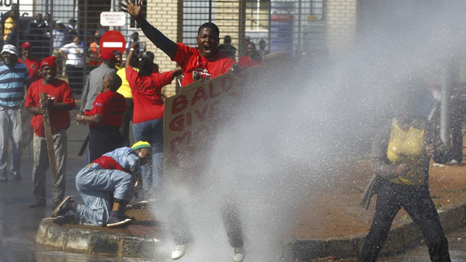


Comment number 1.
At 15:03 27th Sep 2010, Victor Okubasu Juma wrote:This comment was removed because the moderators found it broke the house rules. Explain.
Complain about this comment (Comment number 1)
Comment number 2.
At 15:07 27th Sep 2010, Victor Okubasu Juma wrote:This comment was removed because the moderators found it broke the house rules. Explain.
Complain about this comment (Comment number 2)
Comment number 3.
At 16:33 27th Sep 2010, Victor Okubasu Juma wrote:Our government are so large, despite the problems that seems to be affecting people this is real a waste the fat salaries to pay the ministers can be used to improve the food situation in the country by improving the farming methods and research.
Complain about this comment (Comment number 3)
Comment number 4.
At 19:45 27th Sep 2010, George Oyeho wrote:Public expenditure all over the world is exagerated because the formula used may have been based on military war wastage rates. On the other hand, services offered by the governments are intended for common good and single organization may want to shoulder the burden.
With all the challenges faced in funding public service, we may want to compromise and accept that it is a shared social responsibility between the citizens and the governments. However, it has never been easy for any government to delienate the roles and responsiblities being shared to make the public accept their piece.
But, there are some expense lines that may not make alot of sense and make citizens go into the defiance mode against government control. This is the example of situation in Europe. Why do countries spend and spend on military rather than diplomacy? Why should the governments trap people in Pavlov's dog scenario?
Complain about this comment (Comment number 4)
Comment number 5.
At 05:29 28th Sep 2010, Daylue Goah wrote:This comment was removed because the moderators found it broke the house rules. Explain.
Complain about this comment (Comment number 5)
Comment number 6.
At 09:36 28th Sep 2010, Olulere Adewale wrote:Openess & mechanism for opositional view to be table & consider is very important.
If we allow opensource culture to get into governance, where all contracts are offered, executed, and the progress & failure are allowed to be open to the public.
Wastage could be limited through this medium.
Things that are not neccesarily needed to be run by the state should be left to the private sector with competitive platform, to prevent Monopoly.
Complain about this comment (Comment number 6)
Comment number 7.
At 11:13 28th Sep 2010, Vonjosiamai wrote:I do not think my government has waste to cut, because the Government of Liberia (GOL) is operating a national budget based on a cash basis. The GOL is living on what it earns as revenue.
Complain about this comment (Comment number 7)
Comment number 8.
At 14:18 28th Sep 2010, Robin wrote:This comment was removed because the moderators found it broke the house rules. Explain.
Complain about this comment (Comment number 8)
Comment number 9.
At 15:57 28th Sep 2010, Silas Nyambok wrote:In Kenya we have a whooping 42 ministries while a giant economy like Japan has less than 20 ministries. Most of these ministries have ministers, assistant ministers, permanent secretaries and heads of departments each allocated government vehicles where fuel, maintenance drivers are allocated. The first 3 above also have bodyguards being paid for by the government. We have a ministry of Public Health and a ministry of Medical Services. These should actually be departments under the ministry of Health. We also have Ministry of Education and Ministry of Higher Education. The latter was previously a department of the former. We have separate ministries for Land, Public Works, Roads, Housing, Regional Development etc. In Japan these are combined in one Ministry of Land,Infrastructure and Transportation.
Think about all those ministries with equiped offices, accountants, auditors, clerks, watchmen, tea-girls or boys etc and you will know the magnitude of wastage. However, some schools of thought have it that having many people in employment spreads resources to many and not to a few hence contributing to equality and economic growth or what do you think?
Complain about this comment (Comment number 9)
Comment number 10.
At 18:20 28th Sep 2010, Sunday Laari wrote:It's important for governments in Africa to take radical measures to prevent the economies of various countries from total collapse. What we ordinary citizens do not agree with is when government asks its citizens to bite the bullet whilst they live profiligate life styles. The ordinary people should not make sacrifices for those who don't pay for utilities to enjoy or even get rich. Governments should work to create budget surplus by increasing sources of income and not cut down on spending in the public sector. Monitoring of public sector workers should however be intensified.
Complain about this comment (Comment number 10)
Comment number 11.
At 01:08 29th Sep 2010, Akinwale wrote:The starting point is ensuring more money is spent on infrastructure than on running the government. The cost of running the government is too large!! The next step is to punish corrupt official with long jail terms and confiscate any property obtained from proceed of crime. Imagine spending 90% of the budget on just recurrent expenditure!!! How do we grow then?
Complain about this comment (Comment number 11)
Comment number 12.
At 01:18 29th Sep 2010, Akinwale wrote:First, reduce wages and allowances earned by public servants, reduce the number of public servants. for example, each state usually send three senators to the upper house. Why three? Why not one or two per state. For the lower house, Increase the population to be represented by each representator. Then i do not see reason for having a minister and a minister of state for each ministry. All these will lead to reduction in the number of public servants. Then since the state house of assembly make law for the state, what is the need for counselors? Let each local government be headed by a Chairman and the 'functions' performed by local government counselors be taken over by the state assembly. All these will reduce the cost of conducting elections and cost of governance.
Complain about this comment (Comment number 12)
Comment number 13.
At 05:59 29th Sep 2010, Ibrahim wrote:I am Sierra Leone living in the United Stated, i saw my president Mr. Ernest Bai Koroma when he came for the United Nation conference at New York. I saw the amount of people he traveled with, and i knew all of those people where paid for from public fun or tax payers money, while the rest of the people are suffering in the country or lack of basic social services like water supply, road construction and or electricity for the people .
The wasteful side of this is that, what is all those entourage where doing at the meeting? are they representing different department at the meeting or what?
Beside the meeting, they tour other states such as Pennsylvania, Maryland etc. after the meeting at at New York and all was done at the expense of tax payers money.
Complain about this comment (Comment number 13)