In search of an urban legend: the man who squeezes muscles

Jon Kelly
Senior Broadcast Journalist, BBC Digital Current Affairs
Ten years ago, as a young reporter, I read a news report that, although brief, stayed with me because of its profound oddness. A Liverpudlian man called Akinwale Arobieke had been handed a court order banning him from squeezing muscles, asking people to do squat exercises and loitering outside gyms.
I did a bit of Googling. It turned out Arobieke, who stood at 6ft 5in and weighed over 20 stone, was notorious on Merseyside for his obsession with accosting young men and asking to feel their muscles. Sometimes he’d measure their calves and biceps, too. And he had a nickname – “Purple Aki”. It was racially charged, based on the suggestion that he was “so black he’s purple”. For years he’d been a kind of urban myth – parents would warn their children not to stay out late or he’d get them. It was as though he’d been conjured up from some brew of 1980s anxieties about race and sexuality. Lots of people didn’t even believe he was a real person.
But he was, and the dawn of the internet meant his notoriety spread. Online, he would become a meme, with websites, songs and even a Wikipedia page devoted to him. People took flags and banners bearing his nickname to wrestling matches, the Glastonbury festival and Liverpool and Everton games.
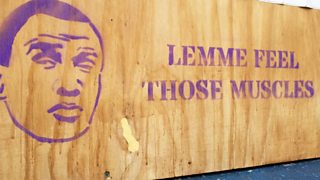
He was treated as a joke. But there was surely more to the story than that, I thought.
Fast forward a decade, and Arobieke, after a string of convictions for breaching the order, persuaded a judge to lift it, representing himself in court. I wanted to properly tell the story of this real-life, self-described “bogeyman” for the first time, separating myth from reality, as an in-depth longform text feature for the BBC’s Digital Current Affairs unit.
I set to work tracking down and interviewing people who’d encountered Arobieke – young men whose muscles he squeezed, a woman he was jailed for issuing threats against, a former colleague, one of his friends. BBC Three learned of the project, a 15-minute documentary was commissioned and I pooled my resources with director Nick Mattingly.
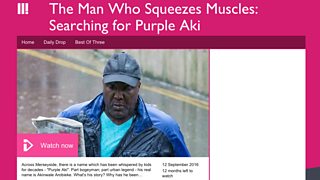
BBC Three film
Our sources wanted to speak out because they felt the often traumatic encounters with Arobieke they’d experienced had been trivialised by the cult that had grown up around him. Some of their stories were deeply tragic. There was Elaine Jordan, whose boyfriend (the father of her unborn daughter) had been fatally electrocuted on a railway line running away from Arobieke. In 1987 Arobieke had been found guilty of his manslaughter but this was later overturned on appeal.
I felt strongly that her voice and those of my other interviewees needed to be heard as a corrective to the memes and jokes. I was also discovering there was more to Arobieke himself than the cartoonish persona you read about on the web.
But Arobieke didn’t want to talk. It wasn’t that he wasn’t capable of representing his own interests – he’s an intelligent and articulate man who has successfully defended himself in court on several occasions. Yet when I and my colleagues approached him numerous times – at his home, by letter, and then (at his request) through his lawyer, he didn’t respond.
How do you tell the story of a man who won’t speak to you? You start by getting people who’ve met him to describe him, by combing through records of his court appearances, by digging up his birth certificate and other official documents.
In fact, the sheer volume of material was a challenge. The resulting feature was over 5,000 words long. The BBC uses the immersive publishing application Shorthand for long-form text articles. It allowed the story to be told in an immersive, visually striking way.
On Monday the feature finally went live, alongside the documentary, presented by Liverpudlian journalist Benjamin Zand. After devoting the past few months of my life to Arobieke, I can’t pretend that I fully understand what makes him tick. But I reasoned that sometimes the journalist’s job is to let the audience make up their own minds, even if I couldn’t make up mine.
Text feature: The man who squeezes muscles
BBC Three film: The Man Who Squeezes Muscles: Searching for Purple Aki
