BBC Pop Up India: Crowdsourcing odyssey, well worth the bumpy ride

Matt Danzico
heads the BBC Pop Up travelling news project @mattdanzico
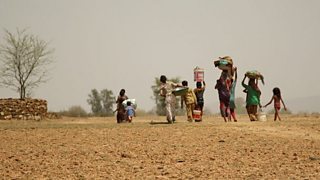
Five thousand people four hours south of Delhi rely on one spring for all their water.
“I can’t believe I just knocked over my tea. I can’t believe I just knocked over my tea. I can’t believe I just knocked over my tea… ”
My brain was in a tailspin as I watched my metal cup clank about on the dry mud ground after knocking it over with my camera.
Our BBC Pop Up team was in a small village in the Chitrakoot district of India (above), about 400 miles south of Delhi, to interview locals who walk miles each day just for a glass of drinking water.
The severe drought that has struck India is now affecting hundreds of millions of people in more than 200 states. The conditions have been so bad in 2016 that within the first four months of the year, 116 farmers committed suicide. Sadly, that number is likely to rise much higher.
And I just did the unthinkable. I carelessly knocked over a cup of tea made with water we had just filmed being hauled miles by hand from a spring.
But I’m getting ahead of myself. Why were we there?
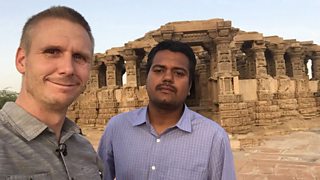
Neither Christian Parkinson nor Vikas Pandey turned to stone filming a 'cursed' Rajasthan temple
On the trail of the stories you want told
BBC Pop Up is the corporation’s travelling bureau. It’s also a crowdsourcing unit full of video journalists who only film stories suggested to us by our audience. A Twitter user had asked us to do a story on drought in that part of the country prior to our arrival in April.
In the village of Gopipur, 80% of men are still single because families from adjoining communities are afraid to marry their daughters into the village due to the extreme lack of water. There is one small spring that is shared by 5000 people in the surrounding region, with most using buckets and ropes to get water out of the deep well that the spring feeds into.
This terribly sad yet fascinating story was just one of the 165 ideas that were suggested to us via two town meetings and through social media. BBC Pop Up is an evolving machine. There’s no right or wrong way to go about collecting story ideas from our audience, and we often change our process with each stop.
In India, we held a town meeting at an apartment block on the outskirts of Delhi as well as one at a local university. We also put out a call on social media a month before we arrived, and in the end, received story suggestions that ranged from a temple that allegedly turned people into stone (above) to day care for the children of sex workers.
One Twitter user even invited us to a far-away state to go frog hunting with him. Another town meeting idea led to a rickshaw v Uber road race across Delhi.
We strive to flip the idea of how journalists conceive their stories on its head. BBC markets Pop Up as its travelling bureau, but more importantly, it’s a crowdsourcing opportunity.
In total, we were in India for just over three weeks and produced around ten glossy feature videos as well as one half-hour programme.
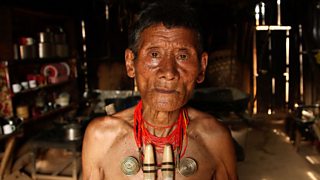
Many of the former headhunting tribes in Nagaland have adopted Christianity.
We filmed a story on a campaign to revive the tattoos headhunters once received in remote Nagaland; we created a short film on what it’s like to be black in the country; we made one on the dying art of sari-making as well as many others.
Three of our stories were picked up by national papers, and two were covered internationally by Buzzfeed and other media companies.
Agile and collaborative
BBC Pop Up is truly a pop-up unit. I’ll arrange for a new destination, create a plan with local managers and editors and months later, video journalists from different countries descend on a location.
It’s a collaborative effort that has seen heavy participation from the BBC’s Washington and East Africa bureaux in the past year. Though we’ve typically kept our teams small to keep costs down, our India operation was, by necessity, the largest so far.
To cover the whole country, we divided into two teams, both of which also served as training vehicles for some of our Delhi-based colleagues. One reason Christian and I visited India was to encourage BBC journalists in the country to think about new ways of telling video stories.
And while we were out filming, Samiha was back at base keeping us informed about what was being said and shared on our social media accounts. One of the more controversial stories we covered, about the place of traditional Indian snake charmers in modern India, caused a particular stir on social networks.
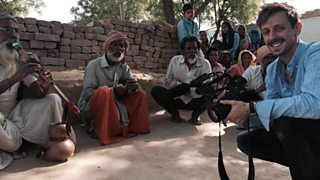
Matt Danzico filming with former snake charmers outside Delhi
The rough with the smooth
Taking the project to India was in many ways much easier than it has been in our other Pop Up destinations, including the US, Kenya and Canada. Indians were overall far more open to speaking to us in the regions we visited, which simply speeded up the whole story-gathering process.
That said, the sheer scale of the country presented us with huge challenges. At one point, we found ourselves travelling to far-flung Nagaland, near Myanmar, via a 15-hour car ride on switchback roads to find a former headhunter, who, it turned out, was no longer alive.
Though that story worked out in the end, it’s situations like this that I dread will set us back. After all, we have only a finite amount of time in each country.
I’ve edited and filed pieces in the backs of trucks, navigating roads bumpy enough to make the dirt tracks in my home US state of Pennsylvania look like immaculately-paved thoroughfares. We were often short of sleep, editing in the most peculiar of circumstances and filing from tortoise-like internet connections.
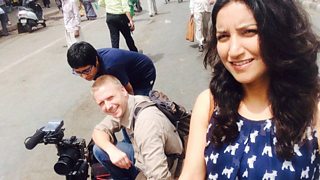
Shalu Yadav, Christian Parkinson and Neha Sharma reporting for BBC Pop Up in India.
But I think the videos we captured and the experiments we tried along the way were worth it. We filmed ancient sari looms with 360 cameras and live-streamed an entire half-hour Q&A over Facebook from a moving rickshaw.
On our last night, the full team came back together for a dinner to cap off three heavy weeks of dirt, exhaustion and smiles. And we all agreed it had been the best Pop Up to date.
Now the only question is: where should we go next?
The BBC Pop Up team in India with Matt Danzico were: Christian Parkinson, a video journalist (VJ) based in South Africa; Vikas Pandey, an online writer from the BBC Delhi bureau; Neha Sharma, a Delhi VJ; Shalu Yadav, a producer based in Delhi; Samiha Nettikkara Aboobacker, a Delhi-based social media producer; and online editor Ayeshea Perera. The project was managed by the BBC News website’s North America editor Ben Bevington and Asia editor Samanthi Dissanayake.
Our other blogs by Matt Danzico
Engaging social media audiences
How to be a digital innovator: BBC Trending
Digital innovation: Producing video for online and TV
