Operation Gold Rush: An epic production challenge

Cathy Loughran
is an editor of the BBC Academy blog
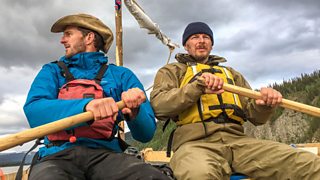
Dan Snow and bear expert Chris Morgan head down the Yukon River. Photo: BBC/Kevin Fong
Shooting white water rapids, trekking icy wilderness, braving grizzlies and avalanches, all in search of history - and gold.
Operation Gold Rush with Dan Snow sounds (and looks) like a glorious Boys’ Own adventure. But over 27 gruelling days in the wilds of Alaska and Canada, the production team faced physical, logistical and editorial challenges that threatened to take the romance out of their mission to retrace the steps of the original 1898 Yukon Gold Rush ‘stampeders’.
I asked series producer Ben Crichton about what the assignment entailed, how he and his team literally kept the production schedule afloat in one of the most unpredictable environments on earth and as a programme-maker, what lessons he’d mined in the Yukon.
He started by telling me how tough it had been to get a project off the ground that - for an international audience - would be a worthy successor to the BBC/Discovery co-production Grand Canyon with Dan Snow, in which the hunky history presenter set out to recreate a trail-blazing 1869 expedition through the canyon. Crichton was director on the 2014 BBC Two series.
“There was definitely an appetite from the channel and we threw loads of ideas at commissioners. But it was much harder to find the right one for the international market - and we couldn’t do it alone.”
In the end, BBC Worldwide stepped in to back the Klondike epic, the next marketable vehicle for Dan Snow (although the title will simply be Operation Gold Rush for the international version.)
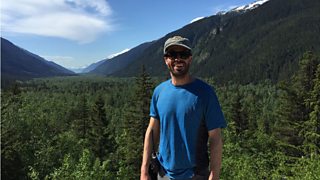
Series producer Ben Crichton on the Gold Rush trail: No ordinary risk assessment
Just over a year ago, Crichton made a solo recce to the Yukon to scout out key contacts and start negotiations with the three different US and Canadian national parks authorities through whose territory the 600 mile trip would cross, from the coast of Alaska to the edge of the Canadian arctic.
“Grand Canyon seemed complex and demanding but it was nothing compared with the Klondike. Canyon was one location. For Gold Rush we had mountain hiking through snow, crossing lakes, rivers and rapids, then mining for gold.”
He assembled an unusual team of 30, the maximum number allowed by parks’ authorities. In addition to the talent (Dan Snow, polar explorer Felicity Aston and remote environment medic Dr Kevin Fong), Crichton signed up polar guide Devon McDiarmid – who’s reputedly been to the South Pole more times than anyone alive - as fixer.
Porters (to help lug 40 bags of equipment, food, gear and tents), swift water rescue experts, an avalanche safety team plus national park representatives all joined a BBC crew that included producer Stef Buonajuti, assistant producer (AP) Natalie Hewit, licensed BBC drone cameramen Pasquale Tropea and Simon Winchcombe and a “heroic” DIT (digital information technician) called CJ December.
“We also had sound recordist Simon Forrester, an expedition veteran, and cameraman Will Edwards, who combined an eye for epic majesty with the observational instincts needed to follow dialogue and story, and was happy doing all this in the wilds of bear country,” says Crichton.
“Stalwart producer/director Anthony Barwell worked tirelessly across the series and AP Alisdair May spent so much time setting up the mine at Dawson City he almost became a local.”
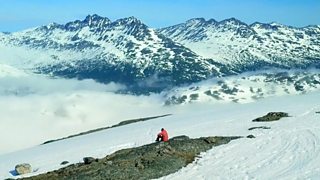
Man against nature: Dan Snow in the mountain wilderness
The location team divided, to experience different terrain - Crichton joining Snow and Aston to follow the famous 33-mile Chilkoot Gold Rush trail, from the Coast Mountains of Alaska to Lake Bennett in British Columbia, and Fong’s team trekking the older, little-used White Pass to reach the same destination.
“That was physically and mentally draining,” Crichton says. “The challenge for TV is that hiking doesn’t make great footage and you can’t see weight.” Snow was carrying around 90lbs of kit, the porters 120lbs.
“Something else that doesn’t translate to screen is blisters. By the time we got to the Golden Staircase, the final ascent of Chilkoot, everyone was aching, sore and utterly exhausted.” A televisual challenge, he points out, but also with implications for team morale, health and safety.
There were other setbacks along the way: “Our lead guide had set a deadline of 11am for us to reach the summit, because of the rising avalanche risk, but we’d become separated from our porters on the trail. So five volunteers went back down the mountain to help the whole party make the ascent, against the clock.”
The weather, though, was on their side. Days of clear blue skies - and rather too sunny a backdrop for their gruelling efforts - gave way to snow blizzards as they reached the final summit. Great for the camera, grim for pitching tents.
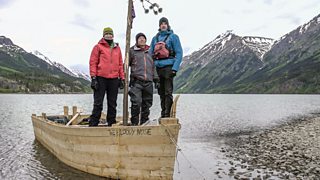
Felicity Aston, Kevin Fong and Dan Snow survived the rapids on replica boat 'The Bloody Nose'
Between lakes, a stretch of rapids awaited that Crichton believes no one has negotiated, in a period wooden boat, since the Gold Rush. The specially made replica boat had been transported on the old White Pass railway, then wheeled, carried and rowed to the rendezvous point.
This was no ordinary risk assessment and the reality was “nerve wracking”, the producer admits. But he’d hired “the best in the business”, white water support expert Kevin Daffe, to supervise and recce the rapids. Two reserve boats would follow the craft, white water staff and wilderness first aiders were on hand.
And off camera, Snow and the others were repeatedly assured that they didn’t have to go ahead if they judged it too dangerous. “I told them we’d have managed it editorially if they weren’t comfortable getting into the boat,” Crichton says.
The rapids footage is thrilling and while it looks like there were some really close calls, the worst that happened was that Snow ended up with a bloody nose.
Unsurprisingly, safety considerations permeated every aspect of the production: “Six of us had had wilderness first aid training and we had Kevin Fong, who’s advised NASA on repatriating injured astronauts. We were in a first world country, but access to first world care could be days away if the weather closed in and helicopters couldn’t fly. We had to prepare for a scenario where we could look after ourselves, no matter what, for up to 72 hours.”
And then, of course, there were bears. Grizzlies and black bears are commonly sighted in the region and the BBC team had “terrifying” bear briefings from national park officials, Crichton says: “It didn’t help that we’d all just seen The Revenant, with its famous bear mauling.”
A black bear did enter their camp one night, to be scared off by rangers, and Natalie Hewit sprinted away unscathed from a lone close encounter (not advised in the bear briefings).
I asked Crichton about authenticity and compromise. How close a ‘recreation’ of the pioneers’ journey was it?
“There were compromises, of course, not least because of presenter availability,” he says. If we’d done it as a non-TV event we might possibly have completed the trek in a month. As it was, we did all the mountains at the beginning, some of the lakes, then some of it by road, then the rapids, more lakes and finally the mining - 27 days in total.”
In a fluid natural environment, the production needed to be fluid too. Plan A was that Fong’s team would descend a steep valley into the White Pass trail. But when a dislodged rock narrowly missed the presenter, producer Stef Buonajuti made the decision to abandon that section of the schedule - her decision featuring in the final cut.
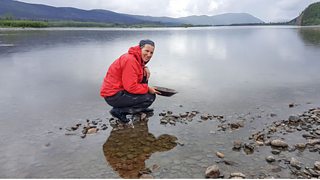
Felicity Aston panning for gold at the end of the trail
Similarly, when sudden squalls and a two-feet swell on the Lake Bennett part of the journey forced the wooden boat to find land, presenters and crew had to spend a night on a beach instead of rejoining the support team ahead of them, as planned.
“The Robinson Crusoe element made great TV, but not if we were going to be stuck there waiting for the wind to change for three days. We needed that time to spend mining. So we had the discussion on camera about how we would tow the boat away.”
The intention, he says was to be “transparent and honest with the audience at all times”: “We show the tow and how we reached our destination on screen. So although we lost historical authenticity, we preserved the authenticity of how we shared our expedition.”
The programmes are undoubtedly immersive documentary. But is there a tension between serious historical intent and very watchable adventure TV?
“This is a great way into history - visceral and experiential,” Crichton argues. “It’s a way of introducing audiences to content they might not otherwise engage with.” He points also to the “extraordinarily rich” Gold Rush archive of books, letters, diaries and photos that the production was able to draw upon and feature - including searching out evidence of Brits among the stampeders.
An intense programme-making experience, on many fronts, so what will the series producer take away from his Klondike adventure?
“A few things. First, recognise that you should do all you can to control an environment, but then accept that you won’t be able to control everything - and that can be an opportunity,” he says.
“Second, you can never have too many GVs (general views). We had our crew, of course, and some fantastic drone footage but a lot of content was shot on 305 [video cameras] by our assistant producers or by Dan and Kevin (Fong) as video diaries.
“Thirdly, the calibre of the production team is everything. You don’t need battle-hardened mountain guides, you need professionals who can still do their jobs well in gruelling situations. It’s more about attitude.”
He singles out Hewit, for tackling logistics that were “like some terrible puzzle set by MENSA”; the packing skills of camera assistant Ryan Atkinson, who ensured all kit came home in one piece; and CJ December, who managed 10 different formats of cards and cameras, backing up 200 hours of footage in the wilderness.
Finally - having experienced the unpredictability of such a testing environment - the lengths the team went to do plan MEDEVAC, on top of regular risk assessment, was essential, he believes.
The million dollar question: did they strike gold? “Yes! But not enough for us all to retire on, sadly.”
And is there another Dan Snow adventure in the pipeline?
“We need a great historical story that doesn’t feel like it’s been done before, that can be achieved in a month, isn’t ridiculously expensive or inaccessible - and has international appeal,” he says.
Bears, a bonus…
Operation Gold Rush with Dan Snow, 9pm, Sunday 30 October, 9pm, BBC Two
Watch a trailer for the series:
